Rocca del Brunelleschi: A Medieval Fortress in Vicopisano


Site at a Glance
- Rating
- 4.6
- Popularity
- Very Low
- Country
- Italy
- Primary era
- Medieval
- External website
- Open
- Eras represented
- Medieval
- Civilizations
- Republic of Florence
- Site type
- Military
- Remains
- Castle
On this page15 sections
History
Rocca del Brunelleschi is a medieval fortress in Vicopisano, Italy, whose present fortifications were transformed by the Florentine architect and engineer Filippo Brunelleschi between 1435 and 1440. Also called Rocca di Vicopisano, it occupies the strategic hill above a settlement positioned near the navigable Auser branch of the Serchio and the Arno.
Early fortification and Pisan rule
The first recorded fortification at Vicopisano dates to 975, when it was identified as the castellum or castrum Auseris Sala, later called Auserissola. Its position may have encouraged an earlier fortified settlement, perhaps established through the initiative of the Obertenghi, a powerful medieval comital family whose possessions in northern and central Italy were gradually transferred to ecclesiastical institutions during the late tenth century.
By 1138, Vicopisano fell under the jurisdiction of the bishop of Pisa. Attempts by the inhabitants to secure greater autonomy were suppressed with support from Pisa’s political and military authorities. During the twelfth and thirteenth centuries, control increasingly shifted from the bishop to the Republic of Pisa, while the settlement expanded from the hilltop into the Maggiore and Riale districts on the lower slopes. These districts were enclosed by walls.
In the thirteenth century, Vicopisano served as an important Pisan defensive stronghold against Florentine, Lucchese, and other Guelph forces. The Guelphs supported the papacy and generally opposed the imperial-aligned Ghibellines in medieval Italian politics. Vicopisano later became involved in territorial struggles among Pisa, Lucca, and Florence.
The Florentine conquest and Brunelleschi’s reconstruction
Around 1330, the Republic of Pisa constructed a separate fortress at the foot of the hill, partly on the site now occupied by the town hall. The older hilltop castle remained under the archbishop of Pisa. Florence attacked Vicopisano in 1406 and maintained the siege for eight months. The castle surrendered from hunger on 14 July, and the fall of Vicopisano preceded Florence’s conquest of Pisa on 9 October.
During the siege, Florentine forces transported a galley overland to the Lake of Sesto and then brought it to the Arno through the Serezza, an emissary of the Serchio. From the river side, the vessel enabled bombardment of the fortress. After Florence gained control of the lower Arno corridor, it commissioned Filippo Brunelleschi to remodel Vicopisano’s defenses. Work began in 1435 and ended in 1440.
Revolt, military planning, and decline
Pisa and its surrounding territory rebelled against Florence in 1495, expelling the Florentine garrison and resisting reconquest until 1498. Vicopisano was then retaken by Paolo Vitelli, an Italian military commander active in the late fifteenth and early sixteenth centuries. At that time, Vicopisano and Pisa were also held by forces of the Republic of Venice. After its recapture, the fortress became a base for operations against Pisa.
In 1503, Leonardo da Vinci occupied the first level of the Rocca while preparing plans for the Florentine conquest of Pisa. Leonardo, an Italian Renaissance artist, engineer, and inventor, also worked in military planning, cartography, and hydraulic engineering. His surviving maps from this project are preserved in Oxford and Madrid. He devised a plan to divert the Arno toward Stagno, the ancient Pisan port, so that Florence would have an independent route to the sea. The completed operation ended disastrously.
The Medici government later rectified the course of the Arno between 1560 and 1570. This permanently separated Vicopisano from the river and reduced its strategic importance. The fortress was subsequently abandoned as a military installation and passed into private ownership.
Conversion to a private estate and restoration
Toward the end of the seventeenth century, the government retained the first level of the Rocca but sold the upper levels to private owners. The Franciscans, members of the religious order founded by Francis of Assisi, acquired the second level and built a church dedicated to Saint Francis with an adjoining convent. After the convent was suppressed in 1700, the Swiss Fehr Walser family acquired the property and converted it into a farm.
Under the architect Bellincioni, the church was later converted into a villa, and the surrounding grounds became a Romantic park. Around 1870, the owners restored the complex without changing its structure. During the passage of the front in 1944, German forces mined numerous towers and bell towers along the Arno to remove landmarks used by Allied artillery. Protection from the Swiss government saved the Rocca’s main tower from destruction, while Swiss flags displayed on the tower and in front of the villa helped protect Vicopisano from American shelling.
After the Second World War, the Fehr family acquired the Soccorso section and the Brunelleschi Tower at its end, then planned the recovery of the entire complex. Restoration of the Rocca was completed during the 1990s.
Remains
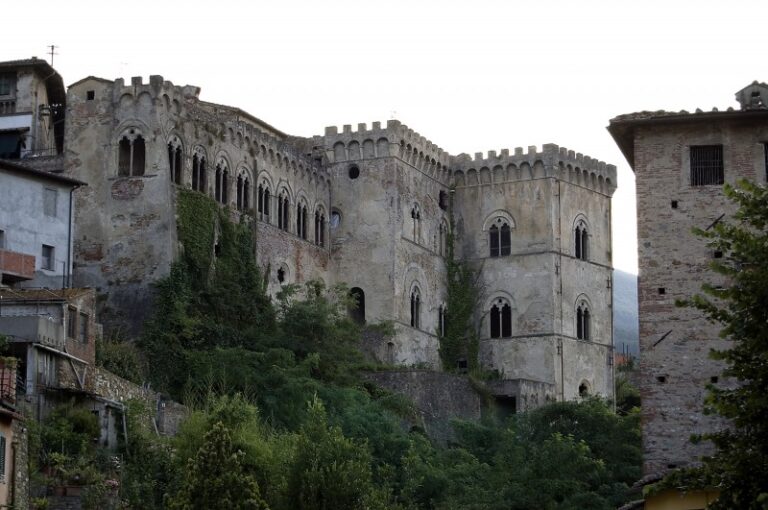
The fortress occupies the highest part of the settlement and uses the natural form of the hill to create a compact defensive system. Verrucano stone and brick are the principal building materials. The arrangement of the stronghold allowed defenders to withdraw toward advantageous positions from which they could attack assailants.
Main stronghold
Central keep
The central keep, or mastio, is the principal fortified tower of the castle. Its sides measure approximately 15 metres, and it contains original fifteenth-century rooms distributed over six levels. The keep accommodated the commander and sentinels, while cisterns, which stored water, and storehouses supplied the garrison during prolonged sieges.
Angular tower
An angular tower rises 31 metres at the highest point of the fortress. Together with the keep and the connected walls, it formed part of the elevated defensive core created in the fifteenth-century reconstruction.
Defensive circuit and lower works
Torre dei Silvatici
A defensive wall links the keep with the Torre dei Silvatici, one of the wall towers. This connection formed part of the fortified route extending from the hilltop stronghold toward the lower defenses.
Torre del Soccorso
A further wall, approximately 60 to 70 metres long, descended toward the Torre del Soccorso at the base of the hill. The tower communicated with the Arno, allowing assistance to reach the fortress during sieges. A drawbridge formerly opened in the connecting wall. The Soccorso section and the Brunelleschi Tower that terminates it later became part of the Fehr property and its Romantic park.
Lower enceinte
The lower enceinte, meaning the enclosing defensive wall or fortified perimeter, was reinforced with towers of circular and square plans. Its northern section survives as part of the remaining defensive circuit.
Inner fortified areas
Cassero
The complex also included the Cassero, an inner fortified stronghold or citadel. Along with the Brunelleschian keep, it later formed part of the architectural setting of the Romantic park surrounding Villa Fehr.
Nearby sites