Rinnō-ji Temple: A Tendai Buddhist Monzeki Temple in Japan


Site at a Glance
- Rating
- 4.2
- Popularity
- Medium
- Country
- Japan
- Primary era
- Early Modern
- Eras represented
- Medieval, Early Modern
- Civilizations
- Tokugawa
- Site type
- Religious
- Remains
- Monastery
On this page25 sections
History
Rinnō-ji Temple is a Tendai Buddhist monzeki temple in Nikkō, Japan, traditionally founded by the monk Shōdō Shōnin in 766 during the Nara period. Tendai is a major Japanese Buddhist school combining study, meditation, devotion, and esoteric rites. A monzeki temple was traditionally headed by an imperial prince or aristocrat, and Rinnō-ji later acquired an unusually strong religious and political position through its connection with the imperial family.
Shōdō Shōnin and the mountain sanctuary
Temple tradition places the beginning of Rinnō-ji at Shōdō’s arrival beneath Nikkō’s sacred mountains in 766. Shōdō and his disciples were said to have been unable to cross the Daiya River until the deity Jinsha Daio produced two serpents that formed a bridge. The legend is associated with the site of the present Shinkyō, also known as the Yamasuge Snake Bridge, and reflects Nikkō’s early character as an isolated sanctuary of mountain religion.
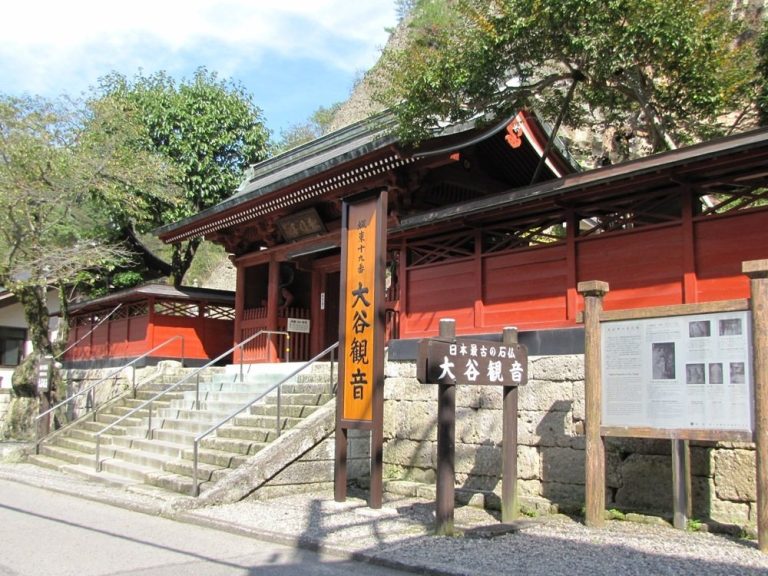
After crossing the river, Shōdō is said to have established a temple and enshrined Senju Kannon, the thousand-armed form of Kannon. The institution was first called Shiunryū-ji and later Shihonryū-ji. Its original location was near the Inari River, close to the present Takinoo Shrine, more than one kilometre from the present Sanbutsudō. This predecessor temple is regarded as the origin of Rinnō-ji.
Shōdō’s activities also shaped the religious geography of the surrounding mountains. In 767, he is traditionally said to have enshrined the deity of Mount Nantai at the site now called Hongū Shrine, marking the beginning of Futarasan Shrine. Another tradition places this event in 790. Shōdō is also said to have climbed Mount Nantai in 782. A tradition linked the mountain’s name with Fudaraku, the abode of Kannon, calling it Futara-san, a name later read as Nikkō. Finds from the summit show that the mountain was already a centre of worship during the Nara period.
In 784, Shōdō founded Chūzenji beside Lake Chūzenji, probably as a winter base for worshipping Mount Nantai. Also known as Tachiki Kannon, the temple remains affiliated with Rinnō-ji. Its original buildings on the lake’s northern shore were swept away by a landslide during the Meiji period, after which the temple moved to the eastern shore.
Heian and Kamakura developments
The monk Kūkai and the Tendai master Ennin are traditionally said to have visited Nikkō during the Heian period. Ennin is associated with the foundation of the Sanbutsudō, Jōgyōdō, and Hokke-dō in 848, although the buildings now standing are early-modern reconstructions.
During the Kamakura period, around 1240 to 1242, Minamoto no Sanetomo moved the main temple to the area now occupied by Nikkō Tōshō-gū. Support from the shogunate and powerful regional families brought renewed prosperity. During this period, worship of the three mountain deities as the Nikkō Sanzan Gongen became established. Gongen worship identified sacred Buddhist manifestations with local kami, or sacred beings and presences in Shinto belief.
Conflict, confiscation, and early-modern revival
During the Sengoku period, Rinnō-ji effectively came under the control of the Mibu clan through the stratagem of Mibu Tsunafusa. In 1590, Toyotomi Hideyoshi confiscated the temple’s estates because it had supported the Hōjō side during the campaign against Odawara. The loss caused a temporary decline.
The Tendai master Tenkai became abbot during the early Edo period and promoted the temple’s revival. In 1617, Tōshō-gū was established to enshrine Tokugawa Ieyasu as a deity, and the main hall was moved to the vicinity of the present Futarasan Shrine office. A main hall destroyed by heavy snow was rebuilt in 1647 through the patronage of Tokugawa Iemitsu, giving the building its present scale. Iemitsu’s mausoleum, Taiyū-in, was established in 1653 and later became part of Rinnō-ji’s holdings.
The Rinnō-ji Monzeki
In 1655, Emperor Go-Mizunoo granted the temple the name Rinnō-ji by imperial decree. Before then, it had been called Mangan-ji, a name traditionally attributed to Emperor Saga in the Heian period. Go-Mizunoo’s third son, Prince Shōchō, entered the temple. Thereafter, its abbots were generally imperial princes ordained as Buddhist monks, known as the Rinnō-ji Monzeki or Rinnō-ji-no-miya.
The Rinnō-ji-no-miya also served as abbot of Nikkō Rinnō-ji, Ueno’s Rinnō-ji, and Kan’eiji, and held authority over Mount Hiei, Nikkō, and Ueno. Prince Kōgen, later known as Prince Kitashirakawa Yoshihisa after returning to secular life, came from this institutional line. One interpretation holds that the permanent presence of an imperial family member in the eastern provinces also served a political purpose during possible anti-shogunate uprisings.
Meiji reorganization and modern preservation
Before the Meiji period, the Buddhist halls, shrines, and mausoleums of the mountain were collectively called Nikkō-san or Nikkō Sansho Gongen. Their worship was shaped by Shinto-Buddhist syncretism, the premodern integration of Buddhist practice with the veneration of kami. The early Meiji policy of separating Buddhism and Shinto created the separate institutional identities of Rinnō-ji, Tōshō-gū, and Futarasan Shrine. Rinnō-ji’s buildings consequently remained dispersed through the wider Nikkō sanctuary rather than gathered in a single enclosure. The affiliation of the Kyōzō and Yakushidō remains unresolved.
After the Boshin War, the Meiji government confiscated the title Rinnō-ji in 1869 and restored the name Mangan-ji. The 1871 separation policy required the main hall to be moved to its present location, and demolition was ordered. Through the efforts of Kido Takayoshi, the hall was relocated while retaining its former appearance, and it became Rinnō-ji’s main hall. The residential compound of the Rinnō-ji Monzeki later burned. In 1883, through the mediation of Tochigi Prefecture, the temple was again officially permitted to use the name Rinnō-ji.
The Nikkō Imperial Villa occupied the former compound from 1890 to 1947. The building now serves as the temple’s honbō, the main administrative and residential compound of a Buddhist temple. A major repair of the Sanbutsudō took place from 2007 to 2018. Rinnō-ji, Tōshō-gū, and Futarasan Shrine form part of the UNESCO World Heritage property called “Shrines and Temples of Nikkō,” while their precincts together constitute the national historic site of Nikkō Sannai. Rinnō-ji also possesses numerous National Treasures and Important Cultural Properties.
Ritual traditions
Rinnō-ji’s annual Gōhan-shiki takes place on April 2. Participants called gohan-chōdai-nin are ceremonially made by monks dressed as mountain ascetics to drink from a large sake cup and eat piled servings of rice. The rite, also called Nikkō-zeme, is believed to remove seven calamities and bring seven blessings. It is regarded as a transformation of a medieval ascetic ritual, although another interpretation connects its formation with a dramatized early-modern Ōhan hospitality ceremony. The rite was historically well known and was adapted as a kyōgen script. Noodles were reportedly used in the coercive ritual during the early-modern period.
Chinjō Yasha, a hidden deity normally kept from public view and revealed only at specified ritual occasions, is unveiled once every nine years. A public unveiling took place in 2023. A 2016 to 2017 exhibition at Chūzenji displayed the hidden image of Kisshōten to commemorate the 1,250th anniversary of the temple’s foundation.
Remains
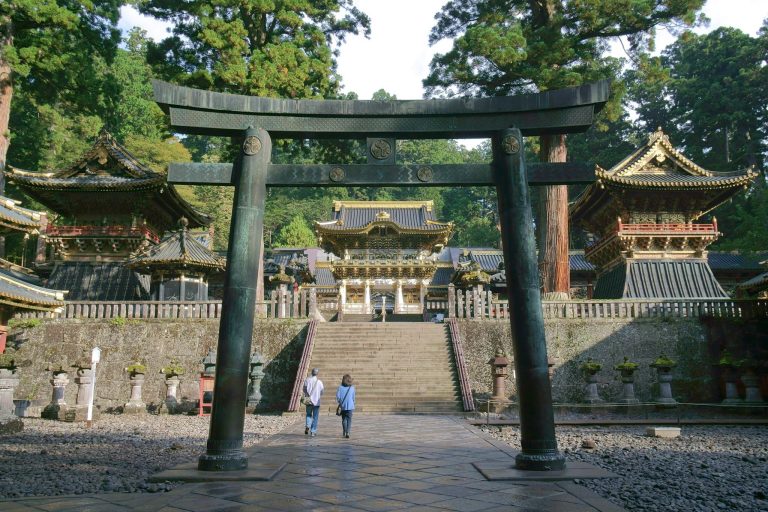
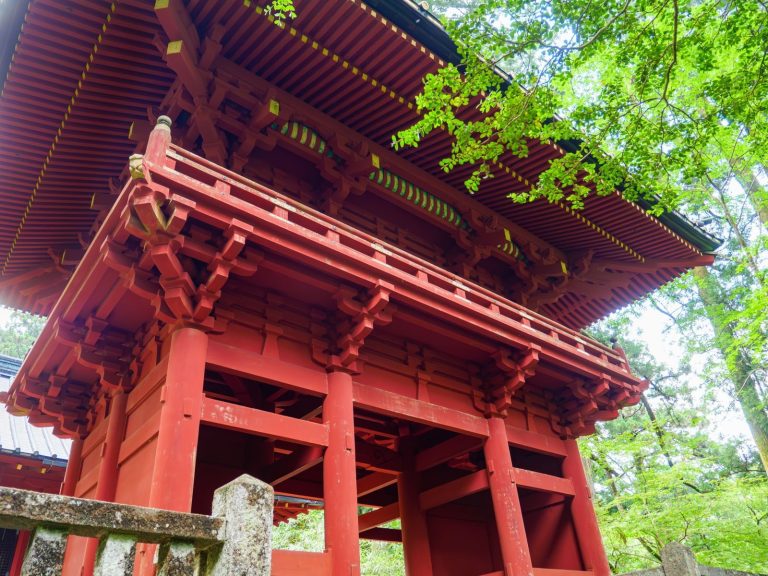
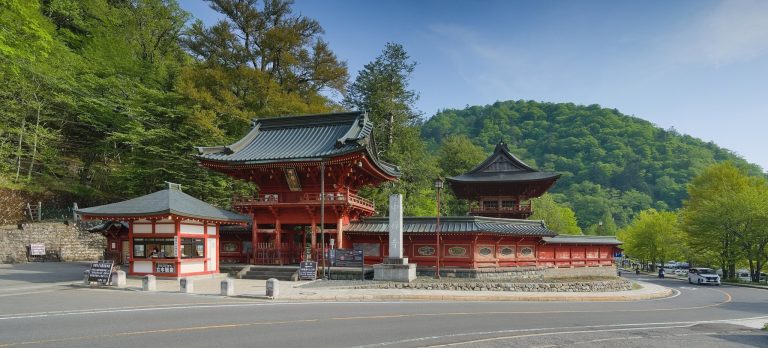
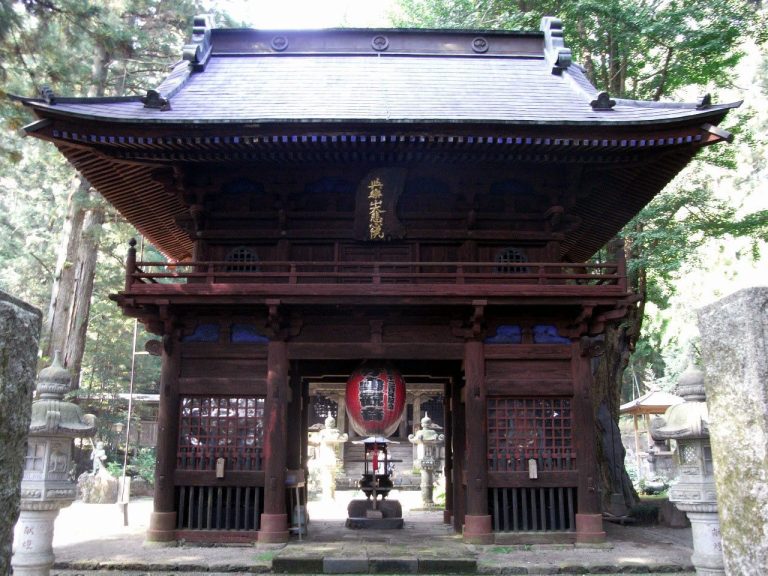
Rinnō-ji is a dispersed religious complex woven through the wider Nikkō sanctuary. South of Tōshō-gū are the Sanbutsudō and temple offices, including the Honbō front gate, Gohō Tendō, and bronze Sōrintō. West of Futarasan Shrine lies the Taiyū-in mausoleum complex, with the Jōgyōdō and Hokke-dō farther south. The Jigen-dō stands at the top of a long stone stairway, while the Kaizandō lies north of Tōshō-gū on the route to Takinoo Shrine. The former site of Shihonryū-ji near the Inari River contains the Kannon-dō and a three-story pagoda. The detached Kodama-dō precinct and Chūzenji on the shore of Lake Chūzenji are also affiliated with Rinnō-ji.
The central temple precinct
Sanbutsudō
The Sanbutsudō, or Three Buddha Hall, is described as the largest wooden building in eastern Japan. Built on its present scale in the mid-seventeenth century through Tokugawa Iemitsu’s patronage, it measures approximately 33 metres across the front, 22 metres in depth, and 26 metres in height. Its three principal images represent the religious unity of Nikkō’s mountains, deities, and Buddhas. Senju Kannon is associated with Mount Nantai, Amida Nyorai with Mount Nyohō, and Batō Kannon with Mount Tarō.
The figures are covered with gold leaf. Their total heights are 703.6 centimetres for Senju Kannon, 756.3 centimetres for Amida Nyorai, and 744.7 centimetres for Batō Kannon. The principal figures themselves measure 335.4, 306.3, and 301.3 centimetres respectively. They are among the largest Buddhist statues in Japan, although their dates and production histories are unknown and they have not been designated as cultural properties.
Gohō Tendō and Sōrintō
Gohō Tendō and the bronze Sōrintō form part of the historic buildings associated with the central precinct. They stand near the Sanbutsudō and temple offices, whose surviving arrangement reflects the dispersed form that Rinnō-ji acquired through the separation of the Nikkō institutions.
Treasure House and Shōyō-en
The Shōyō-en Garden and the Rinnō-ji Treasure House stand beside the Sanbutsudō. The Treasure House contains Buddhist sculptures, paintings, calligraphy, scrolls, and other works, mainly dating from the eighth century, with approximately 50 objects displayed at a time. Rinnō-ji also houses the Daihatsu Nehankyō Shūge, a 59-scroll commentary on the Nirvana Sutra dating from the Nara and Heian periods. This work is designated a National Treasure.
Halls and memorial buildings
Jōgyōdō and Hokke-dō
The Jōgyōdō and Hokke-dō are halls of matching size and form placed side by side, a layout characteristic of Tendai temple architecture. The Jōgyōdō is also described as a training hall founded in 1145, while the structure standing today is an early-modern reconstruction. A connecting corridor joins the two halls.
Jigen-dō complex
The Jigen-dō complex includes a memorial pagoda, worship hall, sutra repository, bell tower, and Amida Hall. Its memorial pagoda is a stone gorintō, a Japanese funerary monument made from five symbolic forms representing the elements. A stone fence, six stone heavenly figures, a stone offering table, and stone flower vases accompany it. The Amida Hall is associated with 15 stone lanterns and a stone tahōtō.
Kaizandō and the former Shihonryū-ji site
The Kaizandō is among Rinnō-ji’s designated historic buildings. At the former Shihonryū-ji site near the Inari River, the Kannon-dō was built in 1685. The adjacent three-story pagoda survives as part of the same former temple site, preserving a material link with the institution regarded as Rinnō-ji’s predecessor.
Taiyū-in mausoleum
Approach and gates
Taiyū-in is the mausoleum of Tokugawa Iemitsu, built in 1653 in Buddhist temple style. Its plan and decoration were intended not to surpass the mausoleum of his grandfather, Tokugawa Ieyasu. The design uses black and gold in a substantial but restrained manner. The approach from the Niōmon to the worship hall and main hall bends rather than following a straight axis, and the complex contains 315 lanterns.
The Niōmon contains two Kongō Rikishi guardians. Misshaku Kongō stands on the right with an open mouth, while Naraen Kongō stands on the left with a closed mouth. The Nitenmon is the largest gate in the Nikkō precinct and houses Jikokuten on the left and Zōchōten on the right. Above its front is a plaque reading “Taiyū-in,” written by the retired Emperor Go-Mizunoo. The name comes from the first three characters of Iemitsu’s posthumous title.
Mizuya and Ryūkō-in
The Mizuya at Taiyū-in was donated by Nabeshima Katsushige, a Kyushu daimyo, and is made of granite. Its ceiling bears a dragon painting by Kano Eishin Yasunobu. The dragon’s reflection in the water gave the building the name “Water-Mirror Dragon.”
Ryūkō-in is an administrative building with an attached entrance. Its Buddhist room contains the mortuary tablet of Kaji Sadayoshi, a senior retainer who served Iemitsu from childhood. Kaji continued guarding the precinct after Iemitsu’s death, lived in Nikkō for 47 years, died in 1698 at the age of 87, and was buried near Taiyū-in. Ryūkō-in is closed to entry.
Central buildings and Kōka-mon
The Taiyū-in main hall, intermediate chamber, and worship hall form the central building and are designated collectively as a National Treasure. The intermediate chamber links the other two spaces, an arrangement known as gongen-zukuri. Monthly Buddhist services are held there, including a major service on April 20, the anniversary of Iemitsu’s death.
The Kōka-mon, also called the Dragon Palace Gate, leads to Iemitsu’s tomb. It is built in the Ryūgū style associated with Ming-dynasty Chinese architecture. The gate and the mausoleum beyond it are closed to entry.
Yashamon
The Yashamon contains four yaksha guardians, Abatsumara, Bidara, Kendara, and Umodokara. A yaksha is a protective supernatural being in Buddhist tradition. Carved peonies decorate the gate, giving it the alternative name Botan-mon. The blue guardian Umodokara is traditionally associated with the origin of the hamaya arrow.
Images and ritual objects
Rinnō-ji’s associated works include eight painted images of Tōshō Gongen on paper, two painted images of Shōdō Shōnin on wooden panels, six painted images of the Nikkō Sansho Gongen, and two painted images of En no Gyōja and the Eight Great Attendants. The collection also includes a wooden standing Senju Kannon from Tachiki Kannon Hall, a wooden seated Amida Nyorai with four bodhisattvas in the Jōgyōdō, and a wooden seated image of Tenkai made by Kōon in 1640.
The Taiyū-in inner sanctuary contains a bronze seated Shaka Nyorai with a bronze canopy, made by Kōchi in 1653. The seated Amida image in the Jōgyōdō is popularly called “the Buddha riding a peacock” and was restored in 2017. Together with the Sanbutsudō’s three gold-leaf-covered Buddhas, these works preserve the religious and commemorative traditions connected with Nikkō’s mountain worship and the Tokugawa mausoleum.
Hidden deity and affiliated sites
Chinjō Yasha
Chinjō Yasha is enshrined as a hidden image in the Great Goma Hall. A goma hall is used for fire rites in which offerings are burned before a sacred image. Chinjō Yasha is associated with protection of the state and the transformation of misfortune into blessings. The deity is identified with a yaksha and traditionally regarded as a manifestation of Vaiśravaṇa, a guardian deity associated with protection and the northern direction.
Chūzenji and Tachiki Kannon
Chūzenji, also called Tachiki Kannon, remains affiliated with Rinnō-ji on the shore of Lake Chūzenji. Its collection includes a wooden standing Senju Kannon. The temple’s present location on the eastern shore follows the loss of its original buildings on the northern shore during a Meiji-period landslide.