Futarasan Shrine: A Shinto Sanctuary of Nikkō’s Sacred Mountains


Site at a Glance
- Rating
- 4.4
- Popularity
- Medium
- Country
- Japan
- Primary era
- Early Modern
- External website
- Open
- Eras represented
- Medieval, Early Modern
- Civilizations
- Tokugawa
- Site type
- Religious
- Remains
- Sanctuary
On this page16 sections
History
Futarasan Shrine is a Shinto sanctuary in Nikkō, Japan, traditionally founded in 767 by the Buddhist monk Shōdō Shōnin. Its creation followed the establishment of Rinnō-ji in 766 and belonged to the developing Nikkōsan faith, a religious tradition combining Shinto and Buddhism. The shrine’s early history is closely connected with the three sacred mountains of Nikkō and with the worship of their deities.
Foundation and sacred mountains
The sanctuary is dedicated collectively to Futarasan Ōkami, associated with the three mountains of Nikkō. Ōkuninushi is linked with Mount Nantai, Tagorihime with Mount Nyōhō, and Ajisukitakahikone with Mount Tarō. These three kami, or Shinto deities and sacred presences, were traditionally regarded as a divine family. The mountains were also worshipped as sources of water for the rice-growing plains around Nikkō.
The first sanctuary was a small shrine built in 767 at the site now occupied by Hongū Shrine. In 808, it was replaced by a honden, the principal sanctuary building where the deity is housed. Flooding at the meeting of the Daiya and Inari rivers prevented expansion at this location, so a separate shrine called Shingū was moved in 850 to the site of the present main shrine.
Shōdō Shōnin is credited with establishing the principal mountain sanctuaries. After reaching the summit of Mount Nantai in 782, he founded the inner shrine there. In 784, he established the middle shrine and its associated Buddhist temple, or jingū-ji, now connected with Chūzen-ji. These foundations made Mount Nantai both a Shinto sacred mountain and a Buddhist holy place.
Tradition also attributes the foundation of Takinoo Shrine to Kūkai, who is said to have visited Nikkō in 820 and established a sanctuary for the deity of Mount Nyōhō. This visit and the associated construction are traditional claims rather than historically certain events. Another tradition credits Ennin, a Tendai Buddhist monk, with establishing the Sanbutsu-dō, now part of Rinnō-ji, and with helping Nikkō develop as a center of Tendai Buddhism.
The Three Shrines and medieval development
Futarasan Shrine, the original Hongū Shrine, and Takinoo Shrine formed the group known historically as the Three Shrines of Nikkō. The group was also called the Three Gongen of Nikkō, referring to divine manifestations understood through the combined framework of Shinto and Buddhism. Futarasan Shrine appears under that name in the 927 Engishiki, a tenth-century compilation of regulations and ritual prescriptions that included a register of officially recognized shrines. Whether this entry refers to Nikkō or to a similarly named shrine in Utsunomiya remains disputed. Both institutions claim the title of ichinomiya, the highest-ranking shrine in the former province of Shimotsuke.
During the medieval period, the shrine became a major center of the Nikkōsan syncretic faith and Shugendō, an ascetic mountain tradition combining Buddhist teachings with local beliefs and ritual practice. It held the rank of ichinomiya and received offerings from officials of the Kamakura shogunate. The complex expanded beyond its earliest buildings, although warfare between rival clans and repeated natural fires caused damage. Repairs and enlargements followed under the patronage of Minamoto no Yoritomo and his successors.
The religious complex reached its greatest medieval prosperity during the Muromachi period and was regarded as a major sacred center of the Kantō region. Its decline began after the Late Hōjō, a powerful sixteenth-century warrior house, seized many of the shrine’s estates. After Toyotomi Hideyoshi conquered the Kantō in 1590, the province and the city of Nikkō entered a short period of reduced prosperity.
Tokugawa rebuilding and the Edo period
In 1613, Tokugawa Ieyasu appointed the Tendai monk Tenkai chief administrator of Nikkō’s temples. The construction of Tōshō-gū, Ieyasu’s mausoleum, brought renewed expansion and rebuilding to Futarasan Shrine. The shrine received support from the Tokugawa government, the imperial court, daimyō, nobles, and the wider population. Its priests also performed religious duties for the neighboring Tōshō-gū.
During the Edo period, the era of Tokugawa shogunal rule from 1603 to 1868, the shrine’s estates extended across about 70 villages. Its present precincts cover approximately 3,400 hectares and include parts of the Nikkō mountain range, sacred waterfalls, and mountain roads. This broad sacred territory preserves the connection between the shrine and the natural features understood as embodiments or abodes of the deities.
Modern transformation and continued ritual life
In 1868, during the Boshin War, the civil conflict that ended the Tokugawa shogunate and established imperial rule, Nikkō was threatened because it contained prominent symbols of the former government. The city was spared after Itagaki Taisuke persuaded the former-shogunate commander Ōtori Keisuke to avoid fighting there and helped dissuade Saigō Takamori and the imperial coalition from burning the religious complex.
The Meiji government’s separation of Shinto and Buddhism from 1868 transformed Futarasan Shrine and the wider complex. In 1871, administration of Nikkō’s temples and shrines was divided. The former Buddhist temple associated with the sanctuary at the foot of Mount Nantai became separate from the Shinto Futarasan Chūgū-shi. In 1873, Futarasan Shrine became a nationally ranked shrine of the second level and received public funding through that system for more than seventy years.
After the Second World War, government control over Shinto institutions ended, interrupting the shrine’s hereditary priestly succession through the Ōnakatomi family. Supervision passed to the independent Association of Shinto Shrines. In August 1948, ownership of Mount Nantai was formally transferred from the state to Futarasan Shrine.
Futarasan Shrine was included in the National Historic Site of Nikkō Sannai in 1998. The following year, it became part of the UNESCO World Heritage property Shrines and Temples of Nikkō, together with Rinnō-ji and Nikkō Tōshō-gū. Its principal religious buildings and associated structures include numerous nationally designated Important Cultural Properties.
The shrine’s annual ritual calendar continues to express its relationship with the local deities and mountains. The Yayoi Festival, held from April 13 to 17, includes the movement of a sacred palanquin from Takinoo Shrine, offerings of sacred sake, ritual hand dances, kyōgen theater, the dance of eight shrine maidens, processions of flower-decorated neighborhood floats, and the procession of the three mountain gongen. During the mountain pilgrimage festival from July 31 to August 8, a sacred image is transferred from the middle shrine to the inner shrine on Mount Nantai. The middle shrine has long served as the principal ascent route for this pilgrimage.
Remains
Futarasan Shrine is arranged in three geographically separate sections: the main shrine in the Sannai district at about 650 meters above sea level, the middle shrine on the northeastern shore of Lake Chūzenji at about 1,280 meters, and the inner shrine at the summit of Mount Nantai, 2,486 meters above sea level. The sacred precincts encompass the eight peaks of the Nikkō Mountains, Kegon Falls, and the Irohazaka hill road. The mountain range itself functions as the shrine’s go-shintai, a sacred natural feature understood to embody or focus the presence of a deity.
Main shrine precinct and associated sanctuaries
Principal buildings
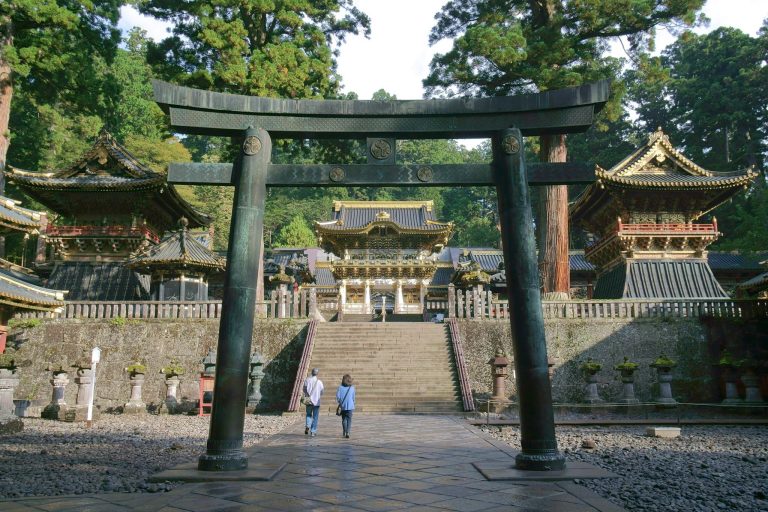
The main shrine lies west of Nikkō Tōshō-gū and occupies the site to which Shingū was moved in 850. Eleven buildings, including the main sanctuary and worship hall, are Important Cultural Properties. The main honden was built in 1619 and moved to its present position in 1645. It follows the eight-ridge style, while the haiden, the hall used for worship and ritual observance, has a hip-and-gable form. The precinct also contains a Karahafu gate, a side gate, a transparent fence, a torii, and a building for sacred palanquins.
Smaller shrines and sacred features
Other buildings in the main precinct include the Daikoku Hall and the small Mitomo and Hie shrines. Mitomo Shrine venerates Sukunahikona, while Hie Shrine venerates Ōyamakui. Both were erected in 848, and festivals associated with them are held on May 15 and June 15 respectively. Futarasan Spring, a sacred spring, lies toward the rear of the precinct.
A bronze lantern in the main precinct bears an inscription dated 1292. Known as the haunted lantern, it was traditionally said to acquire an uncanny appearance when lit. Numerous sword cuts on its surface were attributed to warriors who attacked it.
Hongū and Takinoo shrines
Hongū Shrine stands near the entrance to the Nikkō Sannai area on the site of the earliest sanctuary. It is associated with Ajisukitakahikone, the deity of Mount Tarō. Takinoo Shrine lies farther along the Takinoo route near Shiraito Falls and is associated with Tagorihime, the deity of Mount Nyōhō. Together with the main shrine, these two sanctuaries form the Three Shrines of Nikkō.
Middle and inner mountain shrines
Middle shrine
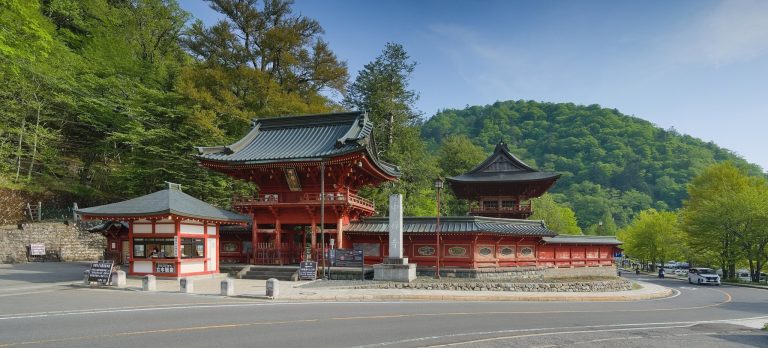
The middle shrine stands on the southern slope of Mount Nantai beside Lake Chūzenji. Its name refers to its position between the main shrine and the inner shrine. Founded in 784, it underwent later construction or rebuilding in 1096, 1155, and 1161. The present buildings date from 1699, and seven structures, including the main shrine building, are Important Cultural Properties.
A pilgrimage entrance beside the main sanctuary marks the traditional front ascent route to Mount Nantai. Two large Japanese yew trees grow near this route. One is estimated to be about 1,100 years old and the other about 1,000 years old. Together they were designated the Japanese Yews of Chūgū-shi, a Tochigi Prefecture natural monument, in 1969. The middle shrine’s treasure museum also preserves religious objects and other treasures associated with Futarasan Shrine.
Inner shrine and summit site
The inner shrine stands at the summit of Mount Nantai and was founded in 782 after Shōdō Shōnin’s ascent. Near the associated Tarōyama Shrine lies the Mount Nantai Summit Site, where ritual objects and other artifacts dating from the Nara period through the early modern period have been excavated. Many of these objects are Important Cultural Properties and are preserved in the middle shrine’s treasure museum.
Shinkyō and shrine treasures
Sacred Bridge
The Shinkyō, or Sacred Bridge, belongs to Futarasan Shrine and crosses the Daiya River at the entrance to the Nikkō Sannai area. The lacquered wooden bridge is approximately 28 meters long, 7.4 meters wide, and 10.6 meters above the river. It was formerly called the Sedge Snake Bridge or Snake Bridge.
Its traditional origin story says that the deity Jinja-Daiō released two snakes that became a rainbow-like bridge covered with sedge, allowing Shōdō and his followers to cross the river. Another tradition connects the bridge with Shōdō’s mountain-opening activities in the late Nara period, although its earliest construction date is uncertain. Before the Edo period, it is understood to have been a cantilevered bridge without conventional piers. Large timbers, called breast trees, were embedded in the soil and bedrock on both banks and projected upward to support the bridge girders.
The later structure combined a cantilevered bridge with a girder bridge and used stone supports for the breast trees. It was rebuilt in connection with the construction of Tōshō-gū and has followed its present design pattern since 1636. Ordinary traffic was then prohibited, while a temporary downstream bridge became the public Nikkō Bridge. Repairs continued, and painting was introduced after 1792. A flood caused by the Ashio Typhoon washed the bridge away in 1902; it was completely reconstructed in 1904.
Swords and ritual objects
Futarasan Shrine possesses two swords designated National Treasures of Japan. One is a small sword inscribed with the name Rai Kunitoshi, with a black-lacquered mounting. The other is a large sword identified as the work of Osafune Tomomitsu and dated 1366, together with its field-sword fittings.
Other shrine-associated cultural properties include excavated ritual objects from the summit of Mount Nantai, sacred palanquins, ritual weapons, and religious treasures. Three gilt-bronze sacred palanquins and three gilt-bronze ceremonial saddles are among the nationally designated objects connected with the shrine. A ceramic wind bell displayed at the entrance to the Shinkyō since 2017 measures 34 centimeters in length and diameter and weighs 5.5 kilograms.