Varberg Fortress: A Medieval Castle and Swedish Coastal Fortress



Site at a Glance
- Rating
- 4.4
- Popularity
- Medium
- Country
- Sweden
- Primary era
- Early Modern
- External website
- Open
- Eras represented
- Medieval, Early Modern, Modern
- Civilizations
- Danish, Norwegian, Swedish
- Site type
- Military
- Remains
- Fort
On this page8 sections
History
Varberg Fortress is a medieval fortress in Sweden, built between 1287 and about 1300 by Jacob Nielsen, Count of northern Halland. He commissioned it after King Eric VI of Denmark declared him an outlaw in connection with the murder of his father, King Eric V, in 1286. With substantial Norwegian assistance and the protection of King Håkon V of Norway, Jacob established the stronghold as a defensive base during his conflict with the Danish monarchy.
Medieval rule and territorial change
In 1305, Jacob Nielsen surrendered Halland to Erik Magnusson, Håkon V’s son-in-law. Varberg and part of the county consequently came under Norwegian control. The following decades brought repeated changes of ownership, with the fortress changing hands eight times by 1365. Among those who controlled it were Albrecht II of Mecklenburg, a German prince involved in Scandinavian dynastic politics, and Margaret I of Denmark, the queen who later created the Kalmar Union.
King Waldemar IV of Denmark captured Varberg in 1366. It then remained Danish for about three centuries. During the fourteenth century, the original stronghold was expanded into a castle. Ingeborg Håkansdotter, a Norwegian princess and political ruler, and her husband, Duke Erik Magnusson, spent considerable time there while governing a semi-independent group of Norwegian, Swedish, and Danish counties. Their son, Magnus Eriksson, who became king of Sweden and Norway, also stayed at the fortress.
Conflict and Danish modernization
Varberg was drawn into the Count’s Feud, a Danish civil and succession war of the 1530s. In 1535, the Lübeck military commander Marx Meyer was imprisoned there. He turned his imprisonment into a center of resistance, but he was defeated in 1536 and executed. The fortress was besieged and captured during the same conflict.
Swedish forces seized Varberg during the Northern Seven Years’ War, a Scandinavian conflict fought from 1563 to 1570. Danish forces recaptured it in 1569 under Commander Daniel Rantzau, who died in the battle. A memorial stone marks the place of his death. The Peace of Stettin that followed required Sweden to relinquish Halland.
King Christian IV of Denmark ordered the medieval castle to be enlarged between 1588 and 1618, creating a modern fortress adapted to changing artillery warfare. The work was initially directed by the Dutch-born architect Hans van Steenwinckel the Elder and completed by his son, Hans van Steenwinckel the Younger. After this modernization, Varberg was not involved in another military conflict.
Swedish military use, prison, and museum
Under the Peace of Brömsebro in 1645, Denmark relinquished Halland, and Varberg Fortress became Swedish. The treaty transferred the province and fortress to Swedish control. Varberg remained a military installation until 1830, although its military importance gradually declined. Swedish forces also continued expanding the complex after the Thirty Years’ War.
After its military use ended, the fortress became a prison. A cellular state prison, or kronohäkte, was built within the walls in 1856. Between 1848 and 1880, the prison population reached approximately 400 to 500 people, and the last prisoner left in 1931. The Halland Museum of Cultural History has occupied the fortress since 1916 and presents the Bocksten Man, a medieval bog body from Halland whose clothing survived exceptionally well.
Varberg Fortress has been protected as a state-listed historic monument since 1935. It is owned by the Swedish state and has been managed since 1993 by the National Property Board of Sweden in cooperation with the Municipality of Varberg. The complex is now used as a museum.
Remains
Hilltop fortress and defenses
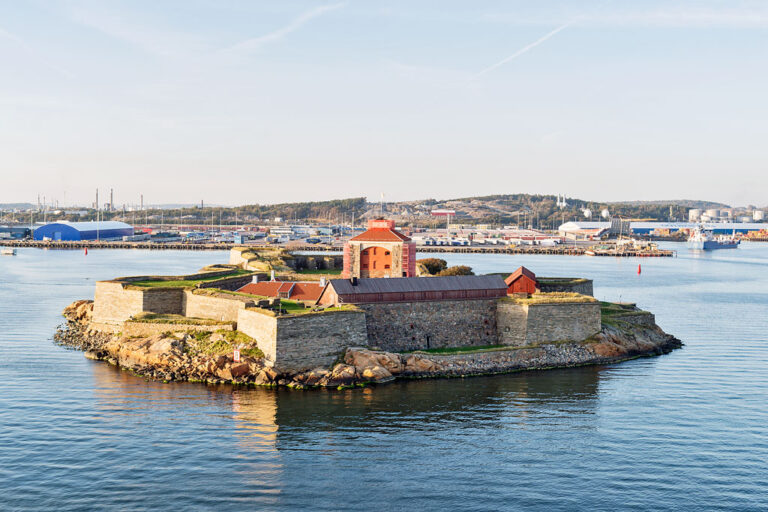
The fortress stands on Vardberget, a cliff above Varberg’s harbor. The hill gave the site its name and was also used for the warning fires of the harbor watch. The surviving complex brings together the original medieval stronghold, its fourteenth-century enlargement into a castle, and the later early-modern fortress. Ramparts, fortress walls, palisades, defensive ditches, and casemates, which are fortified chambers protected by thick masonry, form its principal defensive elements.
The defenses were designed and adapted to withstand cannon fire. The fortress suffered relatively little destruction in the modern period, leaving it in a condition described as close to its original form. The moat remains part of the complex and is associated with a local lake-monster tradition. In August 2006, witnesses claimed that a brown, furless creature with a tail about 40 centimeters long emerged from the dark water and devoured a duck.
Prison and museum interiors
A cellular prison constructed inside the fortress walls in 1856 forms part of the surviving complex. Its creation reflects the site’s change from a military installation to a place of confinement after the end of its military use. The Halland Museum of Cultural History is also housed within the fortress, where the Bocksten Man is presented with his preserved clothing. The clothing is described as the only complete clothing known to have been worn by a single individual in the fourteenth century.
Memorials and later cultural representations
A memorial stone marks the location where Daniel Rantzau died during the Danish recapture of Varberg in 1569. The fortress also appears beyond its own walls in the seventh mural from the north on the eastern side of the waiting hall at Stockholm Central Station. John Ericsson and Natan Johansson made the mural as part of a group of eight Swedish landscape paintings during the station’s 1927 renovation.
The museum displays a bullet traditionally believed to have killed Charles XII of Sweden, who ruled from 1697 until his death in 1718. Together with the Bocksten Man, the object forms part of the museum’s interpretation of historical people and events associated with Sweden and Halland.