Idala Church: A Medieval Church in Sweden
Site at a Glance
- Country
- Sweden
- Primary era
- Medieval
- Eras represented
- Medieval, Early Modern, Modern
- Civilizations
- Danish, Swedish
- Site type
- Religious
- Remains
- Church
On this page15 sections
History
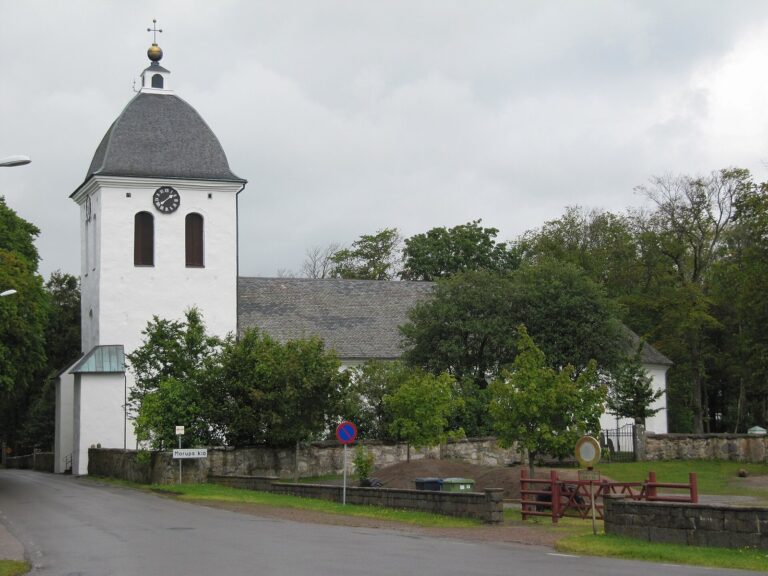
Idala Church is a medieval church in Idala, Kungsbacka Municipality, Halland County, Sweden. It was consecrated in the 13th century, and its oldest central sections date from that period. The church belongs to Idala Parish in the Diocese of Gothenburg.
Medieval origins and 18th-century changes
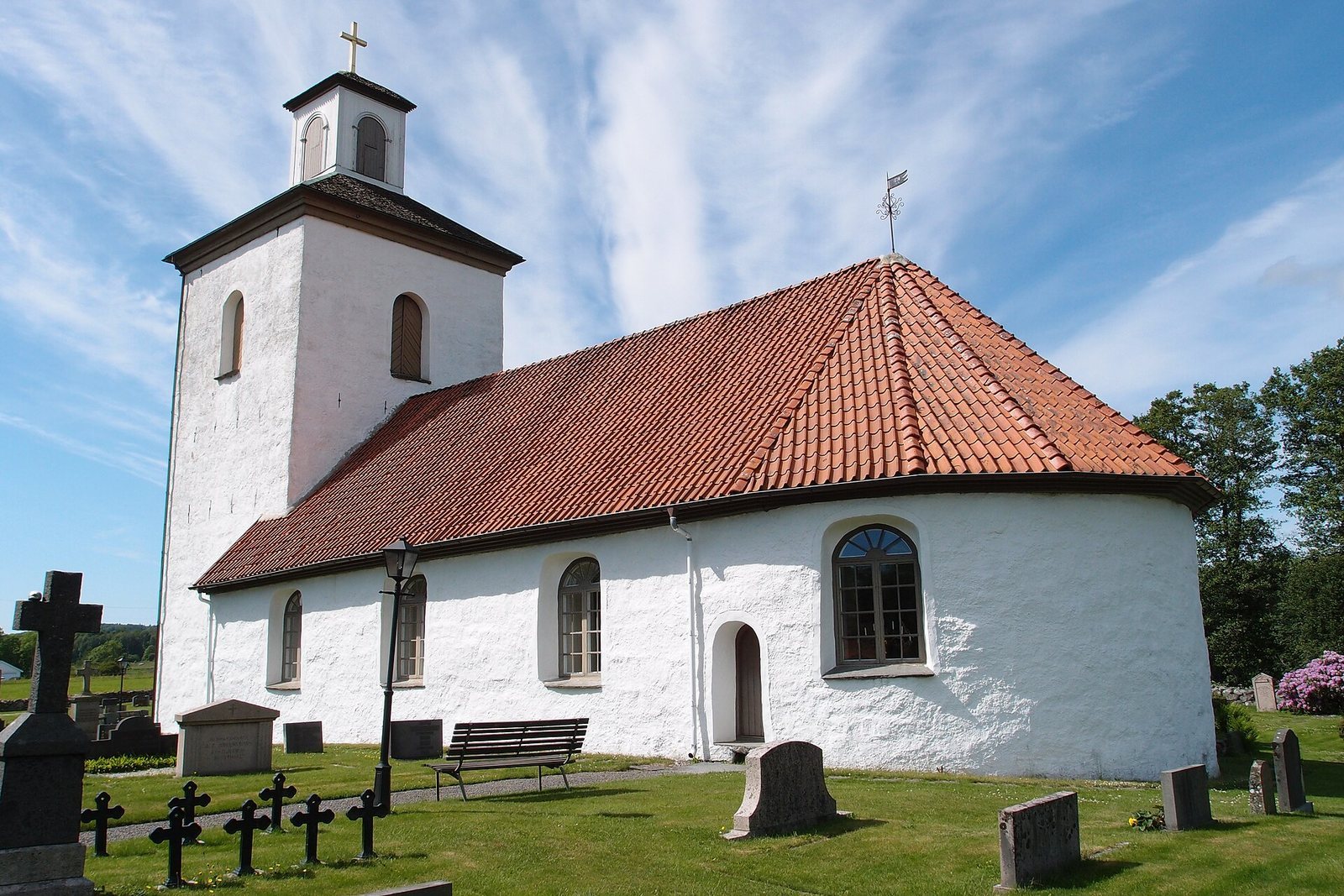
In 1772, the church was extended eastward and given a new chancel, the area around the altar. A major renovation in 1795 included painting the interior walls and ceilings. The church also holds the remains of provost Jonas Ahlelöf, a senior cleric responsible for a church district, who died in 1783; his wife, who died in 1776; their daughter; and a grandchild.
Nineteenth-century alterations
The larger of the church’s two bells was recast in 1799 and again in 1829. Builder Carl Hörstedt constructed the tower, topped by a lantern, in 1828. Repairs in 1859 and 1869 included a new barrier at the gallery, and some older paintings were permanently lost. Ceiling paintings were covered over in 1869 or 1880. The first organ was built by Johan Nikolaus Söderling in 1870. A new organ made by Mårtenssons organ factory replaced it in 1935.
Restoration and later additions
In 1904, the ceiling was covered with panels bearing stencil decoration by Martin Wallström. During a restoration in 1946–1947, led by Thorbjörn Engblad, the earlier ceiling paintings were uncovered and the interior regained its 18th-century character. A sacristy, a room for church furnishings and preparation for services, was added on the north side. The long-sealed entrance to the burial chamber beneath the chancel floor was reopened in 1946, and the 18th-century altar rail was restored and put back in place the following year.
An oak crucifix from the 14th century was held at the Gothenburg City Museum from 1924 to 1953. In 1955, a former parishioner gave the church a marble mosaic plaque from Italy depicting Mary and the child Jesus.
Remains
Layout and architectural form
The church stands on a small ridge overlooking the valley of the Löfta River. Its chancel occupies the eastward extension, while the sacristy is on the north side. A porch formerly stood on the south side. The tower is crowned by a lantern, an open or windowed structure at the top.
Painted interior and furnishings
Ceiling paintings
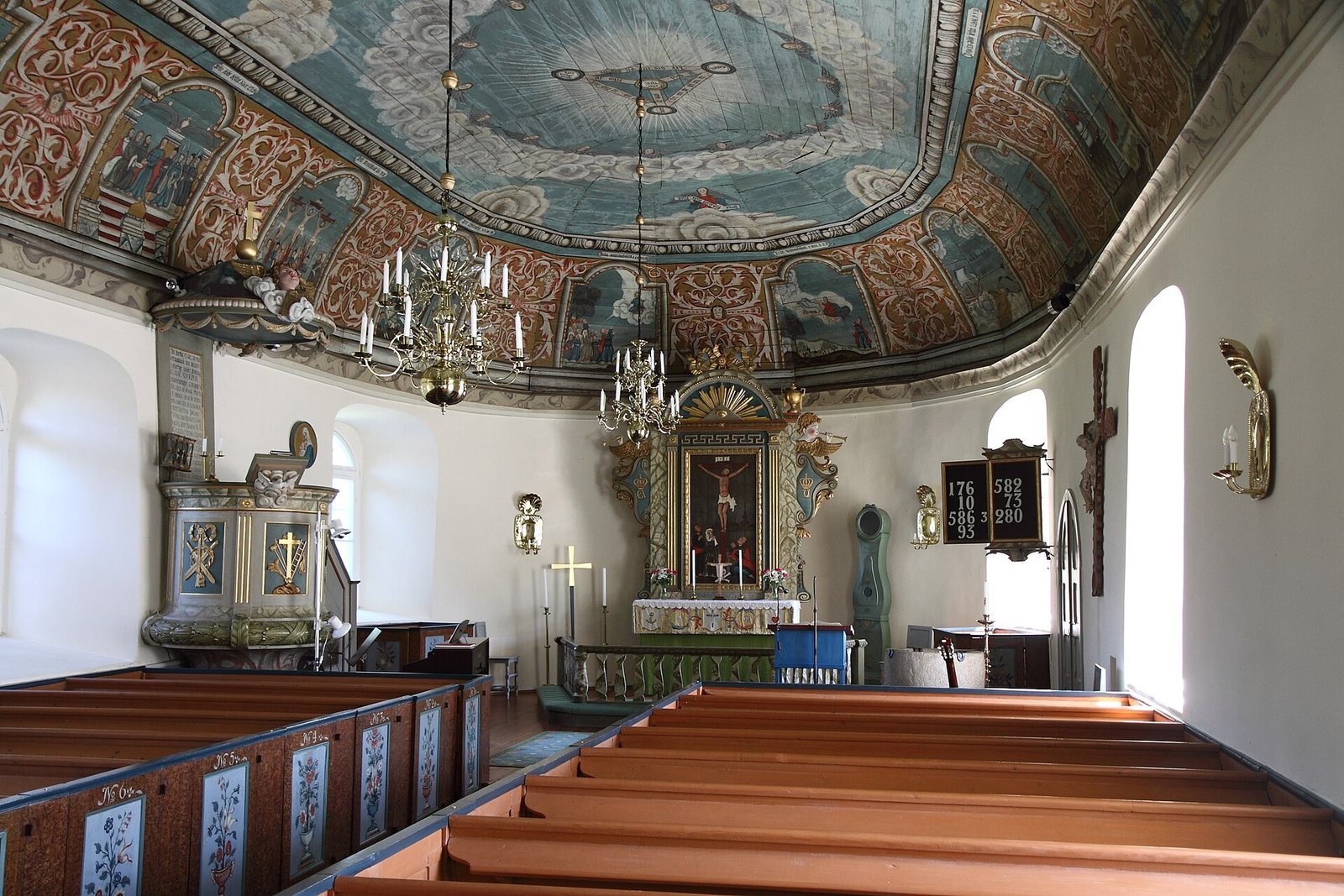
The painted vaulted ceiling forms a cycle of 18 images. Nine show scenes and promises from the Old Testament, and nine present their fulfilments in the New Testament. Other paintings depict the Trinity, the Christian belief in God as Father, Son, and Holy Spirit, and Christ as Judge of the World, with crowds walking toward him.
Altarpiece
The altarpiece has shallow rectangular supports framing an arch. Inside it, the Eye of God, a symbol of divine providence, appears with a radiant halo. Between the supports is a painting of Christ on the cross, with three disciples and a serpent and skull at the foot of the cross. Jacob Magnus Hultgren painted it in 1795. Beneath it is the inscription, “I am the resurrection and the life.” The painting was covered by a cross in the 19th century and later by a canvas, before being brought back into view. Monograms on either side represent Gustaf II Adolf, king of Sweden from 1611 to 1632, and Karl XII, king from 1697 to 1718.
Altar rail and other painted fittings
Hultgren also painted the ceiling vault, altar rail, pulpit, hymn-number boards, and benches. The 18th-century altar rail stands around the altar.
Baptismal font and crucifix
The baptismal font is a single piece of sandstone, 67 centimetres high, and belongs to a type associated with Västergötland, a historical province in southwestern Sweden. Its cylindrical bowl slopes toward a short shaft with a recessed band. It stands on a newly made base. Above it, on the south wall of the nave, the main body of the church, hangs an oak crucifix from the 14th century. A large crucifix of this kind is often associated with the division between the nave and chancel.
Burial features and other furnishings
Burial chamber and grave slabs
A hatch inside the altar rail and a stone stairway lead from the chancel floor to the burial chamber. The chamber contains four oak coffins, three larger and one smaller. Part of the porch floor is made up of grave slabs dating from the 17th and 18th centuries.
Organ and bells
The church has a seven-stop organ, an instrument with seven sound registers, and two bells.
Mosaic plaque
The church’s marble mosaic plaque depicts Mary with the child Jesus.