Renge-in Tanjō-ji Temple: A Shingon Ritsu Buddhist Temple in Japan


Site at a Glance
- Rating
- 4.3
- Popularity
- Low
- Country
- Japan
- Primary era
- Modern
- External website
- Open
- Eras represented
- Medieval, Modern
- Civilizations
- Japanese
- Site type
- Religious
- Remains
- Monastery
On this page16 sections
History
Renge-in Tanjō-ji is a Shingon Ritsu Buddhist temple in Japan, revived in 1930 on the former site of the medieval Jōkō-ji in Tsuiji, Tamana, Kumamoto Prefecture. Shingon Ritsu combines esoteric Buddhist practice with strict monastic discipline derived from the Vinaya tradition. The temple has the mountain title Takaharasan, is a special head temple, serves as the Kyushu head temple of the Shingon Ritsu school, and is affiliated with Saidai-ji in Nara, the school’s principal head temple. Its principal deity is Kōen Daibosatsu.
Jōkō-ji from the Kamakura to Muromachi periods
The earlier Jōkō-ji was founded either in the late Heian period or the early Kamakura period, but its exact foundation date and identity remain uncertain. An Edo-period regional chronicle calls it Jōkō-ji Renge-in and attributes its foundation to Taira no Shigemori. The same tradition credits Shigemori with establishing two five-ring stupas, the Great South Gate, and the nunnery Myōshō-ji. No contemporary document confirms these attributions.
The oldest surviving reference is the 1298 Tōmyō-ji Document. It describes a privately founded Jōkō-ji in Higo Province established by the monk Ekū. Whether Ekū’s temple was the same institution later linked with Shigemori, or whether it succeeded an earlier Jōkō-ji, is uncertain. Records connected with Saidai-ji nevertheless place Jōkō-ji within the Shingon Ritsu network and show that it existed from at least 1290 to 1478. The medieval temple was therefore active during the Kamakura and Muromachi periods.
Destruction and the survival of the site
Jōkō-ji had disappeared by the Edo period and is generally thought to have been destroyed during the wars of the Sengoku period, a time of prolonged military conflict among competing regional powers. An attack by the Ryūzōji in 1581, together with the destruction of the local Ōno family, is considered a possible cause, although no direct historical document establishes the circumstances. The former grounds later became overgrown.
Several features continued to preserve the memory of the medieval complex. Local place-names included Renge, which may refer to a pagoda temple called Renge-in. Two five-ring stupas and a small structure known as Shakado also remained as indications of the former institution. The present name, Renge-in Tanjō-ji, means “Birth Temple” and refers to the revival of Renge-in at the birthplace of Kōen.
Kōen was a Tendai monk of the late Heian period associated with Mount Hiei and known as the Acharya of Higo, meaning a Buddhist teacher or master. He is also remembered as the monk who ordained Hōnen, the founder of the Jōdo school of Pure Land Buddhism. Kōen is credited with writing the Fusō Ryakki, a chronological history of Japan that gives particular attention to Buddhism and the origins of temples and shrines. Later biographies describe his transformation into a dragon and his entry into meditative practice at Sakuraga Pond in Enshū in 1169, although the historical details of his death are uncertain.
Revival in the twentieth century
On December 10, 1929, Zeshin Kawahara, who was then operating a prayer center in Arao, received a spiritual communication attributed to Kōen. It instructed him to revive Renge-in. With the cooperation of local villagers, Kawahara began rebuilding the religious institution. A provisional Main Hall was completed on March 21, 1930, marking the temple’s revival under the name Renge-in Tanjō-ji rather than Jōkō-ji.
Kawahara served as the first abbot from 1930 until his death in 1977. Shin-nyo Kawahara followed him from 1977 to 1992, and Eishō Kawahara became abbot in 1992. Both later abbots had previously served as abbots of Tōmyō-ji in Saga Prefecture. During its early rebuilding, the temple developed from a small hall into a working religious center with an Acharya Hall, dining facilities, and lodging for male and female retreatants. It functions as a prayer temple, offering rites for devotees and the general public.
The provisional Main Hall became the World Peace Hall, also called Daigando, in 1950. It was replaced by the present reinforced-concrete Main Hall in 1966. Archaeological work connected with this construction recovered medieval Buddhist and architectural remains, supporting the interpretation that the Jōkō-ji Main Hall stood at or near the location of the present hall. The recovered objects became Tamana municipal cultural properties in 2008.
Religious and humanitarian activities
During Shin-nyo Kawahara’s abbacy, the Oku-no-in was established on Mount Shōdai, north of the Main Temple. Its opening ceremony took place on November 3, 1978. Kawahara also promoted almsgiving and humanitarian work, including assistance to Cambodian refugees, and founded the Association for Renge-in Tanjō-ji International Cooperation, known as ARTIC, in 1979.
ARTIC supported educational and humanitarian programs among Tibetan communities in India, at orphanages and monastic schools in Sri Lanka, in slum communities in Bangkok, and in Myanmar refugee camps in Thailand. It also organized assistance after the Great Hanshin earthquake of 1995, the Great East Japan earthquake of 2011, and the Kumamoto earthquake of 2016. The organization received a Japanese Foreign Minister’s Commendation in 2015 and the 41st Shoriki Matsutaro Award in 2017.
Shin-nyo Kawahara also established a movement encouraging children to respect their parents. The movement solicits poems from children, publishes selected works, and commemorates them with a stone poetry monument at the Oku-no-in. Under Eishō Kawahara, the temple continued to expand its international and domestic social activities. The 14th Dalai Lama visited from April 10 to 14, 2005, taking part in a World Peace Homa Ceremony at the Main Temple and giving a lecture at the Oku-no-in. A Homa is a fire ritual in which offerings are placed in a consecrated fire while prayers or sacred formulas are recited.
The temple holds monthly religious services on the 13th, with additional observances on the 3rd and 23rd. Monks recite the Rishu-kyō, monks and devotees take part in Buddhist liturgical recitation, and the abbot delivers a sermon. June 13, regarded as the day of Kōen’s death or entrance into meditative seclusion, is the principal festival date. On the night of June 12, devotees carry lanterns from the Oku-no-in to the Main Temple in the Dragon Fire Descent. Fire rituals and an early-morning memorial service follow on June 13. The Oku-no-in also holds a monthly merit-accumulating practice in its Five-story Pagoda, an autumn festival on November 3, and a New Year’s Eve bell-ringing service on December 31.
Remains
The complex is divided between the Main Temple at 2288 Tsuiji and the Oku-no-in at 1512-77 Tsuiji. The Oku-no-in lies about 4 kilometers north of the Main Temple on the mid-slope of Mount Shōdai. The Main Temple includes the Main Hall, World Peace Hall, Acharya Hall, Five-story Pagoda, Tahoto Pagoda, Great South Gate, and a stone circular gate. The surviving medieval remains, later buildings, and modern Buddhist monuments together occupy the site associated with Jōkō-ji and its twentieth-century revival.
Main Temple buildings
Main Hall and World Peace Hall
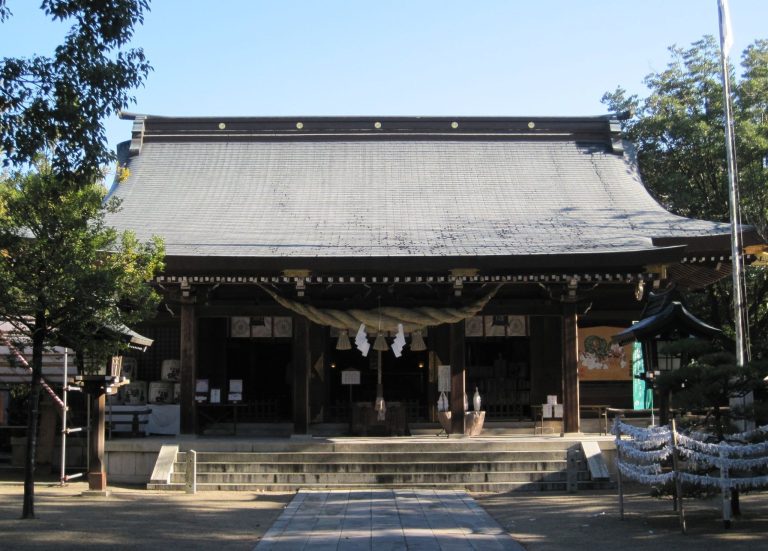
The provisional Main Hall was completed on March 21, 1930, when Renge-in Tanjō-ji was revived. In 1950 it became the World Peace Hall, or Daigando, before being replaced by the present reinforced-concrete Main Hall in 1966. The World Peace Hall has a floor area of 112 tatami mats. Archaeological remains recovered near the present hall place the medieval Jōkō-ji Main Hall at or near this part of the complex.
Acharya Hall and stone circular gate
The Acharya Hall was completed in 1937. An Acharya is a Buddhist religious teacher or master, a designation that also recalls Kōen’s traditional title, the Acharya of Higo. The stone circular gate was completed in 1940 and bears the inscription “Fulfillment of vows, 2,600th Imperial year, Tanaka Torakichi.”
Five-story and Tahoto pagodas
The wooden Five-story Pagoda was completed in 1997 using traditional construction techniques, and its opening ceremony took place on April 12. A Five-story Pagoda is a vertically stacked Buddhist tower traditionally associated with the five elements. The Tahoto Pagoda was completed in 2018, with its opening ceremony and an eye-opening rite for the Five Wisdom Buddhas held on May 12. This pagoda form has a lower square section and an upper cylindrical section.
Great South Gate
The Great South Gate was completed and opened on May 23, 2011, about four centuries after the gate of the former Jōkō-ji had disappeared. Built from Aomori hiba cypress, it is a two-story tower gate. Its main structural body is five bays wide and two bays deep. The outer bay on each side contains one of the Four Heavenly Kings, while the central three bays form an unshuttered passage.
The gate stands on a high stone platform. Two-step bracket complexes support the lower-story roof, while three-step bracket complexes with projecting tail rafters support the upper-story roof. A balustrade runs around the upper level. Because a public road passes immediately in front of the gate, a drum bridge links it with the forecourt. A company specializing in shrine and temple construction carried out the work, with the design handled by a designated architect.
Guardian statues
The Four Heavenly Kings are Buddhist guardian deities traditionally placed at temple entrances to protect the Buddhist teaching. The Kyoto sculptor Tsukumo Imamura made the four statues, and their eye-opening rite was held at the gate’s inauguration. Each is approximately 2.75 meters high. They were enlarged by the saiwari method, in which a small model is divided into measured sections, enlarged section by section, and reassembled. Their surfaces are finished in brilliant polychrome using gold.
Viewed from outside the gate, Zōchōten stands on the left and Jikokuten on the right. On the inner side, Kōmokuten stands on the left and Tamonten, also called Bishamonten, stands on the right. Jikokuten is blue, holds a vajra near his waist, and raises a trident. Zōchōten is reddish purple, holds a sword above his head, and carries a noose at his waist.
Kōmokuten is white and holds a brush near his face and a scroll at his waist, adopting a writing gesture. His comparatively restrained expression was modeled mentally on the sumo wrestler Hakuhō. Tamonten is black, wears a bell on his head, holds a treasure staff, and raises a treasure pagoda. His mental image was modeled on the sumo wrestler Asashōryū. The outward-facing figures carry weapons and present forceful protection, while the inner figures hold implements associated with Buddhist teaching and have more restrained expressions.
Medieval monuments and archaeological remains
Kanpaku Towers
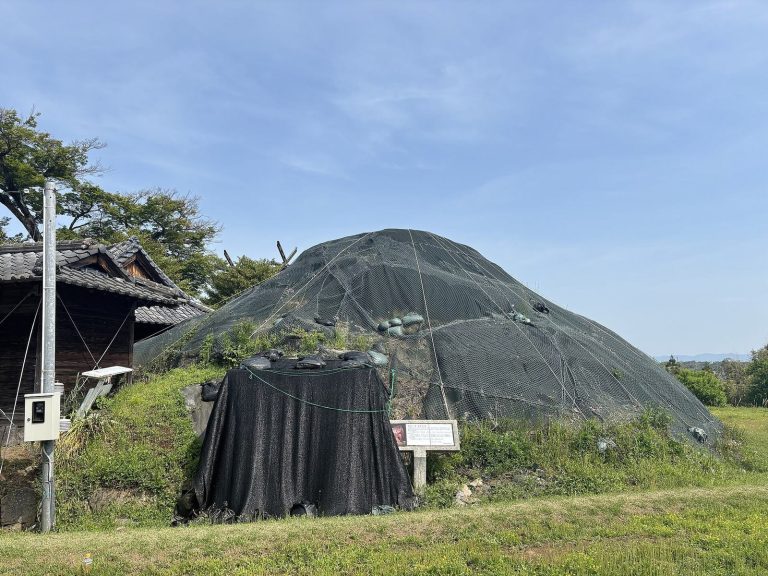
Two large five-ring stupas, known as the Kanpaku Towers, stand together west of the temple’s main gate. A five-ring stupa is a Japanese Buddhist monument made of five stacked forms representing the elements. The towers are constructed from tuff and have no inscriptions. Their forms possess features associated with Shingon Ritsu five-ring stupas of the late Kamakura to Muromachi periods.
The eastern tower is 253.6 centimeters high. The western tower measures 268.8 centimeters, although its foundation stone has been lost. It is described as the tallest five-ring stupa in Kyushu. Excavations nearby uncovered the lower three foundation sections of additional five-ring stupas, with inscriptions dating to the period of the Northern and Southern Courts.
Excavated Buddhist objects and tiles
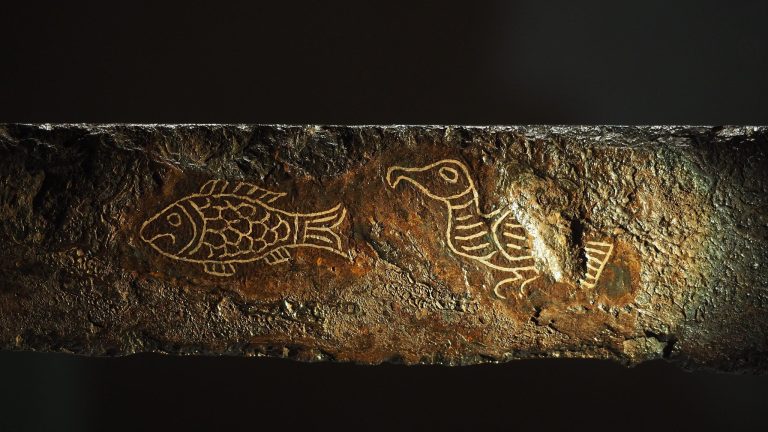
Excavations near the present Main Hall produced two small Buddhist images, an incense burner, three crane-and-tortoise candlesticks, a gilt-bronze Buddha head, a comma-shaped bead, and a ritual basin. These objects are regarded as remains from the Kamakura period. Three cloth-impressed round eaves tiles and two cloth-impressed flat eaves tiles were also recovered and are dated to the same period.
The objects and tiles are interpreted as Buddhist foundation deposits. Such deposits were placed underground beneath a principal image as prayers for the safety of construction. They are preserved and exhibited in the temple’s Kuri, a residential and service building. Together with other archaeological remains, they connect the medieval Jōkō-ji Main Hall with the area occupied by the present Main Hall.
Oku-no-in on Mount Shōdai
The Oku-no-in occupies the mid-slope of Mount Shōdai approximately 4 kilometers north of the Main Temple. Established by Shin-nyo Kawahara, it opened ceremonially on November 3, 1978. Its buildings include the Five-story Pagoda, where the monthly merit-accumulating practice is held, and the stone poetry monument associated with the movement encouraging children to respect their parents. The site also hosts the autumn festival on November 3 and forms the starting point for the Dragon Fire Descent held before the principal June memorial service.