Kannō-ji Temple: A Shingon Buddhist Temple on Mount Kabutoyama


Site at a Glance
- Rating
- 4.4
- Popularity
- Low
- Country
- Japan
- Primary era
- Early Modern
- External website
- Open
- Eras represented
- Early Modern, Modern
- Civilizations
- Japanese, Tokugawa
- Site type
- Religious
- Remains
- Monastery
On this page16 sections
History
Kannō-ji Temple is a Shingon Buddhist temple in Nishinomiya, Japan, founded in 827 or 828 at the foot of Mount Kabutoyama. It belongs to the Omuro branch, a major Shingon lineage associated with Ninna-ji, and is designated a special head temple. The site was known at its foundation as Mani-san Kannō-ji and also carried the alternative name Kanō-ji.
Foundation traditions
The temple’s origin is linked with Manai Gozen, the fourth consort of Emperor Junna, who later became the nun Nyoini. The Genko Shakusho attributes the establishment to her, while the Teio-Hennenki states that Empress Masako ordered Tachibana no Ujikimi and Mihara no Shunjo to establish a Shingon temple in 827. Emperor Junna was Japan’s fifty-third emperor, and the two accounts preserve different traditions about the institution’s beginnings.
According to the foundation tradition, Manai Gozen secretly left the imperial palace in Kyoto in 828 to pursue Buddhist practice. With help from Kukai, the monk traditionally regarded as the founder of Shingon Buddhism, she traveled through the coastal shrine area and Hirota Shrine to Mount Kabutoyama. She practiced there for three years before Kukai shaved her head in 831 and gave her the religious name Nyoini. Two other women who entered religious life with her, Nyoichi and Nyoen, were granddaughters of Wake no Kiyomaro.
The mountain itself was the original object of worship. Kannō-ji combined Shinto and Buddhism until the end of the Edo period, and its guardian deity was identified with the water-associated deity worshipped at Hirota Shrine. Religious traditions also connect Kukai and Nyoini with ascetic practice at Kabutoyama. A separate legend says that Empress Jingu buried a helmet and other objects on the mountain while praying for peace, and that its helmet-like shape gave rise to the name Kabutoyama.
Early temple development
In 830, Kukai is traditionally said to have carved the temple’s principal image, a six-armed Nyoirin Kannon, from a large cherry tree on the mountain summit. Nyoirin Kannon is a form of Kannon associated with the wish-fulfilling jewel and the granting of religious and worldly benefits. The main hall was completed and ceremonially opened on October 18, 831.
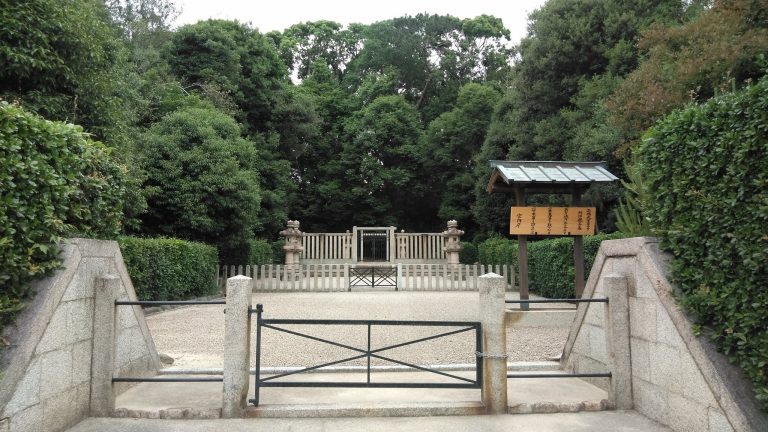
During the early Kamakura period, between 1182 and 1184, Minamoto no Yoritomo revived Kannō-ji and appointed Kajiwara Kagetoki to supervise the work. A stone monument near the temple is traditionally identified as Yoritomo’s tomb. The temple’s original land grant from Emperor Junna was said to comprise 150 cho, bringing the total estate to 250 cho. Later changes reduced the temple grounds to approximately 20 cho.
Warfare and rebuilding
Kannō-ji’s position made it vulnerable during periods of conflict. Troops led by Akamatsu Norisuke occupied the temple between 1351 and 1352, during the Northern and Southern Courts period, a struggle between rival imperial courts. The grounds were later used repeatedly as military encampments during battles.
The temple was also drawn into the Siege of Arioka, when Oda Nobunaga attacked Araki Murashige during the conflicts of the late sixteenth century. Many halls and pagodas were burned. In 1594, Toyotomi Hideyoshi confiscated most of the temple’s landholdings, further changing its material and financial position.
Rebuilding continued in the Edo period. A main hall was donated in February 1629, and Keishoin, the mother of shogun Tokugawa Tsunayoshi, provided 200 ryō of gold in 1696. The buildings were restored in 1719, and the main hall was moved to its present location in 1749. Kannō-ji had formerly been a subordinate temple of Ninna-ji, the head temple of the Omuro branch. In 1763 it joined the Enmeiji branch after receiving the title Hyoritsu-in, but it returned to the Ninna-ji lineage in 1798.
Modern history
The roof ridge of the main hall collapsed during a Buddhist service on August 5, 1839. A new main hall was raised on February 23, 1841. In 1911, Princess Bunshu stayed at the temple for one night, prompting the construction of a lavatory and bathing room for the visit. During the Pacific War, the temple bell cast in 1889 was requisitioned in November 1942 under the Metal Collection Order.
A ceremony marking Kannō-ji’s elevation to special head-temple status took place on October 21, 1959, with Prince Takamatsu in attendance. The Great Hanshin-Awaji Earthquake of 1995 caused some temple buildings to collapse. The temple is the twenty-first station of the New Saigoku Thirty-Three Temple Pilgrimage and also belongs to the Settsu Kokuhachijuhakkasho, the Settsu Thirty-Three Temple Pilgrimage, and the Eighteen Ancient Temples of Buddhist Pagodas circuits.
The mountain was formerly called Mukoyama, a name referring to the Rokko Mountains, before the abbot Kogen changed it to Kabutoyama. The place-name Kannōchō, about three kilometers southeast of the temple near the junction of the Tokaido Shinkansen and Hankyu Imazu Line, is associated with the tradition that the temple was temporarily relocated there during the medieval period. A festival for the hidden Nyoirin Kannon is held on May 18, when the statue is shown publicly. The image is also associated with blessings for prosperous businesses and household livelihoods.
Remains
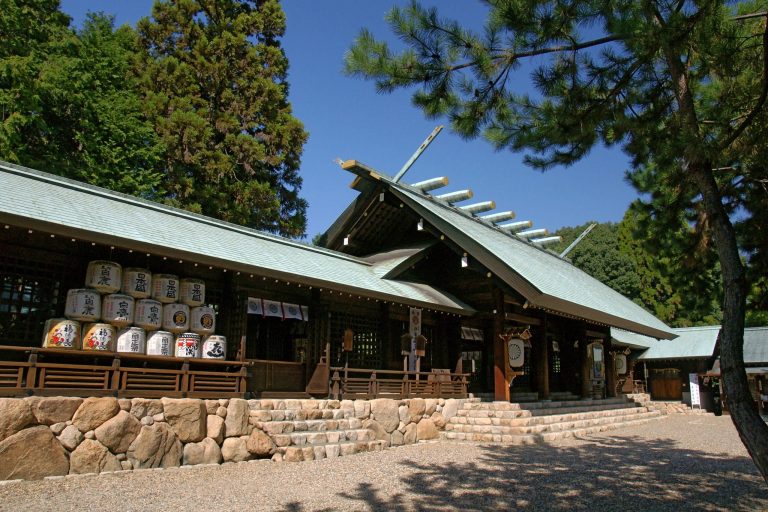
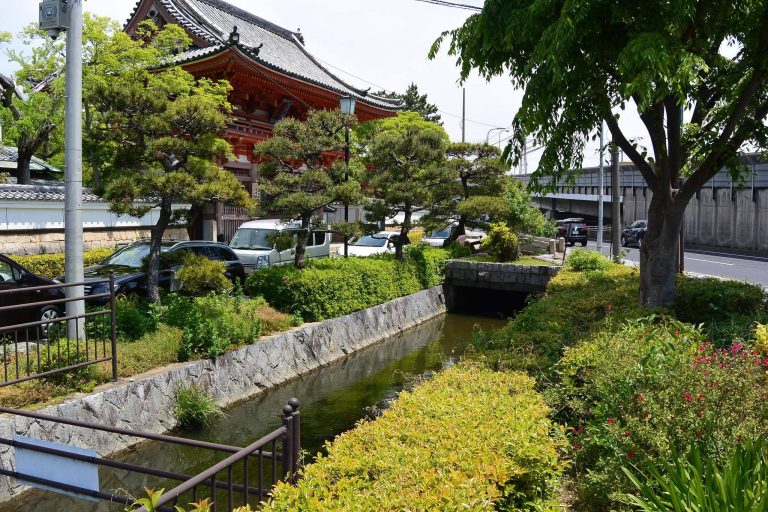
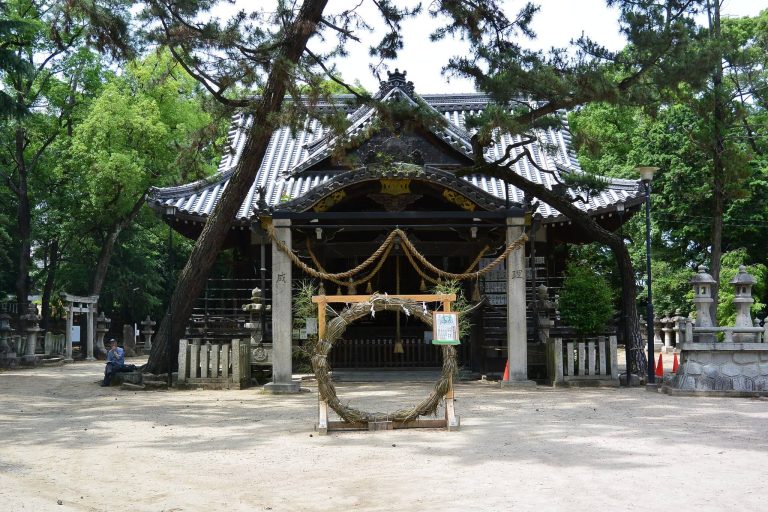
Kannō-ji occupies the lower slope of 309-meter Mount Kabutoyama. Its approach begins at a gate near the foot of the rise, crosses a road, and continues up stairs to an inner precinct enclosed by a wall. The Niō gate, an entrance guarded by two muscular protective figures, opens toward a layout in which the bell tower stands immediately to the right and the main hall lies directly ahead.
Temple precinct
Niō Gate and bell tower
The entrance gate contains guardian figures on either side of the passage and is a Nishinomiya City-designated tangible cultural property. Immediately inside it stands the bell tower, forming the first part of the central approach into the walled precinct.
Main hall and subsidiary buildings
The main hall occupies the position directly ahead after the ascent. To its right are the Fudo Hall and an ossuary hall. The Daishi Hall and the area used by the abbot and monks stand on the left, while a small Tahoto pagoda, a distinctive Japanese Buddhist pagoda form, is located in the upper rear part of the grounds.
Buddhist images and records
Nyoirin Kannon
The principal object of worship is a 98.7-centimeter wooden statue assembled from multiple blocks. It shows six-armed Nyoirin Kannon. Temple tradition attributes the image to Kukai in 830 and says that it reproduces Nyoini’s appearance, while art-historical dating places it in the latter half of the tenth century or the first half of the eleventh.
The statue has an unusual posture. Instead of the customary raised right knee, its right leg crosses diagonally over the left, and its head tilts upward. It is a hidden image, meaning that the sacred statue is normally kept from public view except during designated openings. The image is regarded as one of Japan’s three most celebrated Nyoirin Kannon statues, together with images at Kannon-ji in Kawachinagano and Muro-ji in Uda.
Other wooden images
Other important images include a standing Shō Kannon from the Heian period, which lasted from 794 to 1185, a seated Fudo Myoo from the Kamakura period, and a seated image of Kobo Daishi, another name for Kukai, also from the Kamakura period. These three images, together with the principal Nyoirin Kannon, are designated Important Cultural Properties of Japan, a legal heritage status for objects valued in the country’s cultural history.
Illustrated handscroll
The temple also preserves a three-volume illustrated handscroll concerning its origin. It forms a material counterpart to the traditions surrounding Nyoini, Kukai, Mount Kabutoyama, and the establishment of the temple.
Sacred mountain features
Hirota Shrine Deity Manifestation Rock
Approximately 200 meters from the temple gate is the Hirota Shrine Deity Manifestation Rock, a group of sacred rocks within the Kabutoyama Eighty-Eight Sacred Places. Statues of En no Gyoja, an early Japanese ascetic associated with Shugendo, and of Zenki and Goki stand on the rocks. The place is identified with the tradition that En no Gyoja encountered the deity of Hirota Shrine there.
Nine Contemplations Waterfall
The Nine Contemplations Waterfall lies approximately 200 meters east of the entrance to Kabutoyama Forest Park. It is associated with the ascetic practice of Kukai and Nyoini, extending the temple’s religious landscape beyond the walled precinct and into the mountain setting.