Eta Funayama Kofun: A Keyhole-Shaped Burial Mound in Japan


Site at a Glance
- Rating
- 4.2
- Popularity
- Low
- Country
- Japan
- Primary era
- Classical
- External website
- Open
- Eras represented
- Classical, Medieval
- Civilizations
- Yamato
- Site type
- Burial
- Remains
- Burial Mound
On this page8 sections
History
Eta Funayama Kofun is a Japanese burial mound in Nagomi, Japan, built during the Kofun period, an era from approximately the third to the sixth centuries associated with monumental elite tombs. Probably constructed from the late fifth century to the beginning of the sixth century, it is the oldest and largest mound in the Kiyohara Kofun Group. Its rich burial and inscribed sword connect a regional elite tomb with the expanding authority of the Yamato polity, the early state centered in the Kinai region.
Construction and political setting
The tomb is associated with Murite and others, although recent research considers that three people may have been buried within it. One interpretation identifies the burial as that of a middle-ranking regional chief under the Tsukushi no Kimi, a ruling lineage associated broadly with northern Kyushu. The attribution remains an interpretation rather than a settled identification.
The mound’s stone warriors, shown wearing short tanko cuirasses made from plates of iron or leather, belong to a regional practice of placing stone people and horses around elite tombs. That practice began at Ishibito-yama Kofun, reached its height at Iwatoyama Kofun in the early sixth century, and later disappeared. Iwatoyama has been regarded as the tomb of Tsukushi no Iwai, who was defeated by the Yamato polity in 527–528. This political setting has shaped interpretations of Eta Funayama Kofun and its burial community.
The silver-inlaid sword names Murite as an administrative official serving a great ruler. Comparison with the inscribed sword from Inariyama Kofun has led one interpretation to identify that ruler with Emperor Yūryaku, the conventional English name for the fifth-century sovereign traditionally associated with Wakatakiru in several early sword inscriptions. Swords bearing the same ruler’s name in eastern and western Japanese tombs have been understood as evidence of the Yamato polity’s extensive reach, although the reading of the Eta Funayama inscription remains uncertain because several characters are illegible.
Excavation and preservation
Excavation began in 1873 after a local resident, Ikeda Saju, reportedly received a revelation in a dream and began digging. The Meiji government purchased the objects he recovered for 90 yen and transferred them to the then Exhibition Bureau, now the Tokyo National Museum. Most of the grave goods are held there, and the collection was collectively designated National Treasures in 1965.
Eta Funayama Kofun became a National Historic Site in 1951 because of its well-formed mound, unusual appearance, house-shaped stone coffin, and silver-inlaid inscribed sword. After a 1975 survey established the presence of the surrounding moat, the nearby Tsukabōzu Kofun and Kokuzōtsuka Kofun were added as ancillary components of the designation in 1976. An earthquake registering lower 6 on the Japanese seismic intensity scale in January 2019 damaged the stone coffin. Four areas of the lid surface detached, six cracks were found, and major cracks appeared in the side walls. A restoration plan decided in October 2025 called for internal reinforcement with a metal frame.
Remains
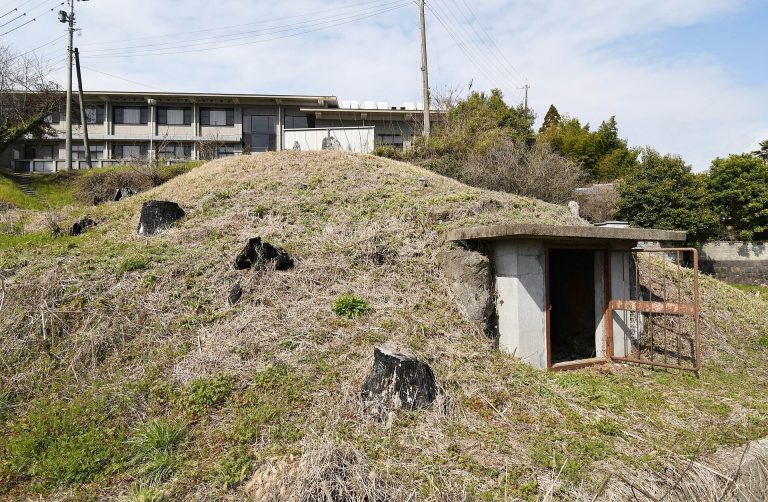
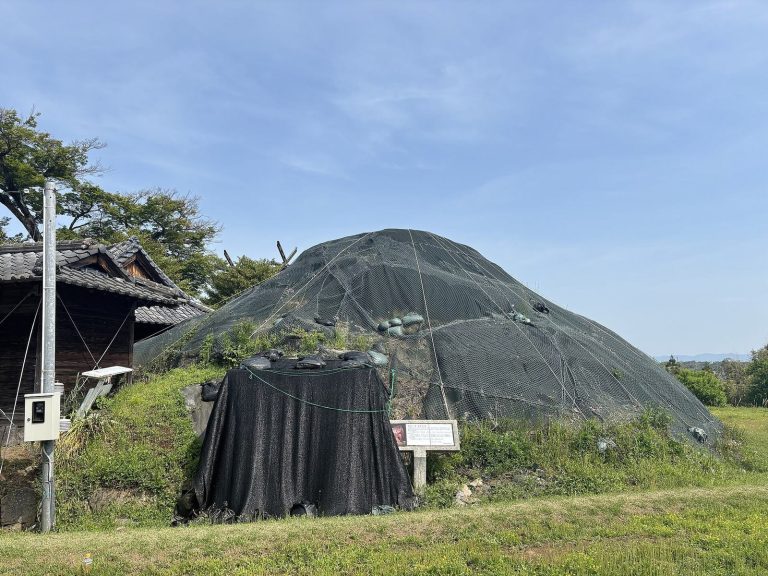
Eta Funayama Kofun is a keyhole-shaped mound, combining a rectangular front section with a rounded rear section. It measures approximately 62 meters in total length and 10 meters in height, although excavation around the mound reduced its present dimensions from its original size. A shield-shaped moat about 20 meters wide surrounds the mound, while stone warrior figures were arranged around its outer form.
Mound and burial chamber
The circular rear section contains an assembled, house-shaped stone coffin. This unusual burial chamber formed part of the evidence supporting the site’s National Historic Site designation. The coffin was damaged by the 2019 earthquake, which affected both the lid and side walls, and its planned internal metal frame is intended to reinforce the surviving structure.
Stone warriors
The figures around the mound depict warriors wearing short tanko armor. Their presence places the tomb within the tradition of stone people and horses associated with elite burials in the region during the late fifth and early sixth centuries. The figures provide physical evidence for a practice that later disappeared after reaching its height at Iwatoyama Kofun.
Inscribed sword
The excavated sword is a straight, single-edged iron weapon dating to the fifth century. Its 75-character inscription was worked in silver along the narrow back, or ridge, of the blade rather than across its broad surface. The text refers to service to a great ruler, the official Murite, activity during the eighth month, a large iron cauldron, a four-foot sword, and repeated metal refining. It expresses hopes for the wearer’s long life, the prosperity of his descendants, and the endurance of his authority. The sword-maker Itaka and the writer Chōan are also named, although the illegible characters leave parts of the reading and interpretation uncertain.
Silver-inlaid images decorate both sides of the blade. Flowers and a horse appear on one side, while a fish and a bird appear on the other. Some of the inlay is thought to have been lost when a Japanese-sword polisher worked on the weapon at the end of the Taishō period.
Other grave goods
The burial produced an iron armor set with a tanko-style cuirass, a bronze crown with traces of gilding, a bronze mirror of Chinese origin, and bronze shoes decorated with a hexagonal pattern. Numerous additional objects came from China and Korea. Some bronze objects resemble artifacts associated with Baekje, the Korean kingdom that maintained exchanges with Japan during this period.