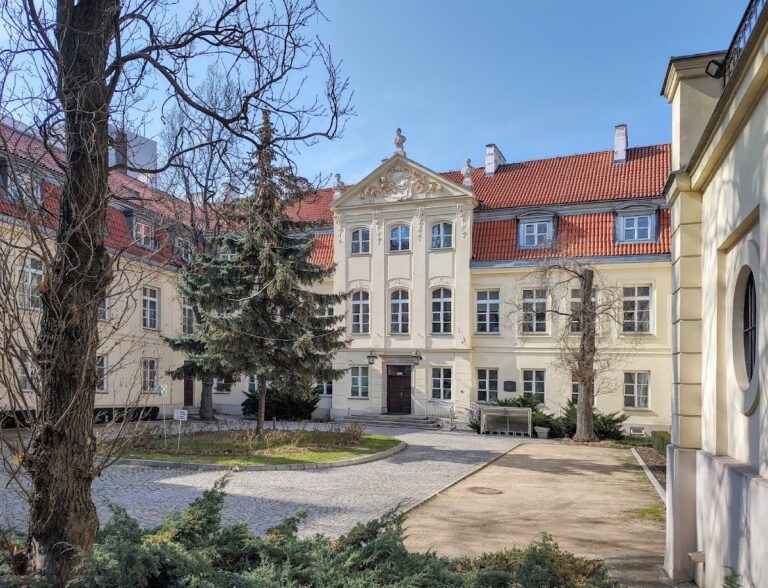
Palace of the Minister of Treasury: A Neoclassical Government Residence in Warsaw


Site at a Glance
- Rating
- 4.4
- Popularity
- Very Low
- Country
- Poland
- Primary era
- Modern
- Eras represented
- Modern
- Civilizations
- Unclassified
- Site type
- Civic
- Remains
- Palace
On this page9 sections
History
The Palace of the Minister of Treasury in Warsaw, Poland, is a neoclassical palace built between 1825 and 1830 for Franciszek Ksawery Drucki-Lubecki, the minister of the treasury of Congress Poland. Congress Poland was a nineteenth-century constitutional kingdom established in personal union with the Russian Empire after the Napoleonic Wars. Designed by Antonio Corazzi, an Italian architect active in Warsaw, the building was modeled on Italian Renaissance villas and replaced an earlier Baroque residence associated first with the Wiśniowiecki family and later with the Ogiński family.
A ministerial residence and public institution
The palace was intended as Drucki-Lubecki’s residence and also provided accommodation for senior ministry officials. It stood between the Palace of the Government Commission of Revenues and Treasury and the Stock Exchange and Bank of Poland Building, forming part of an important governmental and financial group at Bank Square.
From the 1870s until 1915, the building housed the Russian-language First Girls’ Gymnasium. In this period, a gymnasium was a secondary school. In September 1918, the palace began to be adapted for the State Council of Poland, but the council was dissolved the following month before the work was finished. A proposal to use the building temporarily as the seat of the Sejm, the lower house of Poland’s national parliament, was later abandoned.
Interwar administration and wartime destruction
Marian Lalewicz directed an adaptation and renovation in 1920 and 1921. Afterward, the palace and the neighboring Palace of the Government Commission of Revenues and Treasury housed the Ministry of State Treasury until 1939.
The palace was bombed and burned during the defense of Warsaw in September 1939. It was destroyed during the Warsaw Uprising in 1944, the 1944 armed insurrection against the German occupation of Warsaw.
Reconstruction and civic use
Piotr Biegański directed the reconstruction carried out between 1950 and 1954. The restored palace and the neighboring Palace of the Government Commission of Revenues and Treasury then became part of Warsaw’s city-hall complex. The complex later became associated with the office of the mayor. Since 1998, the palace has also housed the Masovian Voivodeship Sejmik, the elected assembly of the Masovian regional administrative unit. Much of the building is occupied by offices of the Masovian Voivodeship Office, while the Stefan Starzyński Hall is used for sessions of the regional assembly.
A monument to Felix Dzerzhinsky, a Polish-born communist revolutionary who led the Soviet Cheka and OGPU secret-police organizations, was unveiled in front of the palace in 1951. Designed by Zbigniew Dunajewski, it was removed in 1989. A monument to Juliusz Słowacki, a major nineteenth-century Polish poet and leading figure of Polish Romanticism, was unveiled near the former monument’s location in 2001. Its design was created by Edward Wittig in 1932.
The palace has been protected as a registered monument since 1 July 1965, under registration number 468.
Remains
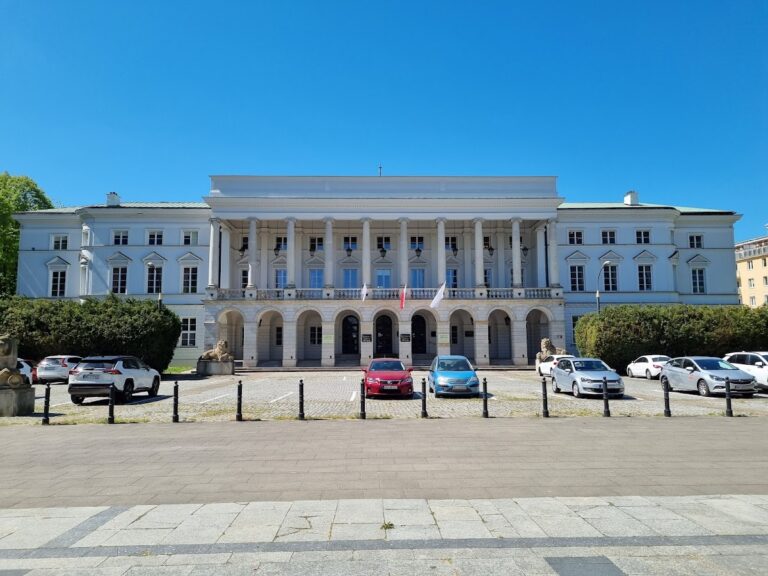
The surviving palace is a three-storey neoclassical building with an 11-axis main elevation. Its rectangular central block projects toward Bank Square in a broad, stepped form, while short two-storey wings flank the main body. A continuous two-storey arcade or colonnade links the sections facing the square and encloses the courtyard. Large terraces are a defining feature of the building and are described as unusual in Warsaw architecture.
Architectural ensemble
The palace is physically joined to the Palace of the Government Commission of Revenues and Treasury and to the Stock Exchange and Bank of Poland Building. Together, these connected buildings form the architectural ensemble that became Warsaw’s city-hall complex.
Commemorative features
Commemorative plaques
Five commemorative plaques are set between the ground-floor arcades of the façade. One recalls meetings of the Polish Jacobin Club, a radical political group active during the Kościuszko Uprising of 1794, held at the earlier Ogiński residence. The other plaques commemorate Antonio Corazzi, Franciszek Ksawery Drucki-Lubecki, Eugeniusz Kwiatkowski, and Piotr Michałowski. They were unveiled in 1952, 1977, 2000, and 2011, while the unveiling date of the Drucki-Lubecki plaque is not given.
Monument to Juliusz Słowacki
The monument to Juliusz Słowacki stands in front of or near the palace. Edward Wittig designed it in 1932, and it was unveiled in 2001.