Reales Estudios de San Isidro: A Royal Educational Institution in Madrid
Site at a Glance
- Popularity
- Medium
- Country
- Spain
- Primary era
- Early Modern
- Eras represented
- Early Modern, Modern
- Civilizations
- Crown of Castile, Habsburg, Habsburg Spain, Spanish
- Site type
- Civic
- Remains
- School
On this page10 sections
History
Foundation and Jesuit expansion
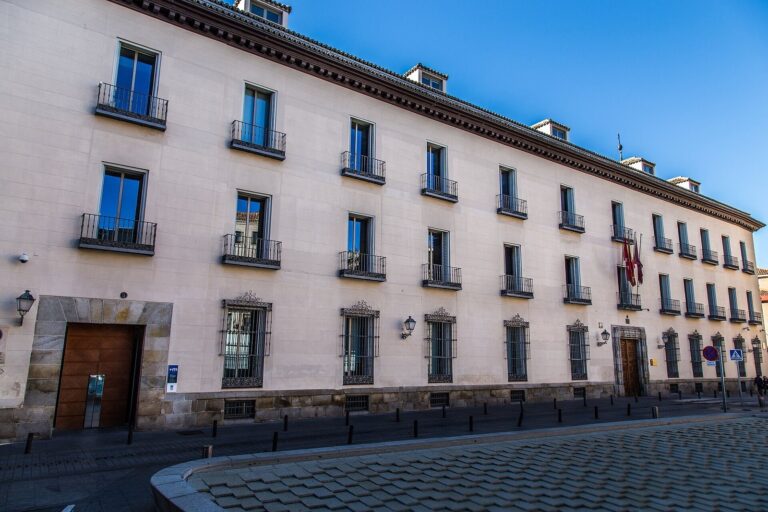
The Reales Estudios de San Isidro is an educational institution in Madrid, Spain, with roots in a school directed from 1569 by the Society of Jesus, a Catholic religious order whose members are known as Jesuits. Efforts to establish the order in Madrid accompanied Philip II’s plans to move his court and government to the city. From 1557, Leonor de Mascareñas, a Portuguese noblewoman and royal governess, pursued a foundation. Philip II opposed a site near the Alcázar, so she asked Captain Alonso Hernández to find another location. In May 1560, he arranged the purchase of a house for her in the parish of San Justo, behind the Concepción Jerónima monastery, on the street later called Calle de la Colegiata.
The Casa de los Estudios began teaching in 1569 under Jesuit direction, with support from Madrid. It eventually offered free lessons in Latin and rhetoric. From 1590, the Jesuits used a substantial endowment from Empress María de Austria, provided for in her wills of 1581 and 1594, to acquire more houses and gardens. These purchases were intended to support an Imperial College and a new adjoining church, forming an educational complex for the nobility in keeping with Philip IV’s wishes.
The first church was demolished in 1603. Under María de Austria’s patronage and bequest, a collegiate church, served by a community of clergy, was promoted, and the Imperial College began operating.
Imperial College and Royal Studies
In 1625, Philip IV sponsored further work and gave the institution the titles Imperial College of the Society of Jesus and College of Saints Peter and Paul of the Society of Jesus at Court. Managed by the Jesuits, it brought together teaching associated with earlier establishments, including the old Estudio de la Villa and the Academy of Mathematics founded by Philip II. Its subjects included theology, philosophy, learned languages, geography, and sciences. The college offered higher studies but could not award official degrees amid pressure from the universities of Salamanca and Alcalá. It may also have been intended to give the capital a prestigious educational centre.
In February 1629, Philip IV and his chief minister, Gaspar de Guzmán, Count-Duke of Olivares, opened the academic year at the Imperial College’s Royal Studies. The project aimed to educate the monarchy’s elite, but construction delays and low student numbers hindered its development. In 1752, Ferdinand VI promoted a new classroom for mathematics.
Reopening and changing institutions
The Jesuits’ expulsion in 1767 brought the Royal Studies to a close. Charles III reopened them in 1770 as the Reales Estudios de San Isidro. On 21 October 1771, fifteen professorships were inaugurated, with appointments made by competitive examination rather than under the arrangements used during Jesuit rule. The director was Manuel de Villafaña, a minister of the Council of Castile, a major royal advisory and administrative body.
After the expulsion, the library became public, staffed by two librarians and their assistants. It had been among Madrid’s most important libraries until the eighteenth century; its holdings were later transferred to the Complutense University of Madrid and the Royal Academy of History. In 1767, the adjoining church became a collegiate church dedicated to Saint Isidore. The remains of the city’s patron saint and his wife, María de la Cabeza, were placed there.
In 1815, Ferdinand VII returned the institution and its building to the Jesuits. They were present from 1816 to 1820 and again from 1823 to 1834, after their departure during the Liberal Triennium, a period of liberal constitutional government in Spain from 1820 to 1823. In 1835, following the disentailment associated with Juan Álvarez Mendizábal, which involved the state’s confiscation and sale of church and other corporate property, the Reales Estudios became a secular institution called the Estudios Nacionales.
University, secondary education, and later use
In 1845, the institution was renamed the Literary University of Madrid. The Pidal Plan, an education reform implemented in 1844–45, also transformed the former Reales Estudios into the Institute of Secondary Education “San Isidro.” The building additionally housed the Central University’s Faculty of Philosophy and Letters library, the Diplomatic School from 1856, and a school of shorthand from 1860.
After the university moved to a building on Calle de San Bernardo in 1876, architect Francisco Jareño y Alarcón began renovating and enlarging the site. The building was subsequently used for a time by the former School of Architecture, previously under the Royal Academy of San Fernando, and by Madrid’s School of Arts and Crafts, which remained at the address.
During the Civil War, classes stopped and the building served as an air-raid shelter, while a school for militiamen’s children continued to operate. The Institute itself was not damaged, unlike the adjoining collegiate church.
Remains
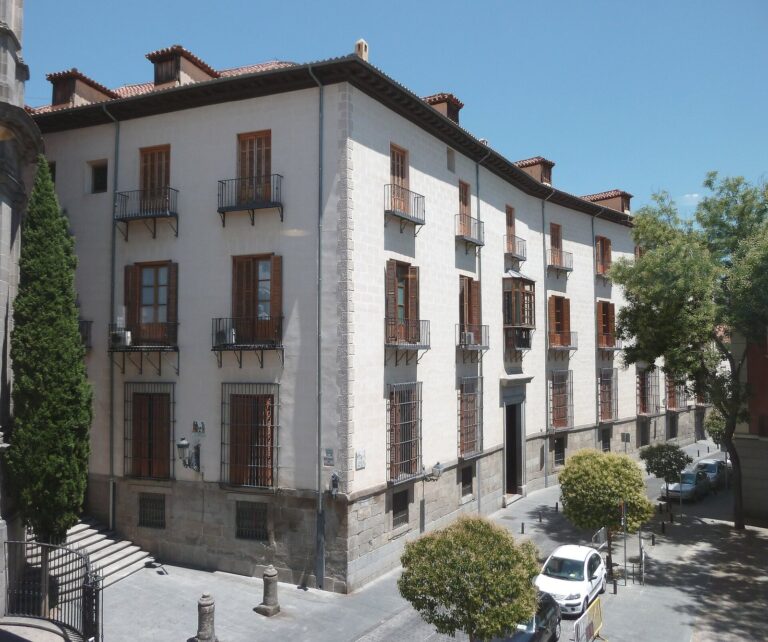
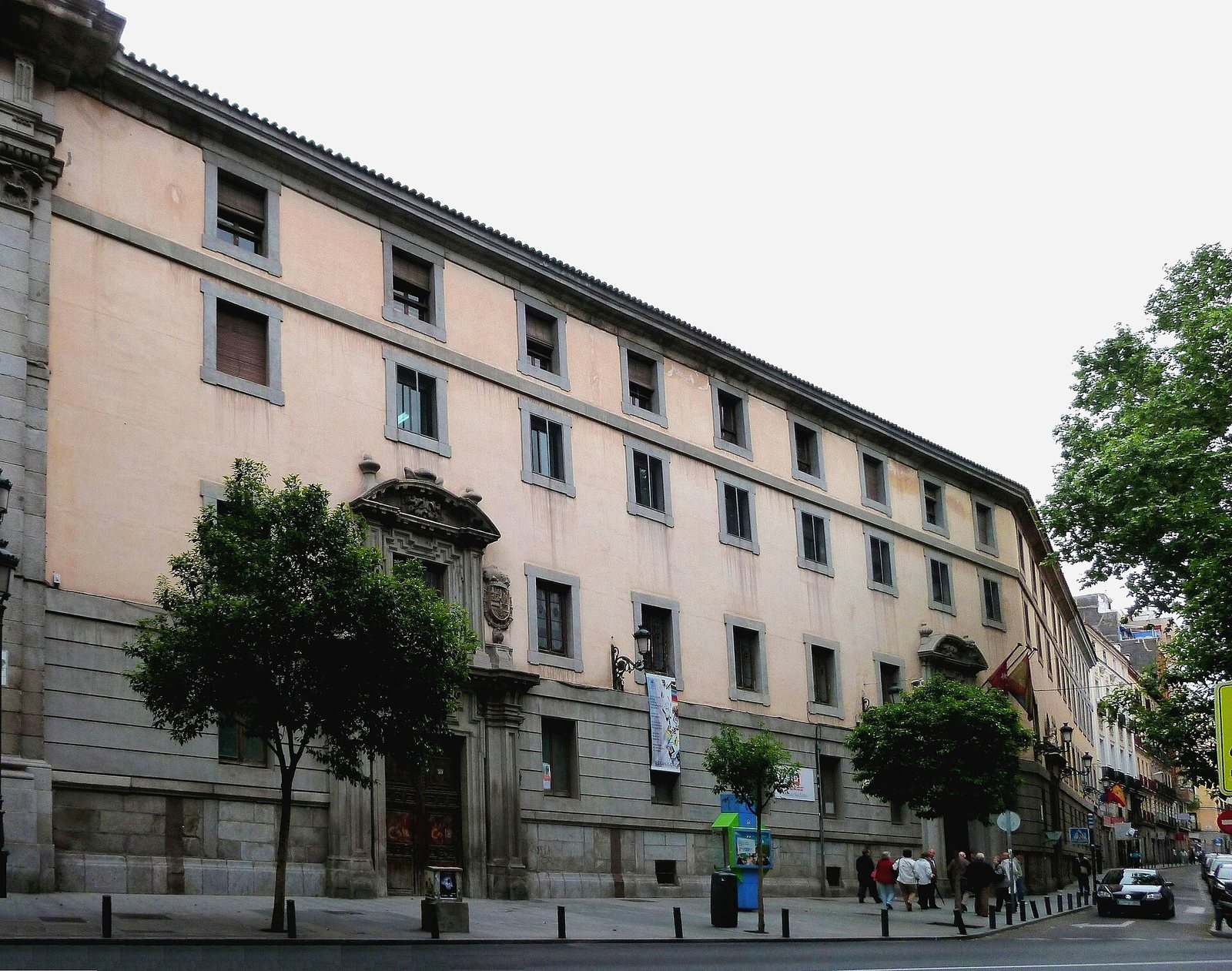
The complex occupied block 143 of old Madrid, at the junction of Calle de Toledo and Calle de los Estudios, and the site is now occupied by the Instituto San Isidro. Its expansion took in properties on Calle de la Merced and Calle de Toledo, as well as along the road from Plaza Mayor to the Matadero, later called Calle de San Dámaso or Calle de los Estudios.
Educational buildings
The Casa de los Estudios, or House of Studies, included a building known as the Cuarto Viejo. Jesuit master builder Juan García constructed it between 1578 and 1581 as the order’s original convent residence. The teaching facilities also included a new mathematics classroom promoted by Ferdinand VI in 1752.
Churches
First church
The first church was built on land occupied by houses purchased on 24 December 1563. It was completed in early 1567 and consecrated on 25 January under the dedication of Saints Peter and Paul. It was demolished in 1603.
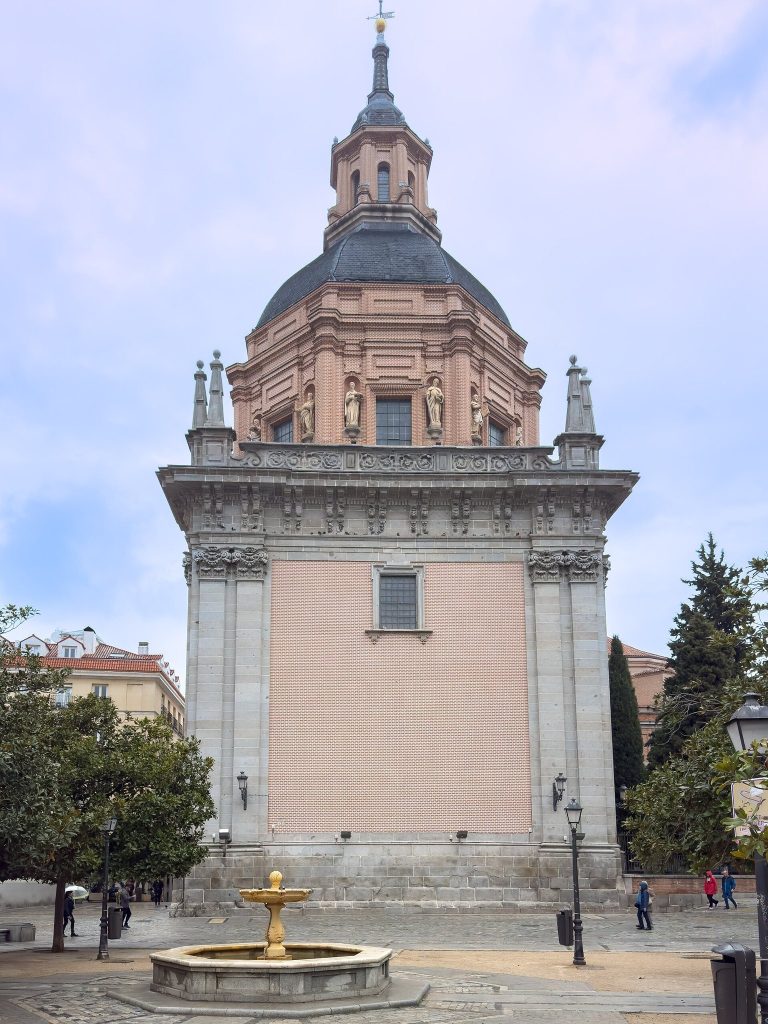
Collegiate Church of San Isidro
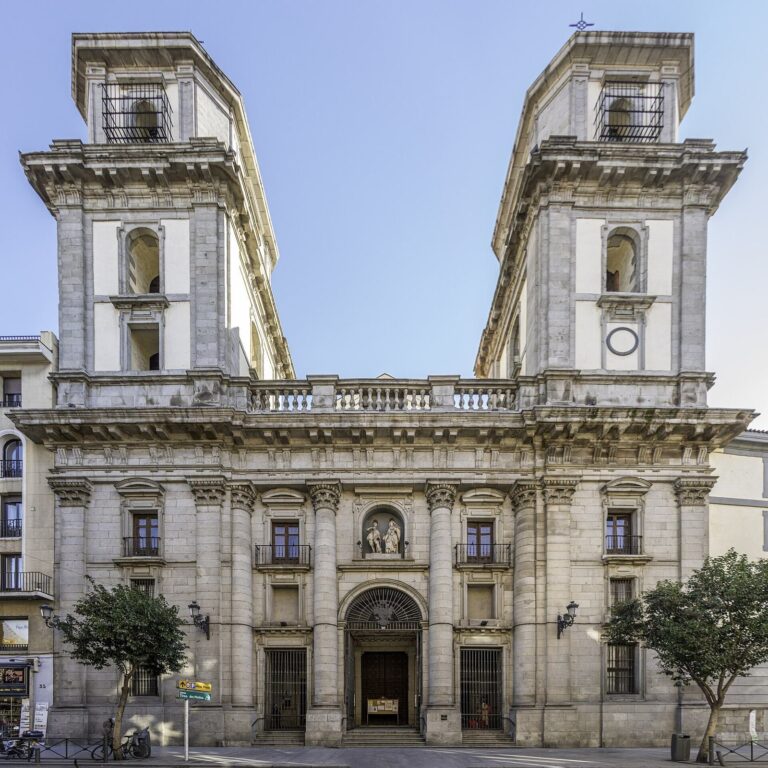
The adjoining church, with its façade on Calle de Toledo, was built between 1622 and 1664 by architects Pedro Sánchez and Francisco Bautista. It was consecrated on 23 September 1651 under the dedication of Saint Francis Xavier and is now the Collegiate Church of San Isidro.