Ragnhildsholmen: A Medieval Norwegian Fortress in Sweden


Site at a Glance
- Rating
- 4.2
- Popularity
- Low
- Country
- Sweden
- Primary era
- Medieval
- External website
- Open
- Eras represented
- Medieval
- Civilizations
- Norwegian, Swedish
- Site type
- Military
- Remains
- Castle
On this page11 sections
History
Ragnhildsholmen is a medieval Norwegian fortress site on an islet in the Nordre älv in Sweden, opposite the former town of Kungahälla near Kungälv. King Håkon IV Håkonsson built the stone fortress in the thirteenth century, and it is first mentioned in 1257. Icelandic annals place its construction before that date. It became the most important Norwegian stronghold in the area and was among the earliest fortifications in the Nordic region to use brick.
Royal fortress and refuge
Ragnhildsholmen also served as a prison. In 1302, the former chancellor Bjarne Lodinsson was held there. The fortress repeatedly offered shelter to nobles caught in political conflicts. In 1275, the Swedish King Valdemar Birgersson, Queen Sofia Eriksdatter, and their son Erik took refuge at Ragnhildsholmen until the following year. Norwegian King Magnus VI then called out the naval levy and travelled through Ragnhildsholmen and up the Göta älv in an effort to reconcile Magnus Ladulås and Valdemar.
From 1287, Danish nobles outlawed after the conflict surrounding Count Jakob of Halland used the fortress as a base for raids against Denmark. They later established themselves at Hjelm and Hunehals, while Ragnhildsholmen remained part of the region’s wider political and military struggles.
The fief of Duke Erik
In 1304, the Swedish Duke Erik received Ragnhildsholmen, Kungahälla, and the surrounding territory as a fief from the Norwegian King Håkon V. The transfer formed part of Erik’s alliance with Norway and his support for Håkon’s conflict with Erik’s brother, King Birger of Sweden. The alliance was reinforced by Erik’s engagement to Håkon’s daughter, Ingeborg.
The relationship between Duke Erik and Håkon V later deteriorated. Håkon tried to recapture Ragnhildsholmen in 1308 but failed. He then established Bohus Fortress about four kilometres upstream, partly to lessen Ragnhildsholmen’s importance. In 1309, Erik’s Norwegian castellan, Tord “Unge” Torleivsson, surrendered the fortress to Håkon. When the river froze during the winter of 1309–10, however, he was forced to surrender it back to Duke Erik. Under the Peace of Oslo, Erik returned the fortress to Norway after several years, probably before 1315 and possibly as early as 1312.
Destruction and archaeological investigation
Shortly after its return to Norway, the fortress was probably destroyed by fire. Most of its walls were dismantled, and their stone was reused at Bohus Fortress. Its active use lasted roughly sixty years, or in any case less than a century.
Archaeologist and bureau chief Wilhelm Berg excavated and investigated the ruins in 1881–82, paying for the work privately. The site was quarried again in the years that followed, and its condition rapidly deteriorated. Before 1891, its best-preserved sections, including areas containing the greatest quantity of dressed stone, had been destroyed. Some stone was used to build cattle-quarantine stables on the island. Restoration of the walls was decided upon in 1930, and some sections were raised during the work. Ragnhildsholmen is listed in Sweden’s national archaeological heritage register as a medieval castle site.
Names and traditions
An older form of the island’s name was Ragnildarholm. In several manuscripts of the early sixteenth-century Rimkrönikan, the fortress is called Nyklaborg, probably a corruption of Miklaborg, meaning “the great fortress.” The name Ragnhildsholmen is traditionally connected with Ragnhild Jonsdotter, who was married to the Norwegian nobleman Skule Bårdsson and was the mother-in-law of King Håkon IV.
Remains
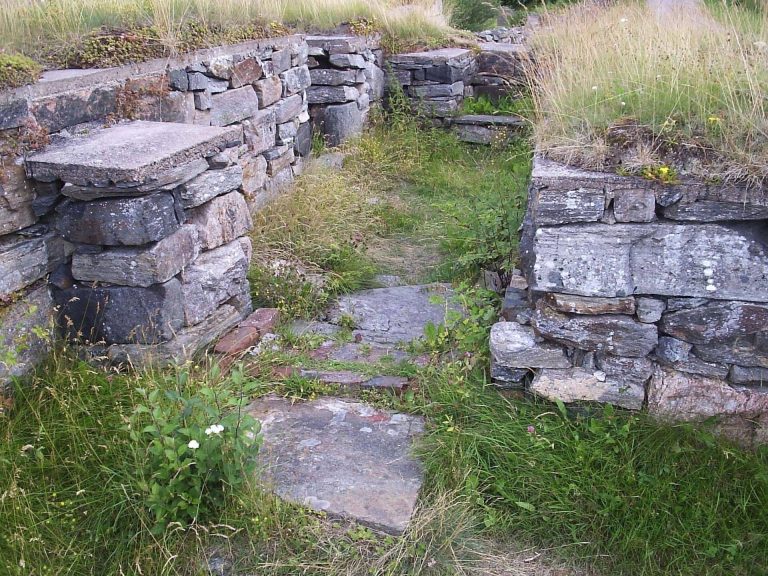
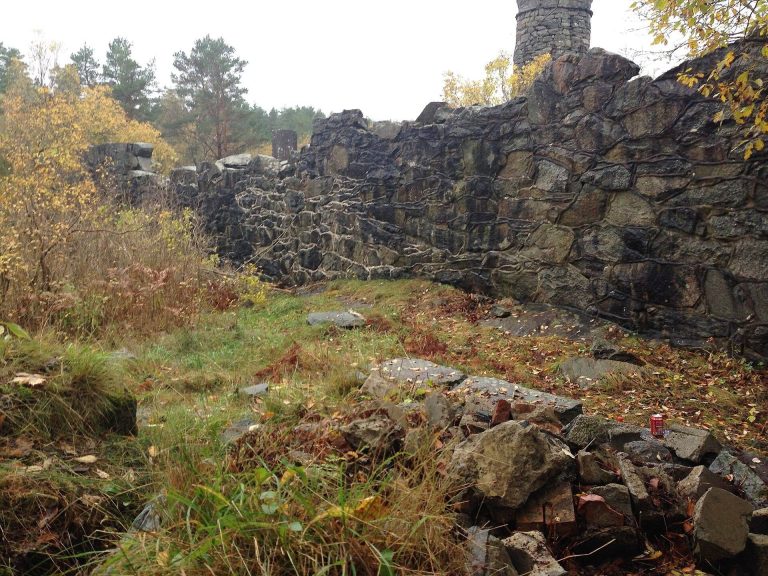
The fortress occupied an approximately rectangular enclosure measuring about 36 by 40 metres and covering roughly 1,500 square metres. A continuous ring wall enclosed the courtyard, with buildings for provisions and accommodation arranged against its inner side. Ramparts and ditches enclosed the wider fortification, while the surviving remains stand on a rocky islet on the southern side of the Nordre älv. The river’s main channel lies to the north, and marshland and wetland currently connect the island with Hisingen to the south.
Walls, gates, and defenses
Ring wall and gates
The ring wall was 2.65 metres thick. The main gate on the northwest side and the sally port on the southwest side were blocked up. A sally port was a secondary exit that allowed defenders to leave or launch attacks without using the principal entrance.
Southeast outwork
A substantial defensive outwork protected the gate on the southeast side. An outwork was an additional defensive structure positioned outside the principal fortification. Wilhelm Berg interpreted the southeast gate opening and its outwork as belonging to a later construction phase. These extensions have been attributed to Duke Erik, although they may have been built earlier.
Main tower
On the northeast exterior of the ring wall stood a substantial, approximately rectangular main tower measuring 18 by 11 metres. Its walls, like those of the ring wall, were 2.65 metres thick. The principal surviving brick wall inside the fortress was built in 1931 from medieval bricks.
Archaeological finds and surviving setting
Excavations recovered many coins, weapons, clothing fittings, household objects, implements, and tools. Together with the surviving walls, these finds provide material evidence for the fortress’s use and activity. The rocky islet, river channels, and surrounding marshland remain part of the physical setting of the ruins. The island is also a breeding site for nightingales, grasshopper warblers, and western marsh harriers.