New Elfsborg Fortress: Sweden’s Sea Fortress at Gothenburg


Site at a Glance
- Rating
- 4.3
- Popularity
- Low
- Country
- Sweden
- Primary era
- Early Modern
- External website
- Open
- Eras represented
- Early Modern
- Civilizations
- Swedish
- Site type
- Military
- Remains
- Fort
On this page13 sections
History
New Elfsborg Fortress is a Swedish sea fortress near Gothenburg, Sweden, constructed by the Swedish state between 1653 and 1677 to protect the city and Sweden’s access to the North Sea and Atlantic through the mouth of the Göta River. Built on Kyrkogårdsholmen, it replaced the more vulnerable medieval Old Älvsborg fortress and became a major part of Gothenburg’s coastal defences.
Origins and construction
Old Älvsborg had been captured relatively easily by Denmark during the Northern Seven Years’ War and the Kalmar War. The idea of replacing it with a modern fortress on Kyrkogårdsholmen was revived after the Danish admiral Ove Gjedde attacked Gothenburg with 20 ships in May 1645. A Dutch squadron serving Sweden, commanded by Martin Thyssens, defended the city. Thyssens was later ennobled as Lord Anckarhjelm.
Artillery was placed temporarily on Kyrkogårdsholmen in 1645, and permanent fortification work was under way by 1647. The Swedish government, led by Axel Oxenstierna, a prominent seventeenth-century statesman and chancellor, approved the plans in 1653. The fortress is generally dated to 1653–1677, although initial works were completed by 1651 and several elements remained unfinished until the late 1670s.
When war with Denmark-Norway began in 1657, the incomplete fortress was placed in service with guns transferred from Old Älvsborg. Fighting did not reach the Göta River during that conflict. The Treaty of Roskilde then transferred Bohuslän and Halland to Sweden, reducing the fortress’s exposure to attack from Denmark-Norway.
Transfer from Old Älvsborg
Sweden decided to decommission Old Älvsborg in 1660. Equipment and building materials were moved to New Elfsborg, including the bells and pulpit from the old fortress chapel. After the older fortifications were demolished in 1661, the newer complex formally took the name New Elfsborg.
The Scanian War
New Elfsborg first experienced major action during the Scanian War, a conflict in which Denmark-Norway attempted to recover territories gained by Sweden. On 16 July 1676, Danish admiral Marquard Rodsten attacked Gothenburg with six warships, but cannon fire from the fortress drove him away.
Rodsten’s flotilla later blockaded Gothenburg from the archipelago. The 42-gun ship København ran aground near Grötö and was scuttled. The shoal became known as the Copenhagen Shoal. New Elfsborg’s fortifications were officially completed in 1677.
The Great Northern War
The fortress was drawn into naval operations during the Great Northern War, a conflict involving Sweden, Denmark-Norway, and their allies. From 1716 to 1719, the Norwegian commander Peter Tordenskjold tried to disrupt the Swedish naval transport supporting King Charles XII’s invasions of Norway.
On 2 May 1717, Tordenskjold’s squadron passed New Elfsborg and attacked the Swedish fleet in Gothenburg harbour. The assault failed, and the retreating ships came under fire from the fortress. A larger attack followed between 20 and 24 July 1719, when Tordenskjold deployed seven ships of the line, two frigates, four galleys, three floating batteries, and four troop-transport barges.
The garrison numbered about 360 men. It included two companies of the Älvsborg Regiment, one company of the Saxon Infantry Regiment, and the artillery detachment. Commander Johan Abraham Lillie refused to surrender. Danish-Norwegian forces bombarded the fortress for three continuous days from floating batteries and positions on the Aspholmar islands.
Swedish forces commanded by General Georg Bogislaus Staël von Holstein established a counter-battery on the northern shore of the Älvsborg fjord. Three Swedish galleys from Nya Varvet attacked the batteries on the Aspholmar islands and captured four mortars, 60 bombs, and three barrels of gunpowder. The attackers withdrew. Swedish losses were 30 dead and 70 wounded, including Lillie, while Danish-Norwegian losses were 60 dead and 73 wounded.
Later military use and decommissioning
The damaged defences were repaired after the 1719 assault, and the garrison was strengthened. Until 1744, while the possibility of another war with Denmark remained, New Elfsborg was regarded as the most combat-ready fortress in the Swedish kingdom.
Its military condition declined during the eighteenth century. The fortress was placed on alert during the Theatre War of 1788–1789, a conflict between Sweden and Denmark-Norway, but saw no action. When King Gustav IV Adolf inspected it in February 1801 during fears of a British attack, he found the defences in disrepair. Strong shelters for soldiers had been built between 1762 and 1766 to protect them from bombardment, and further reconstruction took place in 1808.
Most of the guns were removed during the 1830s, leaving a few saluting pieces. The fortress consequently lost its active military function and became largely ceremonial. A custom developed in which passing ships gave the garrison commander a small gift, often wine or spirits. The command became a coveted sinecure, meaning a position with status or income and little active duty, and was generally assigned to retired army officers.
The Army Administration decided to decommission New Elfsborg in 1868. The fortress was removed from the list of royal fortresses on 22 April 1869, and the garrison departed permanently on 1 May that year. The Commandant’s House became an inn in 1881. A proposal made in 1878 to rebuild the fortress with steel structures was abandoned.
Protection and restoration
New Elfsborg has been a listed building and protected cultural-heritage complex since 1935. It is owned by Sweden’s National Property Board and has been restored, preserving the surviving fortress complex and its evidence of Sweden’s changing coastal defence system.
Remains
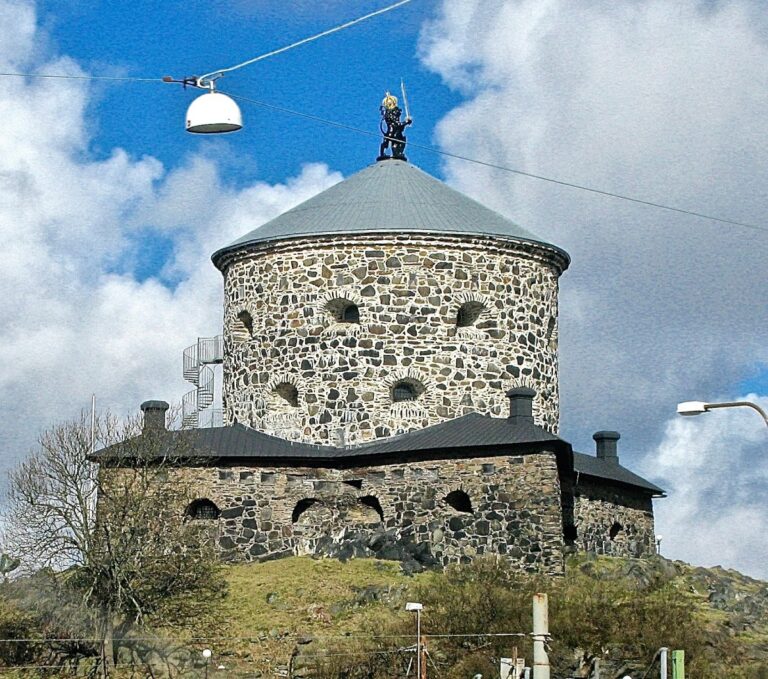
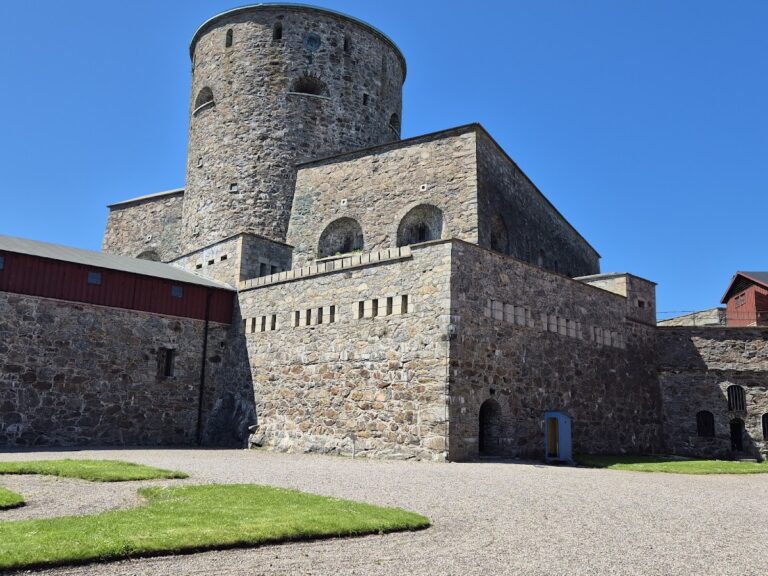
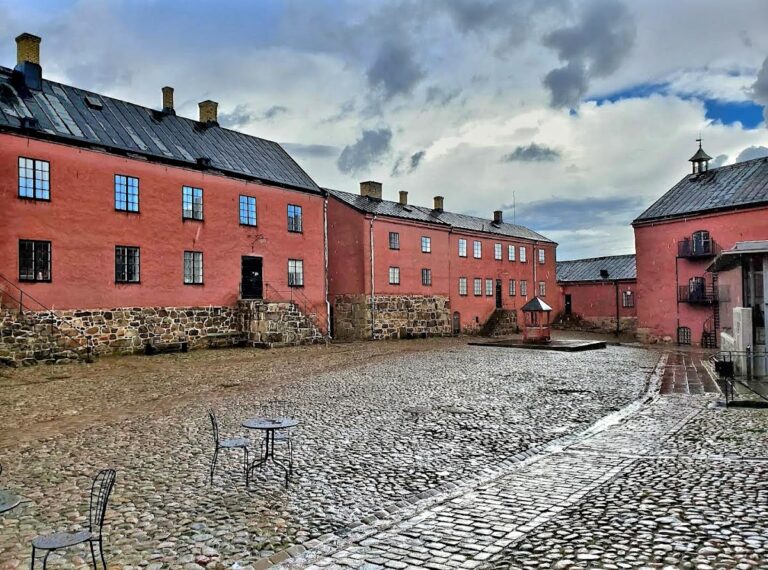
New Elfsborg occupies the small island of Kyrkogårdsholmen at the mouth of the Göta River in the Kattegat, near the northern edge of the entrance to Gothenburg harbour. The sea fortress was built in granite and brick. Its original plan formed a pentagon with projecting bastions, which allowed defenders to fire along the faces of adjoining walls, and hornworks, outer defensive works shaped like horns that protected the fortress from attack.
Fortress walls and outer works
The surviving complex includes walls, bastions, artillery positions, mortars, howitzers, and other defensive works. These elements formed the fortified island position that guarded the river approach to Gothenburg. By 1719, the fortress mounted about 90 artillery pieces of different calibres, giving its walls a substantial defensive role during the Danish-Norwegian assault.
Central tower and artillery positions
A central tower was added in 1686 as part of the fortress’s later development. The artillery positions were linked to the wider defence of the river entrance. During the attack of July 1719, Danish-Norwegian artillery was placed on the Aspholmar islands directly north or northwest of Kyrkogårdsholmen. Thirty-six sixteen-pounder guns stood on Stora Aspholmen, while four heavy mortars were placed on Lilla Aspholmen.
The Swedish counter-battery on the northern shore of the Älvsborg fjord contained four guns and a forty-pound mortar. The position supported the fortress during the bombardment, while Swedish galleys attacked the Aspholmar batteries. The captured mortars, bombs, and gunpowder formed part of the material outcome of that engagement.
Bombardment damage and later alterations
The fortress suffered substantial damage during the three-day bombardment in July 1719. Its defences were repaired after the attack, and protected shelters for soldiers were added between 1762 and 1766. Reconstruction in 1808 further altered the defensive fabric. The removal of most guns during the 1830s changed the character of the surviving works, leaving the fortress with a largely ceremonial military function.
Commandant’s House
The Commandant’s House is a named surviving component of the fortress complex. It was converted into an inn in 1881, after the garrison had left permanently. Its later use forms part of the transition from an active military installation to a protected historic complex.
Chapel furnishings from Old Älvsborg
The bells and pulpit from the chapel of Old Älvsborg were transferred to New Elfsborg after the older fortress was decommissioned in 1660. They connect the later fortress with the earlier defensive site whose equipment and building materials were incorporated into New Elfsborg.
Nearby sites