Eye Castle: A Norman Motte-and-Bailey Castle in Suffolk


Site at a Glance
- Rating
- 4.3
- Popularity
- Low
- Country
- United Kingdom
- Primary era
- Medieval
- External website
- Open
- Eras represented
- Medieval, Early Modern, Modern
- Civilizations
- English, Norman
- Site type
- Military
- Remains
- Castle
On this page12 sections
History
Eye Castle is a Norman motte-and-bailey castle in Eye, England, United Kingdom, built shortly after the Norman Conquest of 1066 during the reign of William I. William Malet, the Norman lord who founded it, made the castle the centre of the Honour of Eye, a substantial group of estates, and controlled the nearby Park of Eye. The castle also became an economic centre, with a market in its bailey. It is one of only two castles recorded in the 1086 Domesday Book as sources of income for their owners. The Domesday Book was William I’s survey of landholding, resources, and obligations in England.
The Malet family and royal control
The Malet family’s authority extended across the estates associated with the Honour of Eye. William Malet died fighting Hereward the Wake in 1071. His son Robert was later exiled and died at the Battle of Tinchebray in 1106. Henry I then confiscated Eye Castle, making it a royal castle for a time. In 1113, Henry granted the castle to his nephew Stephen of Blois.
After Stephen became king in 1135, he granted the Honour of Eye first to his lieutenant William of Ypres and later to his son-in-law Hervey Brito. During the 1140s, he transferred the lands to his second son, William. Because William was still a minor, Stephen’s royal steward, William Martel, initially administered them.
Eye Castle during the Anarchy
These changes took place during the Anarchy, the English civil war between King Stephen and Empress Matilda over the succession to the throne, fought from 1138 to 1154. Fighting affected the region, and Hugh Bigod’s family sought greater autonomy in East Anglia, but Eye Castle played no major part in the conflict because most campaigning occurred farther west.
When Henry II came to power in 1154, he worked to restore royal influence in the region. In 1157 he confiscated Hugh Bigod’s major castles and also took Eye Castle because he viewed Stephen’s son William as a possible claimant to the throne. William died in 1159, allowing Henry to retain the castle and formally secure his control of it.
Rebuilding and decline
Hugh Bigod joined the revolt of Henry II’s sons in 1173 and attacked Eye Castle. The assault failed, but the castle had to be rebuilt afterwards. Its defence was organized through the castle-guard system, which granted local lands to minor lords in return for knights and soldiers to defend the castle.
Eye Castle was attacked and sacked during the Second Barons’ War in 1265. It was subsequently largely abandoned and was mostly ruinous by the fourteenth century. Parts of the site continued to be maintained and used as a prison. Estates once connected to the castle-guard system continued for many years to pay dues to the castle’s owners, although these obligations had been converted into monetary rents.
Later uses and protection
A windmill was built on the motte between 1561 and 1562. In the early seventeenth century, the Park of Eye was divided into fields as part of a wider process affecting medieval parks in Suffolk. During the 1830s, a workhouse and a school were built within the bailey.
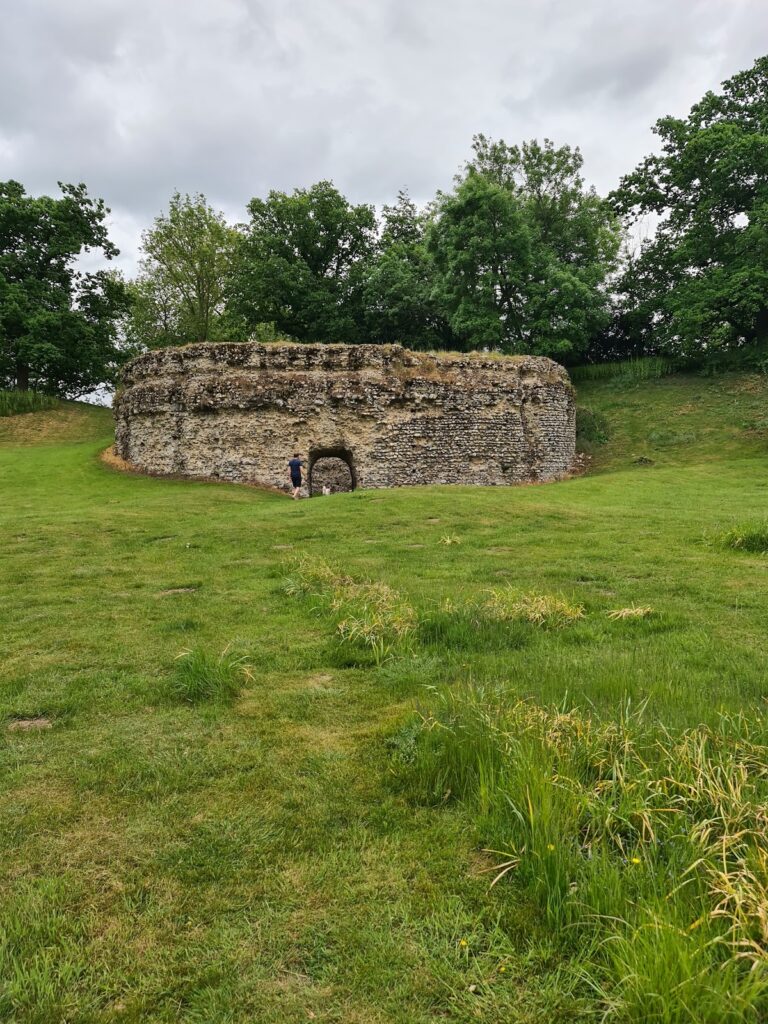
In 1844, Sir Edward Kerrison, then the owner, demolished a later windmill on the motte and commissioned a stone dwelling there for a military attendant who had saved Kerrison’s life at the Battle of Waterloo in 1815. High winds damaged the Victorian dwelling in 1965, and it collapsed further later that year. It subsequently became known as Kerrison’s Folly. Eye Castle is a Scheduled Monument and a Grade I listed building. The historic title of Constable of the Castle belonged to the Lord of the Manor of Eye Sokemere and is held by the Palmer family of Haughley.
Remains
Eye Castle survives as a motte and bailey with a later Victorian addition. This form combines a raised earthwork mound, or motte, with an enclosed courtyard, or bailey. The motte is approximately 49 metres in diameter and 12 metres high, while the bailey measures about 122 by 76 metres. The original earthwork mound and some stone fragments of the medieval castle remain, and the site as a whole is recorded as ruined.
Medieval earthworks and castle buildings
The motte
The motte is the surviving raised earthwork of the original castle. Its substantial circular mound preserves the principal elevated element of the Norman stronghold. Later construction altered its use, but the mound itself remains intact, together with fragments of medieval stonework.
The bailey and medieval towers
The bailey formed the enclosed courtyard of the castle and measures about 122 by 76 metres. A market occupied this area during the medieval period, providing income for the castle’s owner. Two square towers were built on the northern side of the inner bailey in the late twelfth century, possibly at the same time as the towers at Framlingham Castle. The bailey later contained a workhouse and a school, both built during the 1830s.
Kerrison’s Folly
The Victorian dwelling
The later dwelling on the motte was built in 1844 after Sir Edward Kerrison removed a windmill that had occupied the mound. Constructed from flint, it resembled a shell keep, a stone-walled residential or defensive enclosure built on an existing motte. Living quarters were incorporated into its southern and western walls.
The surviving ruin
High winds damaged the dwelling in 1965, and it collapsed further later that year. The structure is now ruinous and is sometimes called Kerrison’s Folly. Together with the surviving mound and medieval stone fragments, it forms the later physical layer of a castle site that had already passed from medieval stronghold to ruin.