Carlsten Fortress: Sweden’s Historic Fortress on Marstrandsö Island


Site at a Glance
- Rating
- 4.5
- Popularity
- Medium
- Country
- Sweden
- Primary era
- Early Modern
- External website
- Open
- Eras represented
- Early Modern, Modern
- Civilizations
- Swedish
- Site type
- Military
- Remains
- Fort
On this page10 sections
History
Carlsten Fortress is a Swedish fortress on Marstrandsö Island in Sweden, above the town of Marstrand. King Carl X Gustav ordered its construction after Bohuslän passed from Denmark to Sweden in 1658, because Marstrand’s ice-free harbor supported the Swedish west-coast trading fleet. The fortress developed through repeated wars, rebuilding, and changes in military technology before becoming a listed historic building complex.
Origins and the fortress of Carlsten
In 1658, engineer Johan Wärnschöld prepared a plan to fortify Marstrandsö. A temporary wooden fort called Valen Fort was quickly erected on the mountain above the town, near a large windmill. It helped repel a Norwegian attack in 1659 and provided the first defensive position on the summit.
The wooden fort was replaced by a more permanent work in 1666. This structure was a rhombus-shaped redoubt, an enclosed defensive work, with four small ravelins, or outer triangular fortifications protecting the approach. Between 1671 and 1673, its tower was enlarged into a square, single-storey structure named Carlsten. Equipped with an artillery battery, the tower became the core of the later fortress.
Danish capture and major rebuilding
During the Danish-Swedish War of 1675 to 1679, Danish forces captured the fortress on 23 July 1677. The town had been besieged for three weeks by approximately 2,000 soldiers and 100 guns led by Ulrik Gyldenløve, the Danish governor of Norway. Carlsten capitulated after the siege, placing the Swedish stronghold under Danish control.
Major expansion and rebuilding began in 1681. Commandant Karl Gustav Frölich prepared the plans for the large tower, while engineer Erik Dahlberg designed the wider fortress. The new round tower rose several storeys and enclosed the earlier square tower. The fortress was nearly complete by 1689, although caponiers, covered defensive works projecting into a ditch, outer fortifications, and residential quarters were added later.
The attack of 1719 and later defenses
On 10 July 1719, during the Great Northern War, a conflict fought from 1700 to 1721 between Sweden and a coalition led mainly by Russia, a Danish fleet commanded by Admiral Peter Tordenskiold attacked Marstrand. After taking the town, Tordenskiold spread a rumor that substantial reinforcements were approaching. Commandant Henrich Danckwardt capitulated on 15 July. Sweden recovered Carlsten after the peace of 1720, and the limited wartime damage was repaired.
The fortress received further defensive improvements during the eighteenth and nineteenth centuries. Battery works were installed on the roofs of the residential quarters in 1770. In 1779, the tower was modified so that it could also serve as a lighthouse, and work carried out between 1780 and 1783 restored the fortress to full defensive readiness. A reinforcement plan adopted in 1834 and expanded in 1840 kept work underway until 1851.
Prison and military decline
Carlsten also operated as a prison for particularly dangerous criminals and political prisoners. Convicts from across Sweden were assigned to hard labor known as Marstrand work, a punishment that could last from several years to life imprisonment. Those sentenced included people convicted of murder, robbery, forgery, and violent offenses, as well as lesser offenders such as thieves and vagrants.
Prison discipline was severe. Escape attempts were controlled by attaching a two-kilogram iron ball to a prisoner’s ankle. Particularly unruly prisoners or those suspected of planning escape could be made to wear an iron crown, an iron vest weighing up to 36 kilograms. Hard labor and poor living conditions caused high mortality, with as many as 20 percent of prisoners dying in some winters.
The best-known prisoner was the thief Lasse-Maja, who received a life sentence of Marstrand work in 1813. His cooking skills allowed him to become a prison cook. King Karl XIV Johan pardoned him in 1839, after he had spent 26 years in the fortress. The Marstrand work system was abolished in 1854, and most remaining prisoners were transferred to Gothenburg in 1855. The government did not want dangerous convicts held at a strategically important defensive site while complications connected with the Crimean War, a conflict involving Russia and an alliance including Britain, France, and the Ottoman Empire, were possible.
Carlsten’s lighthouse function was replaced by the Pater Noster light, a lighthouse and light station in the Marstrand coastal area, in 1868. As sailing shipping declined and war with Denmark became less likely, the fortress lost military importance. In 1878, the Fortification Committee proposed moving its garrison, including two fortress-artillery batteries of the Göta Artillery Regiment, to Vaxholm and Karlsborg. The garrison left on 1 May 1882, and the armament was transferred to Karlsborg.
Reuse and protection
The fortress continued to be maintained after the garrison’s departure. Part of it was assigned in autumn 1906 to the Marstrand school for naval boys, which was organized from 1907. The school used Carlsten until it was dissolved in 1937.
Although it no longer functioned as a regular military fortress, Carlsten was reoccupied during both World Wars and equipped, among other things, with anti-aircraft guns. A small Swedish army unit remained during the Cold War to monitor the airspace, and the military finally left in 1991. The fortress was placed under state protection as a listed historic building complex in 1935 and is held by Sweden’s National Property Board.
Remains
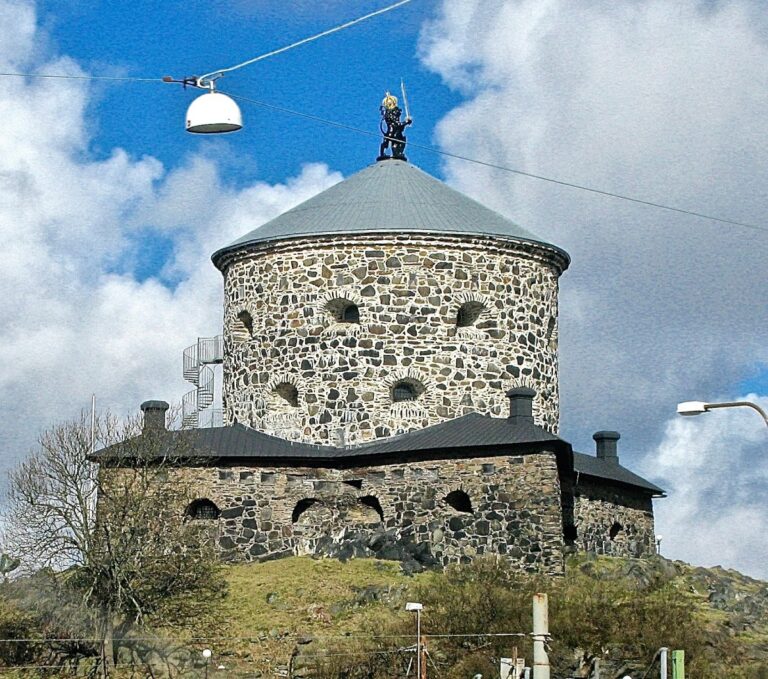
Carlsten occupies the summit of Marstrandsö Island above Marstrand. Its surviving form combines the early square tower with the later large round tower, a moat, outer defensive works, residential quarters, and later additions. Building stone was partly transported to the island by ship because Marstrandsö did not provide enough material. The blocks then had to be carried by hand up to the summit.
The towers and lighthouse
The large round tower, built during the rebuilding that began in 1681, encloses the earlier square tower constructed between 1671 and 1673. Several storeys high, it forms the central mass of the citadel. The earlier tower was equipped with artillery and gave the later fortress its name. In 1779, the tower was altered to accommodate a lighthouse, a function that continued until the Pater Noster light replaced it in 1868.
Defensive works and quarters
The 1666 redoubt established the fortress’s early enclosed plan. Four small ravelins protected its approaches, while the later fortress included a moat and outer defensive works constructed beyond the main enclosure. Caponiers, covered defensive works projecting into the ditch, were added during the later development of the fortress. Residential quarters formed part of the expanded complex, and battery works were installed on their roofs in 1770.
The fortress’s defensive fabric reflects successive periods of construction rather than a single building campaign. The stone blocks brought by ship were assembled on the summit, where the enlarged tower, moat, outer works, and residential buildings formed a connected military complex. A Cold War-era superstructure was later added to the stair tower in the citadel.
Prison spaces
Prison rooms remain associated with Carlsten’s penal use. One chamber is identified with Lasse-Maja, who served his sentence at the fortress from 1813 until his pardon in 1839. These spaces form part of the surviving complex’s connection with the Marstrand work system, which used prisoners for hard labor until its abolition in 1854.