Radom Cathedral: A Neo-Gothic Cathedral in Poland


Site at a Glance
- Rating
- 4.7
- Popularity
- Low
- Country
- Poland
- Primary era
- Modern
- External website
- Open
- Eras represented
- Modern
- Civilizations
- Russian
- Site type
- Religious
- Remains
- Cathedral
On this page9 sections
History
Radom Cathedral is a Roman Catholic church in Radom, Poland, built in the Neo-Gothic style between 1899 and 1918. It is the seat of the Diocese of Radom and serves the parish of the Protection of the Blessed Virgin Mary. The church developed from the need for a larger Catholic place of worship in a rapidly growing city.
The need for a new church
After the Piarist College was suppressed in 1864, Radom’s Catholic population was served mainly by the parish Church of St. John the Baptist and the former Bernardine filial Church of St. Catherine. The Piarists were a Catholic order associated with education, while the Bernardines belonged to the Franciscan tradition. When St. John’s was closed for repairs in 1863 and 1864, St. Catherine’s could accommodate about 1,000 people, which was inadequate for a population of more than 80,000.
In 1873, Józef Juszyński, bishop of the Diocese of Sandomierz, asked the Russian authorities for permission to construct a new church. The architect Antoni Wąsowski prepared two designs at the request of Józef Urbański, the parish priest of St. John’s, but official approval was not granted at that time.
Efforts to secure the necessary funds continued for many years. Zdzisław Szemianowski gave five rubles in 1886, and Józef Urbański appealed for contributions in the Gazeta Radomska in 1890. A Civic Committee was established in 1895 to organize further collections. Urbański pledged 1,000 rubles, and railway workers and other benefactors also contributed. Construction received additional support from an individual donation of 20,000 rubles.
Construction and dedication
In 1896, the Warsaw architect Józef Pius Dziekoński was commissioned to prepare a new design. He drew on his earlier Cathedral Basilica of St. Michael the Archangel and St. Florian the Martyr in Warsaw, while shaping the Radom church according to French Gothic models.
Permission to build was obtained in 1898. Foundation work began in the spring of 1899, and Bishop Antoni Franciszek Sotkiewicz blessed the foundations on 14 September that year. Masonry construction started in 1900. A field Mass was celebrated before the unfinished building in 1906 under the direction of Marian Józef Ryx, who later became bishop of Sandomierz.
The church was dedicated on 22 November 1908 by Piotr Górski, parish priest of St. John’s. The episcopal see was vacant following the death of Bishop Stefan Zawierowicz, so the dedication was performed by the parish priest. By 1911, the church had reached an unfinished shell, yet services were already taking place. Its fittings remained incomplete, with only a small number of pews and stained-glass windows temporarily covered with wooden boards. The principal interior works were completed in 1918.
Wartime experience and religious life
Three bells were hung in the right tower in 1909. The largest was dedicated to Saint Michael, the middle bell to Saint Joseph, and the smallest to Saint Peter. Around the same period, the main nave and transept were plastered and the high altar was installed. Five side altars were consecrated in 1936 by Bishop Paweł Kubicki.
During the Second World War, a parish-owned congress hall was converted into a temporary prisoner-of-war camp. German authorities tried to dismantle and requisition the church bells, but removed only the bell from the roof turret. Devotion to the Virgin Mary as Protectress of the Church also grew during the war, accompanied by prayers for Poland’s liberation from Nazi rule.
On 11 June 1962, Bishop Piotr Gołębiowski consecrated the church under the dedication of the Protection of the Blessed Virgin Mary. In 1984, Bishop Edward Materski celebrated an anti-communist Mass there, linking the church with religious opposition to the communist political order then governing Poland.
Cathedral status and later work
The church became a co-cathedral of the Sandomierz–Radom Diocese in 1981. A co-cathedral is a cathedral sharing a bishop’s or diocese’s seat with another cathedral. On 25 March 1992, it became the cathedral of the newly established Diocese of Radom. The Diocese of Radom is the Roman Catholic territorial jurisdiction whose principal church is this cathedral. The building was entered in the heritage register under number 61/A/81 on 6 June 1981.
Interior work completed in 1989 included new plaster, sgraffito, and polychrome decoration. Sgraffito is made by scratching through one surface layer to expose a contrasting layer beneath, while polychrome means multicolored painted decoration. The altars and furnishings were restored, and part of the roof sheet metal was replaced. Relics of Saint Casimir were brought to Radom on 10 June.
Pope John Paul II visited Radom on 4 June 1991. A plaque in the right nave commemorates his visit to the cathedral, while another plaque in the left nave was consecrated by him outside the co-cathedral. A monument to John Paul II was dedicated before the cathedral on 4 June 2008 by Bishops Zimowski and Materski. A monument to Cardinal Stefan Wyszyński also stands before the entrance.
Remains
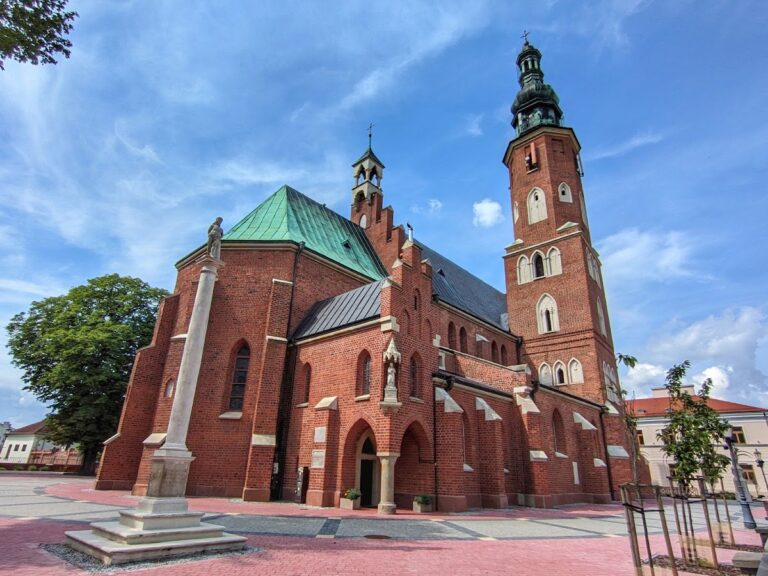
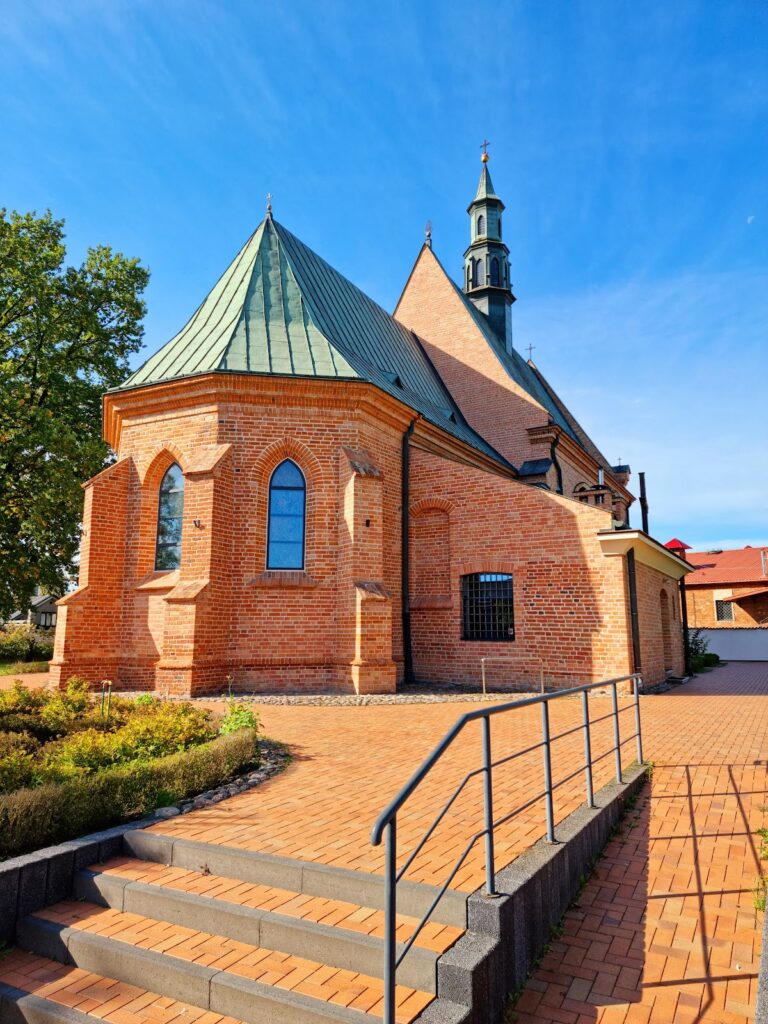
Radom Cathedral is a brick Neo-Gothic church organized as a three-aisled basilica with a transept. A basilica has a taller central nave flanked by lower side aisles, while a transept forms the cross-arm that intersects the church’s main axis. The building’s design combines strong vertical emphasis with an elaborate facade and a system of buttresses and flying buttresses, which are projecting supports that help carry the loads of Gothic walls and roofs.
Exterior and structural form
The facade is dominated by a large rose window and three portals. Its two towers rise to 72 metres and allude to the taller tower of St. Mary’s Church in Kraków. The church also has a roof turret, a small tower projecting from the roof. The east, west, and north elevations, together with the presbytery viewed from the south, form part of the documented architectural structure. The presbytery is the area surrounding the high altar and reserved for the clergy.
Interior arrangement and furnishings
The main nave reaches a height of 21 metres and contains the high altar and the organ case. The church has seven altars, including those dedicated to Saint Joseph, Saint Casimir, the Holy Cross, Our Lady of Częstochowa, Our Lady of Perpetual Help, and the Sacred Heart of Jesus. The eastern nave contains the altar of Our Lady of Perpetual Help, while other recorded furnishings include a pulpit, the altar of Our Lady of Częstochowa, and the altar of Saint Casimir Jagiellon. Saint Casimir Jagiellon was a fifteenth-century Polish-Lithuanian prince and Catholic saint.
The church’s organ was made in 1913 by the firm of Stanisław Jagodziński and has 23 stops. A plaque dedicated to Henryk Sienkiewicz was built into a side altar beside the right nave in 1916. Sienkiewicz was a Polish novelist and Nobel Prize-winning author.
Museum sculpture
The Radom Cathedral Museum preserves a fourteenth-century sculpture of the Madonna and Child. The sculpture originally stood on one of Radom’s city gates, giving the museum object a direct connection with the city’s earlier urban landscape.
Nearby sites