Putna Monastery: A Medieval Moldavian Religious and Cultural Center in Romania


Site at a Glance
- Rating
- 4.8
- Popularity
- Medium
- Country
- Romania
- Primary era
- Medieval
- External website
- Open
- Eras represented
- Medieval, Early Modern, Modern
- Civilizations
- Habsburg, Ottoman, Principality of Moldavia
- Site type
- Religious
- Remains
- Fortified Monastery
On this page16 sections
History
Putna Monastery is a Romanian Orthodox male monastery in Romania, founded under Stephen III of Moldavia, known as Stephen the Great, in 1466. Dedicated to the Dormition of the Mother of God, it follows the Moldavian architectural tradition and developed into a major religious, cultural, and artistic center. Its early community included manuscript copyists, illuminators, embroiderers, sculptors, and other artists, while its scriptorium, library, treasury, and workshops supported the intellectual and devotional life of the monastery.
Foundation under Stephen the Great
Construction began after Stephen’s conquest of the fortress of Chilia. The church was completed in 1469 and consecrated on 3 September of that year by Metropolitan Teoctist. Work on the monastic enclosure, entrance tower, and fortifications continued until 1481. Stephen intended Putna to serve as a royal necropolis, a burial complex for members of a ruling dynasty, and endowed it extensively. By 1503, the monastery possessed 24 villages.
The dynastic purpose was only partly fulfilled, but Putna became the burial place of Stephen the Great, his son and successor Bogdan III, his grandson Ștefăniță, two of Stephen’s wives, and other members of the ruling family. Tradition also connects the foundation with the hermit Daniel, who lived in a nearby cave and is said to have inspired Stephen. Another foundation legend holds that Stephen chose the location by shooting an arrow from a nearby hill. A cross marks the place traditionally identified as the shooting site.
Religious and artistic development
Putna’s early cultural activity included the copying and illumination of manuscripts, meaning the addition of painted decoration and miniature images by hand. Workshops produced embroidery, ceramics, icons, and wooden and stone sculpture. Embroiderers worked with gold and silver thread, silk, and precious stones. An important theological school operated at the monastery in the eighteenth century, extending Putna’s role as a center of Orthodox learning.
Fires, devastation, and rebuilding
A fire destroyed the monastery in 1484, and Stephen initiated a reconstruction that was completed in 1498. Another fire occurred in 1536, while a further fire affected the complex in 1691. In 1653, Cossack forces led by Tymofiy Khmelnytsky looted and devastated the monastery, including its church. Reconstruction began under Prince Vasile Lupu in the same year, continued under Gheorghe Ștefan between 1653 and 1658, and reached completion under Eustratie Dabija in 1662.
An earthquake severely damaged Putna in 1739. Metropolitan Iacob Putneanul directed restoration between 1756 and 1760. During Habsburg rule, the monastic buildings were enlarged, and a new residential building was constructed between 1852 and 1856. The church roof was renewed in 1902 according to plans by the Viennese architect Karl Romstorfer. Further repair and restoration continued during the later twentieth century, with major work extending into 1988. On 15 August 1988, the restored monastery was consecrated again by the patriarch of the Romanian Orthodox Church.
War, national memory, and religious importance
Russian troops devastated the monastery in 1916. On 6 July 1940, Soviet forces attempted to occupy Putna and annex it to the Ukrainian Soviet Socialist Republic, but the Romanian Army repulsed the attack.
During the nineteenth century, and particularly before the establishment of Greater Romania in 1918, Putna became an important symbol of Romanian national consciousness. At celebrations organized in 1871 by the Romanian student association Romania Jună, Mihai Eminescu called the monastery the “Jerusalem of the Romanian people.” The Romanian Orthodox Church canonized Stephen III in 1992 and commemorates him on 2 July. His tomb at Putna has remained a major pilgrimage focus, especially on his feast day. The monastery is listed in Romania’s register of historic monuments under code SV-II-a-A-05595.
Remains
Putna Monastery stands at approximately 700 metres above sea level on the eastern foothills of the Carpathians, in the historical region of Bucovina. A quadrilateral of defensive walls encloses the complex. The Church of the Dormition occupies the center, while the entrance tower, bell tower, treasury, chapel, residential buildings, and museum form additional parts of the enclosed monastic layout.
Church of the Dormition
Plan and interior arrangement
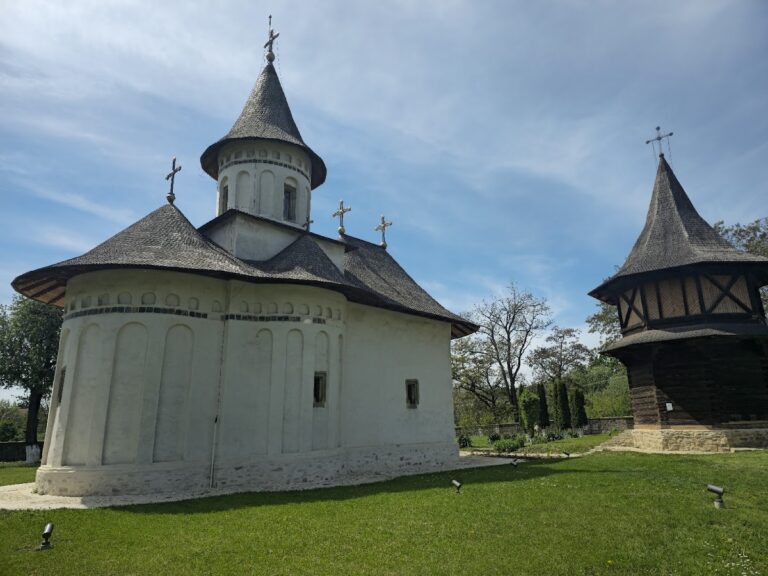
The Church of the Dormition stands freely within the enclosure and has a three-apse plan, with a principal eastern sanctuary apse and two lateral apses. It is approximately 37 metres long, 15 metres wide at the apses, and 33 metres high including the tower. The building consists of a porch, a pronaos or entrance chamber, a burial chamber, a nave, and an altar. Its architectural conception combines Byzantine, Gothic, and Renaissance elements, although major modifications were made between 1653 and 1662.
Two lateral doors in the porch provide entry through stone portals. The substantial doorway leading from the porch into the pronaos bears an inscription referring to the rebuilding carried out under Gheorghe Ștefan and Eustratie Dabija. A two-column arcade separates the burial chamber from the nave. This replaced the partition wall associated with the earlier seventeenth-century Moldavian arrangement.
Burial chamber and dome
The burial chamber contains Stephen the Great’s marble tomb, together with the graves of two of his wives, his son Bogdan, and his grandson Ștefăniță. The nave is covered by a Moldavian dome carried on pendentives, curved transitions that support a dome over a square or polygonal space. A slender lantern tower rises from the center of the dome.
Exterior decoration
The western porch is probably a later addition and has large windows with Gothic stonework. The exterior elevations retain two rows of niches separated by an ornamented stone cord. The tower has twisted columns associated with Wallachian influence. A twisted stone band encircles the exterior and symbolizes the Holy Trinity, and the same motif appears in the interior ornament.
Enclosure and auxiliary buildings
Entrance gate tower
Entry into the enclosure passes beneath the vaulted arch of a two-storey gate tower built in the late 1750s, around 1760. Its eastern facade bears the Moldavian coat of arms dated 1471, while its western facade combines the arms of Moldavia and Wallachia. The tower is known as Eminescu Tower because Mihai Eminescu, Ioan Slavici, and other participants in the August 1871 celebrations spent the night in its upper room. A relief of a bison’s head, taken from the Moldavian arms, is also associated with the tower.
Treasury Tower
The Treasury Tower stands beside the western wall and is the only surviving building from Stephen the Great’s time. Completed in 1481, it sheltered the monastery’s treasures during periods of unrest. An inscription states that Stephen, son of Bogdan, founded and built the monastery dedicated to Mary in 1481, during the abbacy of Ioasaf.
Bell tower and Chapel of Saints Peter and Paul
A separate bell tower stands on the eastern side of the enclosure and was built in 1882. In the western part of the complex, the Chapel of Saints Peter and Paul was built in 1759 by Metropolitan Iacob Putneanul on the site of an older bell tower damaged in the 1739 earthquake. The chapel was restored between 1976 and 1983, when additional spaces were added. The brothers Mihail and Gavril Moroșan painted it in fresco between 1980 and 1984, during the abbacy of Archimandrite Iachint Unciuleac. It serves the resident monastic community.
Princely House
The present Princely House on the southern side of the enclosure was built between 1982 and 1988 on the foundations of an earlier building destroyed under Habsburg rule. Patriarch Teoctist Arăpașu largely initiated and supervised its reconstruction while he was Metropolitan of Moldavia.
Museum and cultural collections
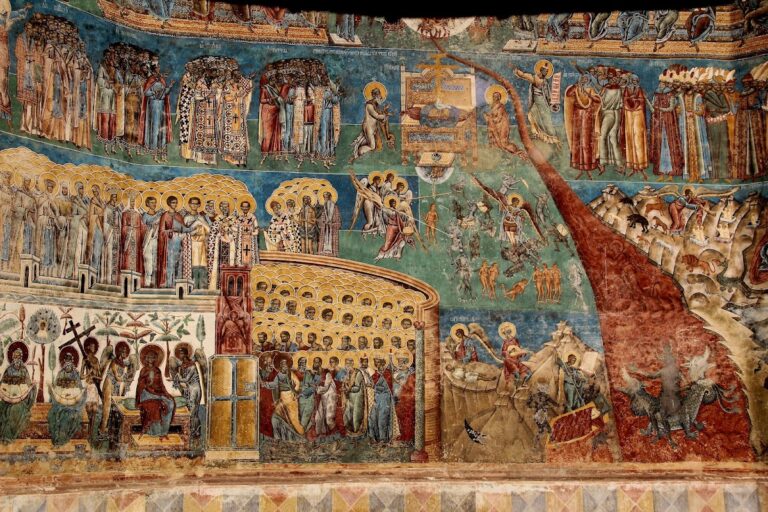
The monastery museum houses embroideries, manuscripts, liturgical objects, icons, vestments, textiles, and works by local artists, embroiderers, and miniaturists. Its collections include a fifteenth-century Gospel book from Humor, a cross traditionally associated with Stephen the Great, a fifteenth-century triptych, examples of goldsmithing, and fifteenth- and sixteenth-century grave and altar coverings. The collections preserve material connected with the manuscript copyists, illuminators, embroiderers, and other religious artists associated with Putna.
A silk burial shroud dated to around 1405 is preserved at Putna. It depicts the dead Christ surrounded by angels and is embroidered with gold and silver thread bearing Greek inscriptions. Its possible attribution to Eufimia, a medieval Serbian nun, poet, and embroiderer associated with important Orthodox liturgical textiles, remains an open scholarly question. The treatment of its figures has stylistic affinities with a curtain from Hilandar and the Mileševa shroud.
Nearby sites