Saint Petka the Old Church: A Medieval Bulgarian Orthodox Church in Sofia


Site at a Glance
- Rating
- 4.8
- Popularity
- Low
- Country
- Bulgaria
- Primary era
- Medieval
- External website
- Open
- Eras represented
- Classical, Medieval, Early Modern, Modern
- Civilizations
- Ottoman, Roman, Second Bulgarian Empire
- Site type
- Religious
- Remains
- Church
On this page9 sections
History
Saint Petka the Old Church is a medieval Bulgarian Orthodox church in Sofia, Bulgaria, built in the thirteenth century during the Second Bulgarian Empire. Construction began in 1241 and was completed in 1257, according to archaeological research, while an inscription inside the church records the beginning of the work. The church belongs to the Bulgarian Orthodox Church and the Sofia Diocese, and stands within the complex of the Sofia Metropolitanate, the residence of the Bulgarian patriarch.
Foundation as a palace church
The church was probably built as a palace church by Sebastokrator Alexander, a high-ranking princely official and the brother of Tsar Ivan Asen II, who governed the Sofia region. The work begun in 1241 may have involved either a complete rebuilding or a new church raised on older foundations. It was connected with the transfer of Saint Paraskeva’s relics to Tarnovo, the capital of the Bulgarian Empire at that time. Some interpretations also allow for an earlier palace church on the site.
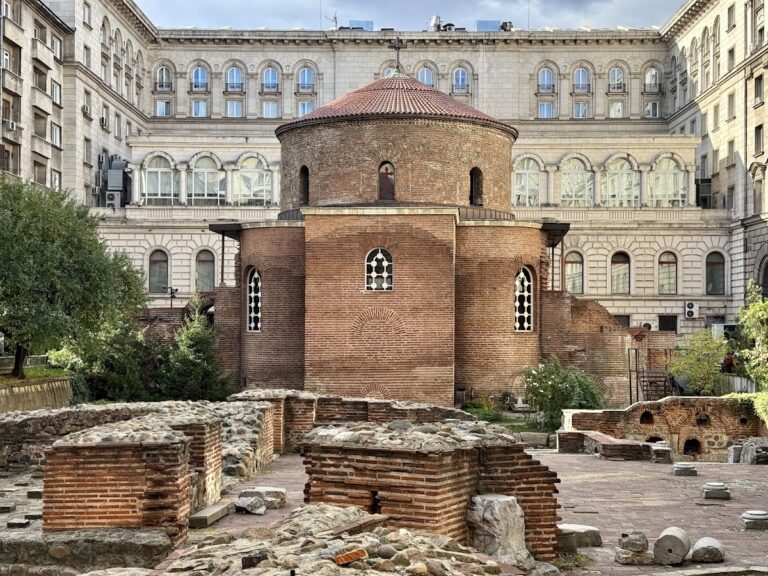
The church’s position is linked to a late-antique palace complex associated with Emperor Constantine I. Remains of that complex have been found beneath nearby buildings. The area has also been considered a possible urban residence of Sebastokrator Alexander around 1240 and of Sebastokrator Kaloyan. The modern direction of Tsar Kaloyan Street follows that of an ancient street that passed through the area.
Ottoman period and later repairs
After Sofia came under Ottoman rule in the late fourteenth century, the church was damaged or destroyed. The date of its restoration is unknown, but the German traveler and Lutheran theologian Stephan Gerlach described it in 1578 as an active metropolitan church called Saint Paraskeva.
Repairs and enlargements took place several times afterward. In 1866, a two-story women’s section was added beside the main church. The building was incorporated into the newly constructed Sofia Metropolitanate between 1928 and 1930, with the historic volume of the interior preserved. By 1934, a revenue-producing building at the corner of Saint Nedelya Square and Saborna Street provided another entrance to the church. A separate four-story metropolitanate library in the southeastern corner of the courtyard was destroyed, together with its books, during an Anglo-American bombardment on 10 January 1944.
Religious life and modern recognition
Saint Petka the Old Church was designated a cultural monument of national significance in 1955 for its archaeological, architectural, construction, and artistic value. It remains an active Bulgarian Orthodox church, holding regular Divine Liturgies. Its patronal feast, dedicated to Saint Petka of Bulgaria, is celebrated on 14 October, and relics associated with the saint are preserved there.
The church also venerates Saint Terapontius of Sofia, a Christian martyr associated with Sofia. His feast is held on 27 May, and the church preserves the wooden block connected with his beheading. Weekly akathist services, devotional hymns or services traditionally performed standing, are dedicated to Saint Mina on Tuesdays, Saint Spyridon of Trimythous on Thursdays, and Saint Petka of Bulgaria on Fridays. A youth Orthodox center operates in connection with the church.
A study by the Bulgarian archaeologist Dimitar Ovcharov and Petar Valev argues that the revolutionary Vasil Levski was buried in the church. Levski was a leading nineteenth-century Bulgarian revolutionary in the struggle against Ottoman rule. Their interpretation rejects claims that his burial took place in the neighboring churches of Saint Petka Samardzhiyska or Saint Nicholas.
Remains
Medieval structure and later additions
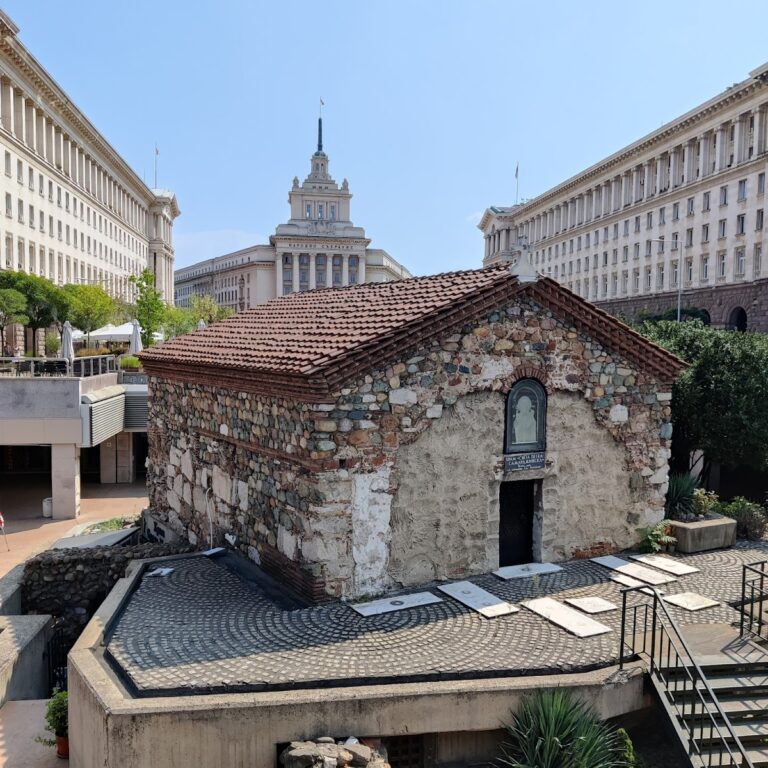
The church is a small, single-nave, single-apse building with one altar, a semi-cylindrical vault, and a medieval single-space plan. It measures approximately 12 to 13 meters in length and about 10 meters in width. Stone foundations support brick walls, while the upper part is wooden; brick vaulting and relatively thick walls form part of the surviving construction. The masonry combines stone, brick, and mortar.
The present interior occupies several levels created by successive building phases. The nave lies about 2 meters below the current ground level, reflecting the repeated extensions and alterations made over the centuries. A Revival-period narthex, or entrance hall, and a vestibule were added to the medieval core. The vestibule is associated with the church’s incorporation into the metropolitanate building.
Entrances and courtyard connections
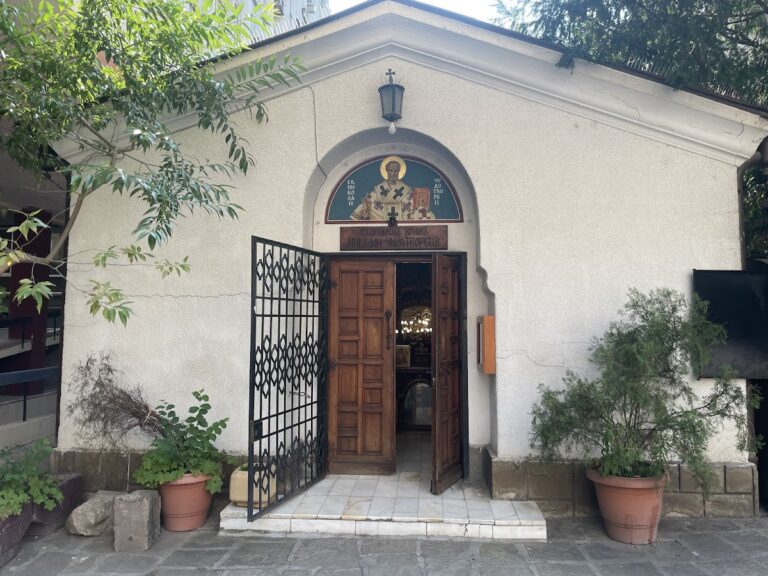
One entrance faces modern Tsar Kaloyan Street, while another opens toward Saborna Street. The church can also be reached from the courtyard of the Sofia Metropolitanate. A 1934 entrance vestibule leads toward the Revival-period narthex, and the passage from Kaloyan Street has vaulted coverings.
The two-story women’s section added in 1866 extends about 5 meters beside the main church. Its lower floor is level with the church floor, while its upper floor is nearly level with the courtyard. The old Revival-period narthex retains its wooden ceiling, and the church also preserves bells and doors.
Archaeological layers and wall paintings
Late-antique walls were uncovered in the deepest and lowest part of the church. They are considered likely to belong to the residence or palace complex associated with Emperor Constantine I. These remains occupy the lower archaeological levels beneath the medieval building.
Sixteenth-century wall paintings have been uncovered inside the church. A fragment of an older mural survives on the medieval wall dating to 1241, while other preserved paintings date from approximately 1500 to 1600.
Iconostasis and devotional objects
The iconostasis dates from the beginning of the twentieth century. Its openwork woodcarving was produced by craftsmen from the Filipov family of the Debar school, and its icons date from the late nineteenth and early twentieth centuries. Older valuable icons are also preserved in the church.
A miraculous icon of Saint Mina is kept here. A proskynetarion, a stand or shrine for a devotional icon, installed in 2018 contains an image of Saint Petka of Rome. Saint Petka of Rome and Saint Paraskeva of Iconium are distinct saints associated with the name Petka, while the church’s dedication refers particularly to Saint Petka of Bulgaria.
The church preserves relics of Saint Petka and a devotional object associated with Saint Spyridon the Wonderworker, consecrated by his relics on the island of Corfu. An ayazmo, a sacred spring regarded in Orthodox tradition as having healing properties, rises beneath the altar.
Nearby sites