Bogdana Monastery: A Medieval Princely Necropolis in Romania


Site at a Glance
- Rating
- 4.7
- Popularity
- Medium
- Country
- Romania
- Primary era
- Medieval
- External website
- Open
- Eras represented
- Medieval, Early Modern, Modern
- Civilizations
- Habsburg, Principality of Moldavia
- Site type
- Religious
- Remains
- Monastery
On this page19 sections
History
Bogdana Monastery is an Orthodox monastery in Rădăuți, Romania, whose Church of Saint Nicholas was founded by Voivode Bogdan I, the medieval ruler associated with the formation of the Moldavian state, during the second half of the fourteenth century. Built in an area that had formerly been ancient woodland, the church served as a princely necropolis, a burial place for members of a ruling dynasty. It received the remains of Bogdan I, his descendants, Moldavian rulers until the reign of Alexander the Good, and relatives of ruling families.
Foundation and episcopal residence
During the reign of Alexander the Good, from 1400 to 1432, the church became the seat and residence of the bishops of Rădăuți. The bishops lived within the monastic complex, giving Bogdana a wider religious, historical, and cultural role. Its connections with the ruling house remained visible through the burials and commemorations maintained inside the church.
Between 1479 and 1482, Stephen the Great installed elaborately carved slabs over the graves of six Moldavian rulers. In 1517, Bogdan III endowed the monastery with 800 zloty in exchange for memorial services. During his lifetime, the monks were to hold a parastas, an Orthodox service for the dead, and a liturgy, the church’s principal Eucharistic service. After his death, they were to celebrate a daily liturgy and an evening parastas for the salvation of his soul.
Restoration, writing, and printing
Under Alexandru Lăpușneanu, the church was restored and received a closed porch in 1559. Some window frames were replaced with Gothic-style frames during the same period. A Slavonic inscription beside the southern door records the construction of the porch under Bishop Euthymius.
During the seventeenth and early eighteenth centuries, monks copied ecclesiastical works at Bogdana. These included a Slavonic tetraevangelion, a manuscript containing the four Gospels, produced in 1613. In 1744, Bishop Varlaam established a printing press at the monastery. It produced church books, including a prayer and chant book in 1745. The press moved to Iași in 1750, after Bishop Iacob Putneanul became metropolitan of Moldavia.
Abolition and later revival
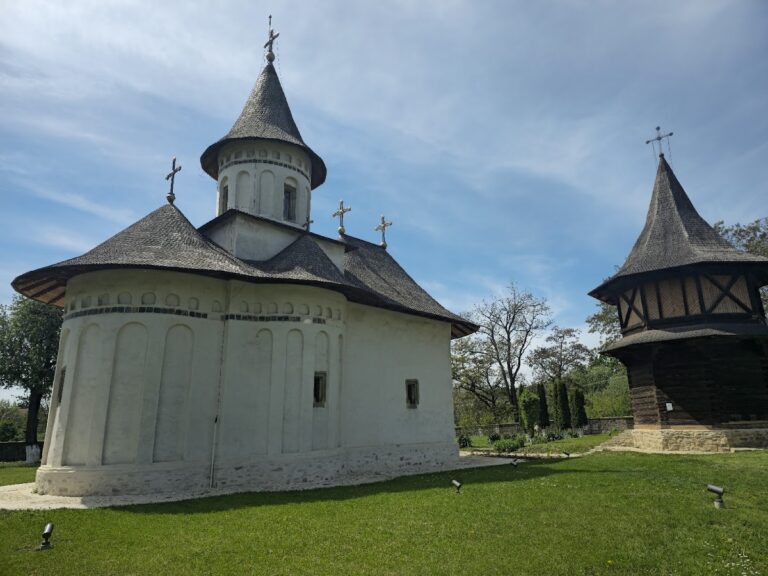
Northern Moldavia was annexed by the Habsburg Empire in 1775. The monastery’s separate bell tower was built in 1781, during the tenure of Bishop Dosoftei Herescu, the last bishop to reside there. The episcopal residence moved to Chernivtsi in 1782, and the monastery was abolished in the summer of 1783. The church continued as a parish church. Some monastic cells were demolished, while others became stables for horses belonging to the Austrian garrison. A parish house was added in 1876.
When Bukovina became part of the Romanian Kingdom in 1918, Bogdana was not re-established as a monastery. The Church of Saint Nicholas remained a parish church until the final decades of the twentieth century, when the Communist regime closed it and treated it as a historic monument.
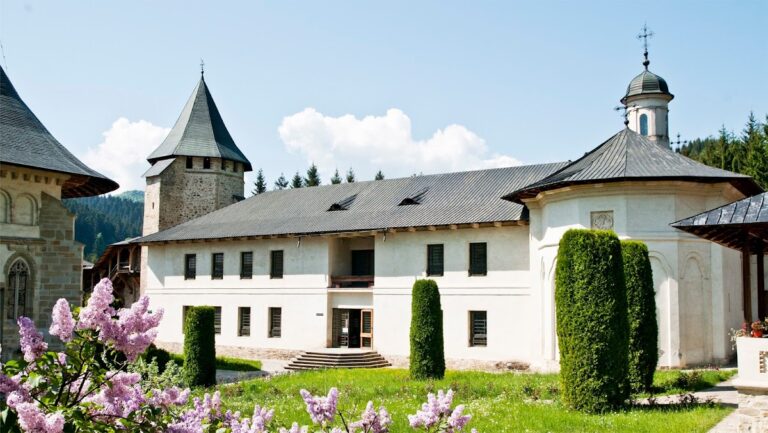
The monastic community was restored on 6 December 1992 by Archbishop Pimen Zainea of Suceava and Rădăuți. Archimandrite Teodor Pavlo became its abbot and died in 1996, after which Archimandrite Iustin Dragomir was elected to the office. Late twentieth-century work included replacing the deteriorated lime-wood iconostasis, the screen separating the sanctuary from the nave, with an oak one in 1996. A new monastic building with guest accommodation and a church dedicated to Saint Hierarch Leontie of Rădăuți were completed in 1998.
Leontie and the monastery’s devotional life
The relics of Bishop Lavrentie, later known as the hermit Leontie, became associated with healing and popular veneration. After Rădăuți was plundered in 1639, monks concealed the relics beneath their former position in the nave to protect them from profanation. Archaeological work between 1974 and 1977 recovered them, and they were placed in a reliquary in 1991. The Holy Synod of the Romanian Orthodox Church canonized Leontie on 20 June 1992 and appointed 1 July as his feast day.
The monastery complex was placed on the Historic Monuments List of Suceava County in 2015 under code SV-II-a-A-05603. The listing includes the Church of Saint Nicholas, the bell tower built in 1781, and the parish house dating from 1876.
Remains
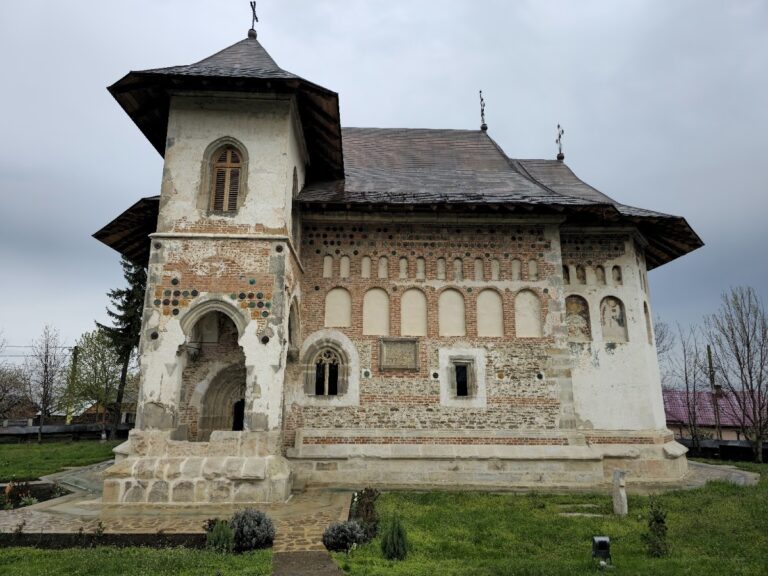
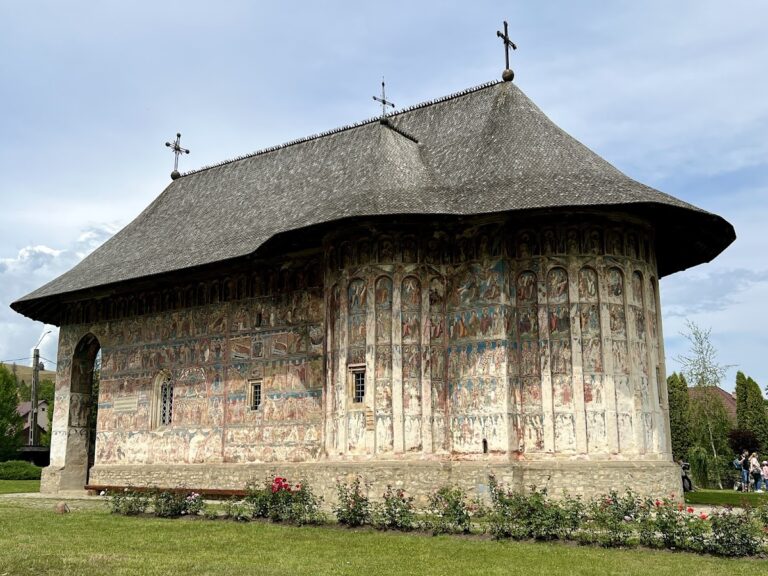
The surviving complex is centered on the tall, stone-built Church of Saint Nicholas, whose thick masonry, steep roof, and separate bell tower express successive medieval and later phases. The church is described as the oldest surviving stone ecclesiastical structure in Moldavia and retains its original form. Its walls are approximately 1.40 metres thick and were originally strengthened by ten buttresses. The roof has steep slopes and a broad eave, and its form was altered when the closed porch was added in 1559.
The church exterior and bell tower
Church of Saint Nicholas
The church has no tower and contains eleven windows. Three belong to the porch, two to the pronaos, the entrance or vestibule section of an Orthodox church, four to the nave, and two to the altar, the eastern sanctuary area. Three nave windows are set in the southern wall and one in the northern wall. The altar windows are narrow on the exterior but much wider on the inside. The southern wall of the pronaos had one buttress and three windows, while its northern wall had three buttresses and one window.
Bell tower
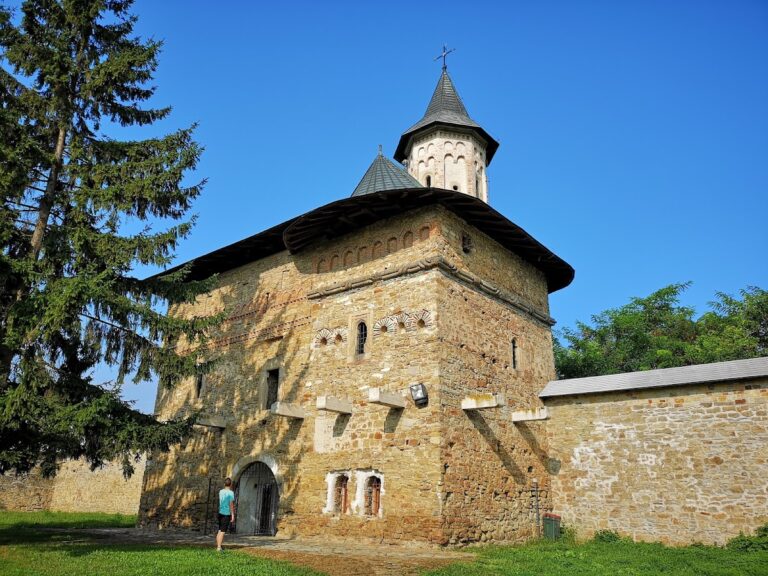
The detached bell tower was built in 1781. One of its bells carries a Slavonic inscription referring to Stephen, Voivode of Moldavia. The inscription may belong to the period of Stephen I, who ruled from 1394 to 1399, although the tower itself is later.
Interior structure and paintings
Architectural arrangement
Inside, Romanesque, Byzantine, and Gothic elements are combined. Six massive pillars divide the central nave from two side aisles, while double arches strengthen the vault over the nave. In the pronaos, the side aisles are level with the central space; in the naos, or main body of the church, they are lower. Two small rooms with semicylindrical vaults were built above the side aisles in the nave and are reached by a spiral staircase. Partition walls with centrally placed doorways separate the porch from the pronaos and the pronaos from the nave.
Wall paintings
The date of the church’s first painting is unknown. A document from 1415 mentions paintings made during the reign of Alexander the Good, while the decoration was later completed or repainted under Stephen the Great. The interior was restored in fresco, painting applied to wet plaster, in 1558 under Alexandru Lăpușneanu. Another painted layer dates from 1745 to 1750, during the episcopate of Iacob Putneanul. Restoration work in the eighteenth and nineteenth centuries damaged parts of the decoration, including the votive composition. Epaminonda Bucevschi restored the interior painting in tempera, a technique using pigments bound in a medium and applied to dry surfaces, in 1880.
Four altar compositions attributed to the period of Stephen the Great show the Last Supper, the Communion of the Apostles with bread, the Communion of the Apostles with wine, and the Washing of the Feet. Their treatment resembles paintings at Voroneț Monastery. On the southwest wall of the nave, the votive painting shows a ruler holding the church without its porch, so the figure cannot be Alexandru Lăpușneanu, who added that structure. The ruler has been proposed as Bogdan I, while other figures may represent Alexander the Good and Stephen the Great. These identifications remain conjectural.
A second painting near Anastasia’s grave in the pronaos depicts a crowned woman holding a scroll. The Virgin Mary leads her before Christ, with Saint Nicholas beside him. The woman is tentatively identified as Anastasia, who is also associated with the donation of Coțmani to the monastery.
Princely and episcopal burials
Graves in the nave
Seven graves lie in the nave. Four form an eastern row running from southeast to northeast: Bogdan I, his son and successor Lațcu, Bogdan who was the brother of Alexander the Good, and Bogdan who was the son of Alexander the Good. A second row runs from east to west, from south toward north, and contains Stephen I, Costea, and Petru I.
Bogdan I’s grave occupies the southeastern corner. Its slab, dated 1480, states that Stephen the Great adorned the tomb of his great-grandfather and names Master Jan as its maker. It also bears a shield with an aurochs head and a star between its horns. The neighboring slab of Lațcu, also from 1480, identifies him as Bogdan I’s son and successor and carries the same symbols.
Stephen the Great installed the slabs of the two men named Bogdan in January 1480. Their inscriptions identify their family relationships to Stephen and give their respective dates of 25 and 30 January. Stephen I’s grave lies between those of his uncle Bogdan I and Lațcu. Its inscription from 1480 names him as an ancestor of Stephen the Great and commemorates his victory over the Hungarians at Hindău.
Costea’s grave extends the burial arrangement associated with Bogdan, son of Alexander the Good. Its inscription is now illegible, and the slab lies level with the floor rather than raised above it. It was once attributed either to Maria, wife of Bogdan I, or to Ana, wife of Lațcu. A partial reading made before 1890 led to a further proposal that it belonged to Petru I. DNA tests later identified the burial as Costea, father of Petru I and Roman I. Petru I’s grave lies against the northern nave wall, and DNA testing confirmed that this is his burial place.
Leontie and Roman I
Two graves occupy the western side of the nave. Bishop Leontie, also called Lavrentie, lies in the southwest, while Roman I lies in the northwest. Leontie’s grave was identified through oral tradition and a sixteenth-century Slavonic document stating that the miracle-working saint lay intact at the Rădăuți episcopate. Roman I’s slab, dated 5 December 1480, identifies him as a Moldavian ruler, the brother of Stephen I, and the nephew of Bogdan I.
Burials in the pronaos and porch
Three graves are located in the pronaos. They belong to Stana, wife of Bogdan III and mother of Ștefăniță Vodă; Anastasia, daughter of Lațcu; and Bishop Ioanichie of Rădăuți. Anastasia’s slab, installed in 1497, states that she donated Coțmani to the church and died in 1420. Stana’s slab was installed by her son in 1518 and identifies her as the donor’s mother. Ioanichie, the first known bishop of Rădăuți, died in 1504. His inscription was partly legible in the mid-nineteenth century but is now erased.
Near the northern door of the porch is the grave of Maria, wife of the Wallachian chancellor Alexa Nicolescu. Its Romanian inscription gives her death date as 4 July 1770. Outside the church, beside the northern altar wall, stands a gravestone for Adrian, the biological father of Metropolitan Iacob Putneanul. Adrian was buried there in 1748. His remains were transferred by his son to Putna Monastery in 1758, while the stone remained at Rădăuți.
Relics, manuscripts, and surviving objects
Relics of Saint Leontie
The recovered relics of Saint Leontie are preserved in a reliquary at the monastery. His burial in the nave and the continued keeping of his relics connect the church’s medieval funerary role with its modern life as a monastic and devotional center.
Dispersed and retained objects
Objects once belonging to Bogdana were dispersed after the monastery’s abolition. They include a funerary cloth showing cherubim mourning Christ, attributed to the period of Alexander the Good and transferred to Sucevița Monastery in 1914; a liturgical veil donated by Stephen the Great in 1493 and preserved at Sucevița; another veil donated by Stephen and held by the Bucharest Art Museum; a wooden icon of Saint Nicholas covered with gilded silver in 1505 and preserved at Sucevița; and a November Menaion from 1504 held in the library of Putna Monastery.
The monastery currently possesses an icon of the Virgin Mary, the prayer and chant book printed in 1745, and a manuscript dated 1783. Together with the reliquary of Saint Leontie, these objects preserve elements of Bogdana’s religious, artistic, and intellectual history after the complex passed through periods of episcopal use, parish administration, abolition, and revival.
Nearby sites