Speinshart Abbey: A Premonstratensian Monastery in Germany
Site at a Glance
- Popularity
- Medium
- Country
- Germany
- Primary era
- Early Modern
- Eras represented
- Medieval, Early Modern, Modern
- Civilizations
- Duchy of Bavaria, Electorate of Bavaria, Holy Roman Empire
- Site type
- Religious
- Remains
- Monastery
On this page17 sections
History
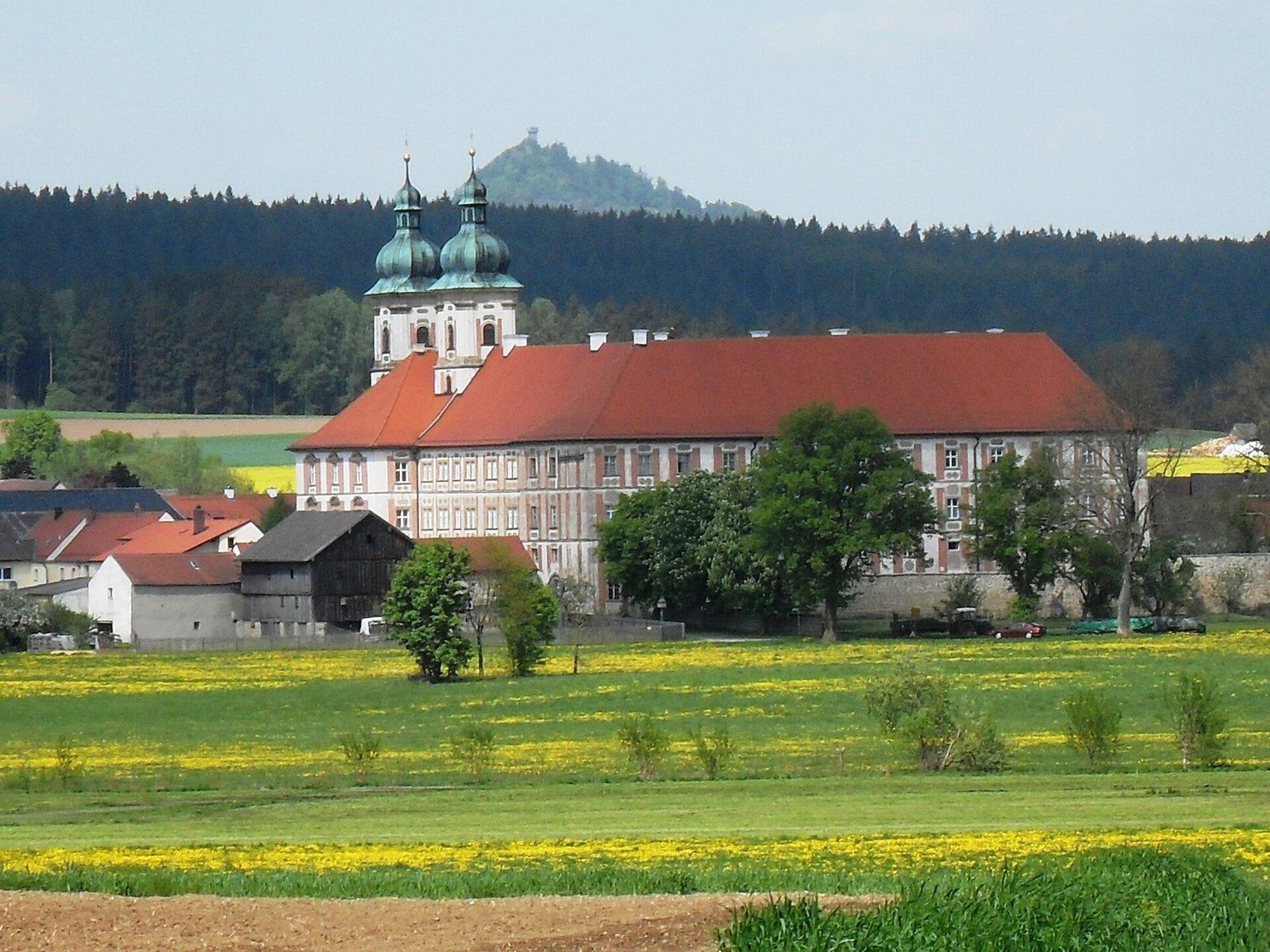
Speinshart Abbey is a Premonstratensian monastery in Germany, founded around 1145 by an order whose canons combine communal religious life with pastoral ministry. Its surviving complex is chiefly Baroque, an ornate European style. Endowments from Adelvolk and Richenza von Reifenberg supported the foundation, with contributions from Adelvolk’s brothers Eberhard and Reinhold. Eberhard later became Bishop of Bamberg as Eberhard II of Otelingen.
Foundation and medieval development
The monastery stood in the marshy Spechtswald forest, a setting associated with Premonstratensian foundations. The order’s first monastery, Prémontré, was also situated in a marshy valley. The first canons may have come from Wilten Abbey near Innsbruck, though their presence at Speinshart at its foundation is uncertain. An imperial confirmation and privilege followed in 1163. The privilege gave the emperor, as protector of the monastery, lay guardianship over it. A papal protection letter in 1181 named the Premonstratensians at Speinshart and declared the house free from secular rule and oppression.
In its early centuries, a provost led the community. Its first provost, Grimo, joined the Second Crusade in 1147. Speinshart’s canons later provided pastoral care in nearby settlements and helped shape their religious and cultural life; at times, the abbey served as the mother house of Tepl in Bohemia. Endowments from the Landgraves of Leuchtenberg and other local noble families greatly expanded its holdings toward the end of the thirteenth century, under Provosts Conrad IV and Heinrich III.
A royal army inflicted severe damage on the monastery in 1310, and Hussites, followers of the Bohemian reformer Jan Hus who formed a major religious and political movement, plundered it in 1429. Speinshart recovered during the fifteenth century under Provost Georg Ochs of Gunzendorf. Pope Pius II raised the house to abbey status in 1459. In 1460, Cardinal Bessarion presented Abbot Georg with a mitre, ring, and pastoral staff on behalf of Pope Paul II.
Reformation and restoration
The Reformation, a movement that reshaped religious life across Europe, reached Speinshart before Lutheran practice was imposed across the Upper Palatinate. Abbot Johann III Georg von Gleißenthal introduced the Reformation at the monastery in 1554. With the territorial ruler’s permission, he married in 1556 but kept his abbatial title. That year, Elector Ottheinrich prohibited Catholic rites in the Upper Palatinate, and a visitation found Speinshart thoroughly Protestant. After the region passed to Calvinist Elector Friedrich III, the abbey collapsed and its property became state property. Gleißenthal moved to a former Franciscan monastery in Amberg in 1557. He was pensioned off in 1564, when the office of monastery judge was established.
Elector Maximilian I of Bavaria brought Jesuits to Speinshart in 1624; Benedictines took charge four years later. In 1661, Elector Ferdinand Maria returned the establishment to the Premonstratensians, who came from Steingaden. The restored community renewed the church and convent buildings, and Speinshart regained abbey status in 1691. Around 1684, the canons revived the medieval pilgrimage to Barbaraberg. Devotion to the scourged Christ also grew in the eighteenth century and led to the building of a chapel beside the collegiate church.
Secularization and renewed community
On 25 April 1803, secularization, the dissolution of the abbey and transfer of its property to the state, ended the community once more. It then housed 23 priests and two lay brothers. The former monastery later served, among other purposes, as a parish house, school, and forestry office. The church became a parish church.
The Premonstratensian Order bought the complex back from the Bavarian state on 30 September 1921, through the mediation of Munich cathedral canon Michael Hartig. Premonstratensians from Tepl arrived two days later. The Apostolic See confirmed the abbey and its rights in 1923, and it again received abbey status in 1944. Speinshart remains a Premonstratensian abbey in the Diocese of Regensburg. Its collegiate church serves both the monastery and the parish.
Conservation work included repairs by the State Office for Monument Protection in 1905 and work on the monastery buildings in 1958–60. A church renovation in 2008–11 restored the interior’s Baroque colors, and a wider programme of monastery repairs and restoration concluded in 2017.
Remains
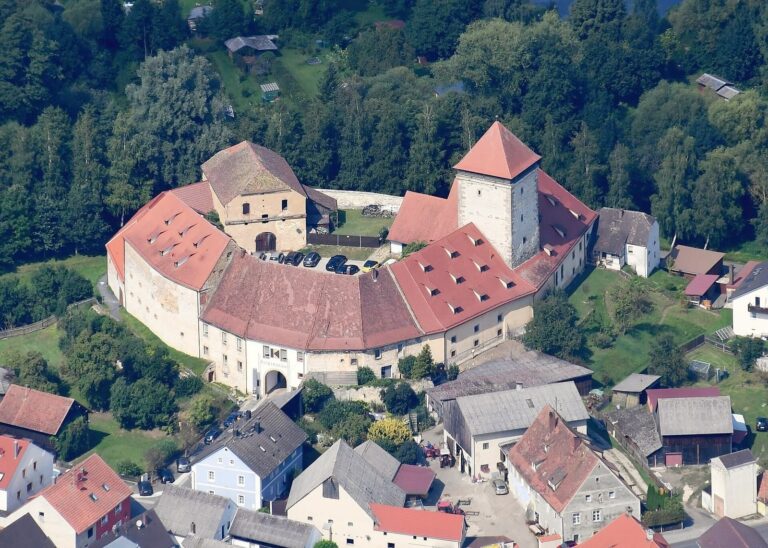
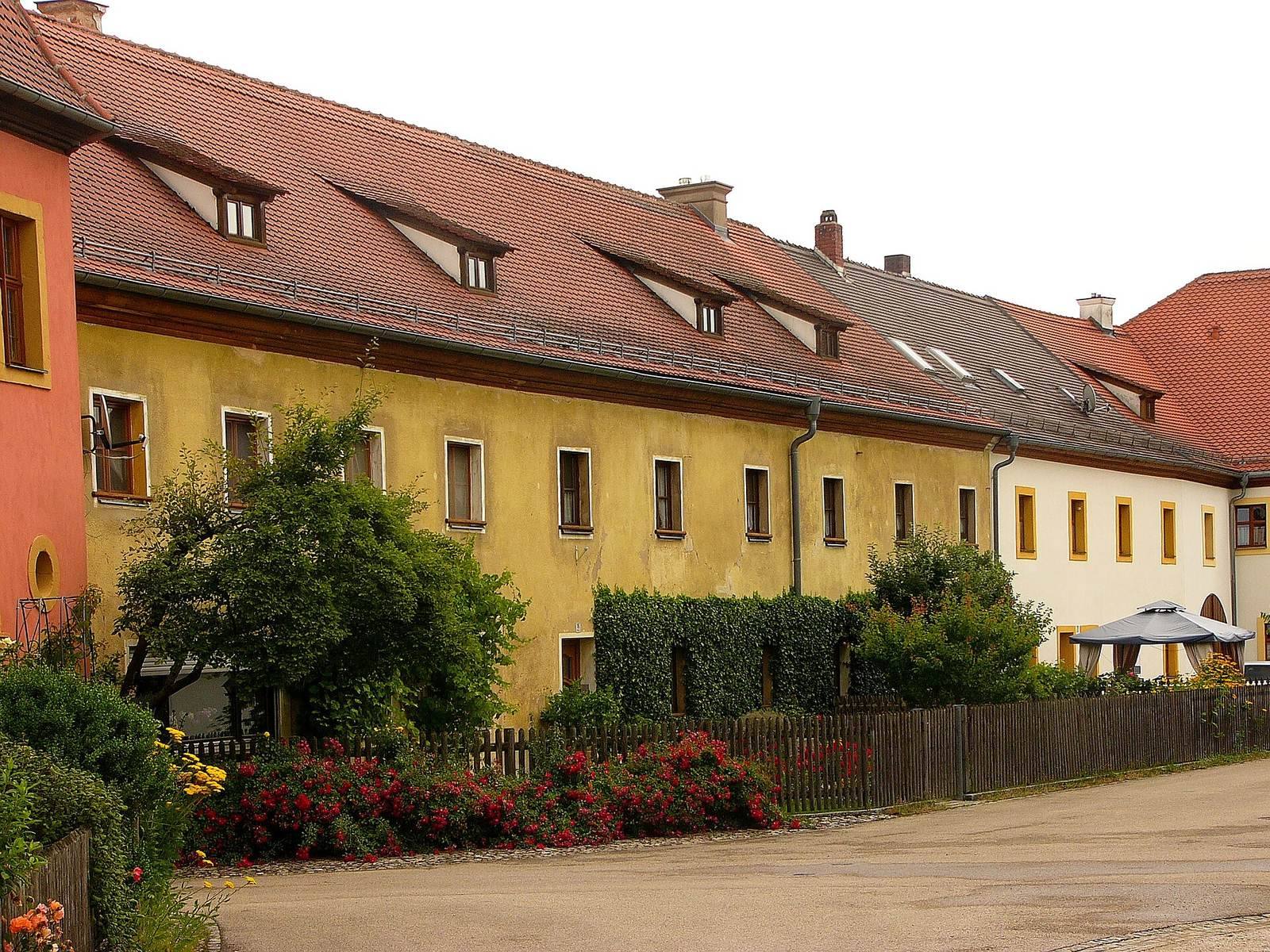
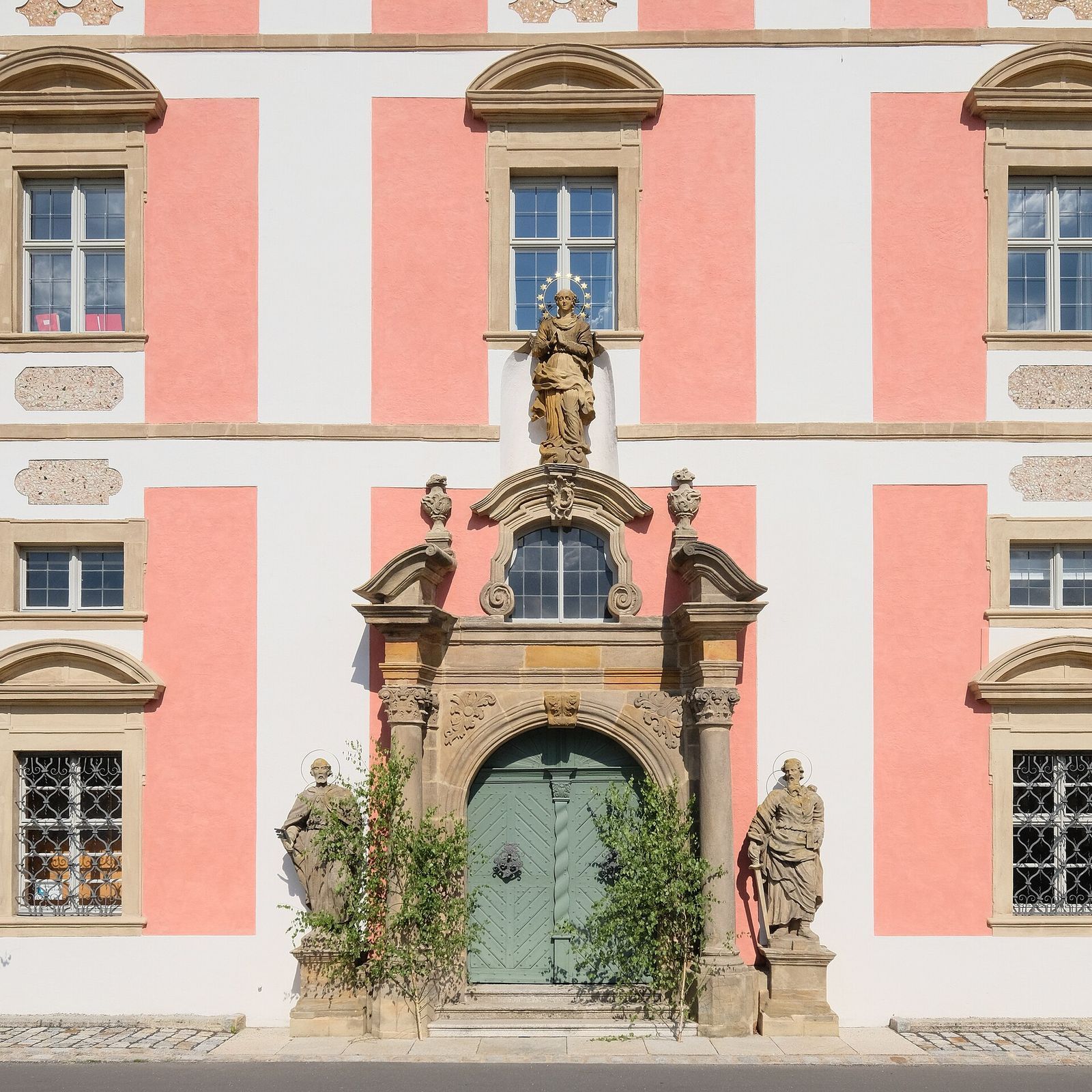
The monastery is a four-wing Baroque complex. The convent occupies the east, south, and west wings, while the former prelate’s wing forms the north side. Within this arrangement, the church, cloister, community rooms, and former abbatial quarters preserve different parts of the monastery’s history.
Monastery buildings
Convent tract and cloister
Construction of new convent buildings began in 1674, and the four-wing complex was completed in 1713 with the west-wing prelature. Georg and Wolfgang Dientzenhofer are associated with its design. The canons’ living and working rooms occupy the convent tract. A spacious cloister runs along the ground floor, adjoining the chapter house, where the community met, and the refectory, its dining hall. Each upper floor has a formal corridor. The refectory was remodelled in the Rococo style, a later, richly decorative style, around 1748.
Former prelate’s wing
The north wing once housed the abbot. His former rooms now serve as an international meeting and educational centre for the monastery.
Earlier basilica foundations
Foundations of a late-twelfth-century Romanesque basilica, a medieval architectural style, lie in the monastery garden. They trace a church with three lengthwise divisions and include remains of its curved choir ends. Reused stone from this earlier building can be seen in the masonry. The Baroque church entrance hall contains a fresco depicting the monastery’s foundation, based on a medieval image that no longer survives. A seventeenth-century drawing also records a painted window from the earlier church.
Painted rooms and heraldry
Michael Wild painted the library ceiling. The room originally rose through two storeys, but a mezzanine inserted after 1803 reduced the effect of the painting. In a guest room, another work by Wild depicts the abbot receiving visitors, with Christ joining the gathering as Abbot Dominikus I von Lieblein greets him. The abbey’s arms show a silver tower on a red field, a design also traditionally attributed to Adelvolk von Reifenberg. A mitre above the shield and a pastoral staff behind it indicate abbatial rank. Speinshart municipality’s arms also feature the tower and mitre.
Collegiate church
Plan and structure
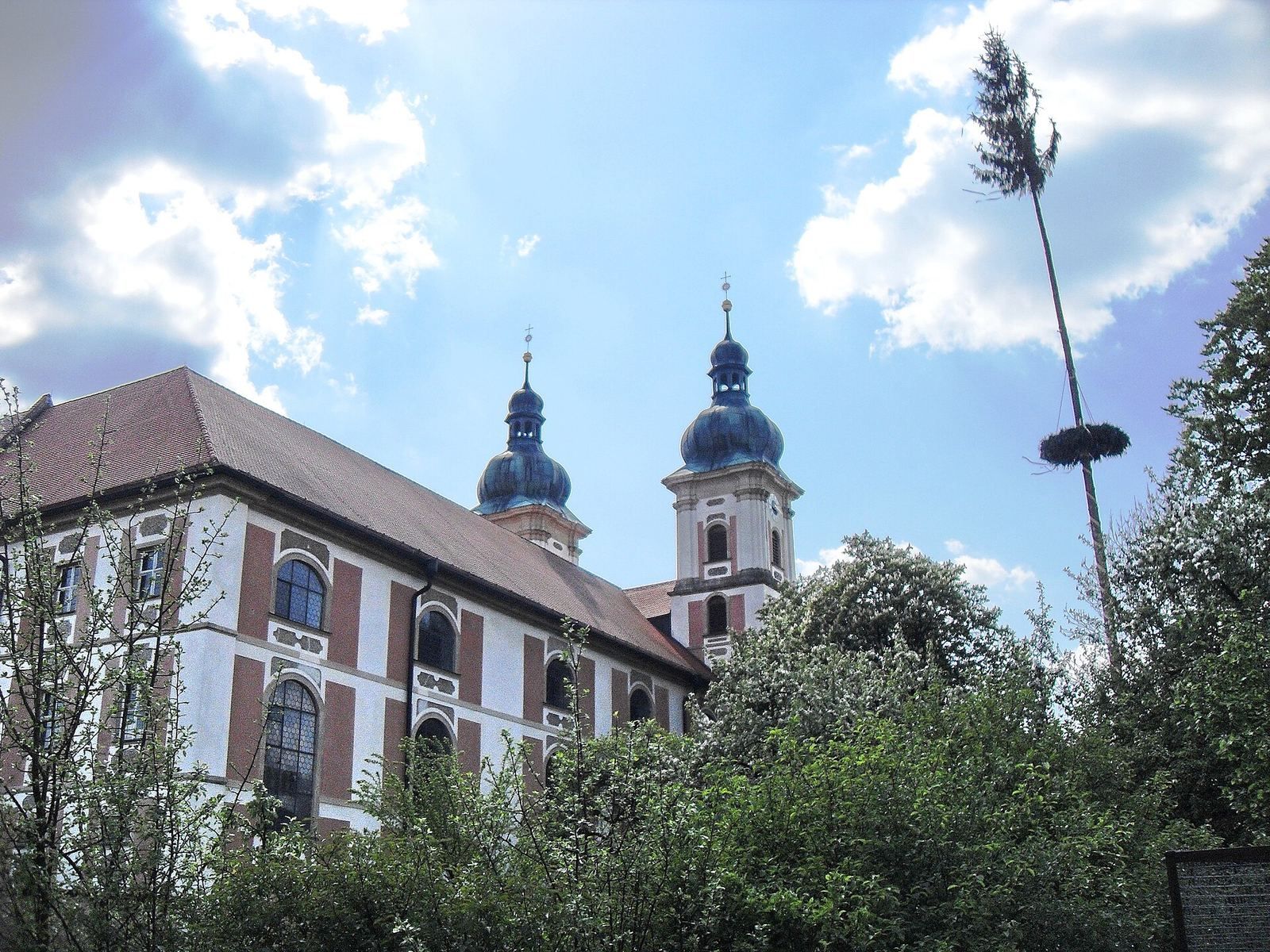
The Romanesque church was demolished in 1691 to make way for the present building. Its outer shell was completed in 1696, and the church was consecrated in 1706. The interior is a hall divided by projecting wall piers, or structural supports, and galleries, with a recessed choir. Curved choir ends contain chapels below and low galleries above; both levels have crosswise barrel-shaped ceilings. The main hall is covered by a flattened barrel vault with lunettes, curved openings cut into a vault. Paired pilasters, shallow wall columns, on the wall piers support a strongly projecting horizontal band. The chapels rise above the galleries, whose parapets extend past that band. A flattened arch framed by paired pilasters divides the main hall from the choir. The church’s broad, compressed proportions shape its interior.
Decoration and altars
Carlo Domenico and Bartolomeo Lucchese decorated the interior with stucco work and frescoes. Pilasters and projecting cornices organize the walls, which lead into ceilings adorned with large garlands of fruit and flowers. Three large frescoes in the nave ceiling sit among smaller painted medallions, while the choir ceiling has denser decoration. Carlo Domenico Lucchese made the stucco high altar, which received its multicolored finish in 1714. Its image of the Immaculate Conception reflects the Catholic belief that Mary was preserved from original sin from the moment of her conception; the painting is probably by Antonio Triva. Abbot Otto Peißner consecrated the last of the side altars in 1722. Milanese artists Stephan and Anton Massini oversaw a church renovation in 1761.
Chapels, stations, and organ
The ceremonial vestibule is flanked by the St. John of Nepomuk Chapel on the left and the Baptismal Chapel, also called the St. Sylvester Chapel, on the right. Michael Wild made a fourteen-station Way of the Cross for the church in 1745–46. Michael Purucker built a new organ around 1716, and the instrument was rebuilt and renovated several times. In 1963, Guido Nenninger installed a new main organ in the historic case, with 24 stops, or sets of pipes. A 1996 instrument by G. F. Steinmeyer replaced it. That organ has 26 stops, two keyboards, a pedal keyboard, and fully mechanical action; the case dates to around 1730.
Pilgrimage churches
Barbaraberg
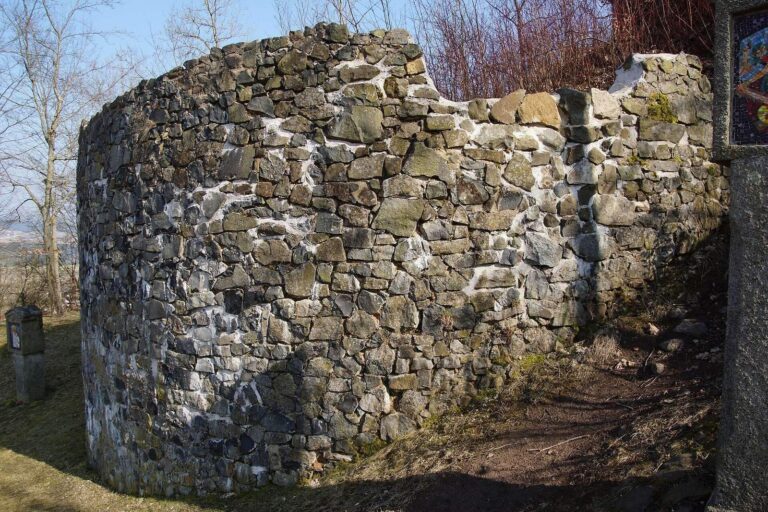
A pilgrimage church built on Barbaraberg between 1741 and 1756 to plans by Father Hugo Strauss survives as its monumental façade.
Wies Chapel
The Wies Chapel, dedicated to the Scourged Savior, was built beside the collegiate church from 1747 to 1752. After secularization, its furnishings were sold and the building was divided for agricultural use as a barn and stable. The district of Neustadt an der Waldnaab now owns the chapel.