Schloss Heringnohe: A Former Iron Hammer Manor in Germany

Site at a Glance
- Rating
- 4.3
- Popularity
- Very Low
- Country
- Germany
- Primary era
- Early Modern
- External website
- Open
- Eras represented
- Medieval, Early Modern, Modern
- Civilizations
- Holy Roman Empire
- Site type
- Domestic
- Remains
- Manor House
On this page11 sections
History
Schloss Heringnohe is a former iron hammer manor in Germany, in the locality of Heringnohe within Vilseck, Bavaria. The present manor building was erected around 1530 during the early modern period, beside an iron hammer mill powered by the Wiesennohe, a tributary of the Vils. The estate was known earlier as Hargenoe, Hargenaw, and Horgnau, and its history reflects the long connection between residence, water management, and iron production.
Medieval ironworking estate
An iron hammer was a water-powered ironworking establishment whose machinery processed or forged iron. Hans Hegner appears as the owner of the Heringnohe hammer in the Upper Palatinate Hammer Association in 1387, an association connected with the region’s late-medieval ironworks. Ownership was recorded in 1438 for the Sulzbach ironmaster Albrecht Frank, who died in 1480.
Albrecht Frank’s father had large reservoirs built at Heringnohe around 1400 to operate the hammer mill. Albrecht was followed by his son Wilhelm, who generally lived in Regensburg. Wilhelm’s daughter Ursula married Lienhart Portner, who inherited Heringnohe in 1517. The estate therefore remained within families connected to the regional iron industry while passing through inheritance.
The Portner period and Bamberg rule
Lienhart Portner’s son Albrecht Portner, who died in 1540, next received the Sulzbach inheritance. His son Wilhelm expanded the hammer mill, and the Portner family continued to be represented at Heringnohe by the descendants Elias and Hans Adam. Hans Adam refused to convert, emigrated, and received no compensation for his property.
The hammer belonged to the Bishops of Bamberg and remained within the Bamberg ecclesiastical territory after an agreement between the Upper Palatinate and the Bamberg diocese on 8 July 1510. This territory was the secular domain governed by the bishops. During the Thirty Years’ War, the major European conflict of 1618 to 1648 involving religious and dynastic struggles, the administrator Johann Kohler sought a reduction of war burdens in 1630. In 1631 the estate passed to Ulrich von Plettenberg, a canon of Bamberg Cathedral, meaning a member of the clergy responsible for cathedral administration and worship. Johann Kohler was again recorded as owner of the hammer mill in 1641.
Later ownership and industrial decline
Around 1700, the hammer owners received the right to brew beer. Kaspar Gessel was recorded as a later owner in 1683, followed around 1740 by the farmer Graf from Oberweißenbach. Georg Graf divided the family inheritances among his three sons: Georg Johann received the Heringnohe hammer, Johann Georg received the Altneuhaus hammer estate, and Johann Baptist received the Altenweiher hammer estate. Johann Georg Graf became the ancestor of the ennobled von Grafenstein family.
After the von Graf family, the Heringnohe estate passed to the von Lindenfels family in 1847, which owned the hammer for about two decades. On 6 March 1867, ownership passed to Christoph Kredler, under whom the hammer mill ceased operation. His son, who died in 1931, incurred further debts on the estate.
Hans Götz, a merchant from Freihung, bought the hammer mill in 1931 and restored its economic prosperity. After his death in 1957, ownership passed first to Emma Götz and then to her son Oswald Götz. Joachim Götz is the current owner and operates an inn at Heringnohe. Schloss Heringnohe is protected as an architectural monument under record number D-2-77-144-8, while archaeological remains of the former hammer castle are recorded as a ground monument under record number D-3-6336-0083.
Remains
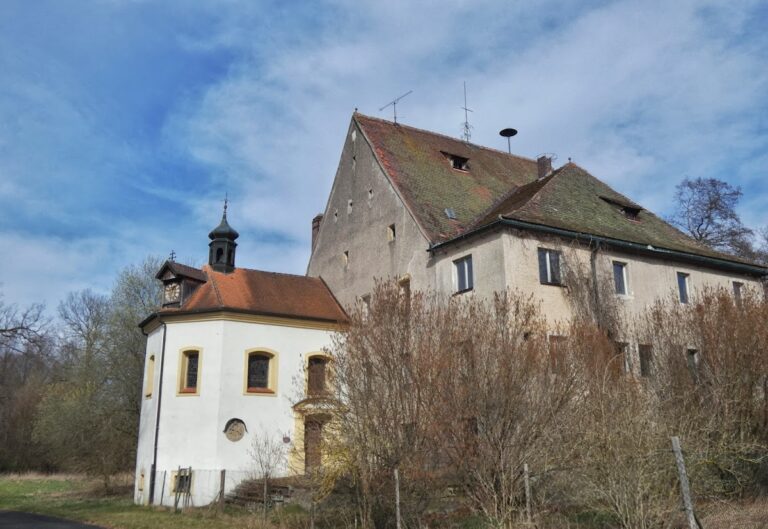
The complex combines a three-storey plastered manor house with associated buildings and a chapel. Its buildings preserve the physical arrangement of a residence linked to the former water-powered ironworks, while the Wiesennohe and the reservoirs created around 1400 provide the water-management setting for the hammer mill. The site lies immediately near the Grafenwöhr military training area.
Manor and associated buildings
Former hammer manor
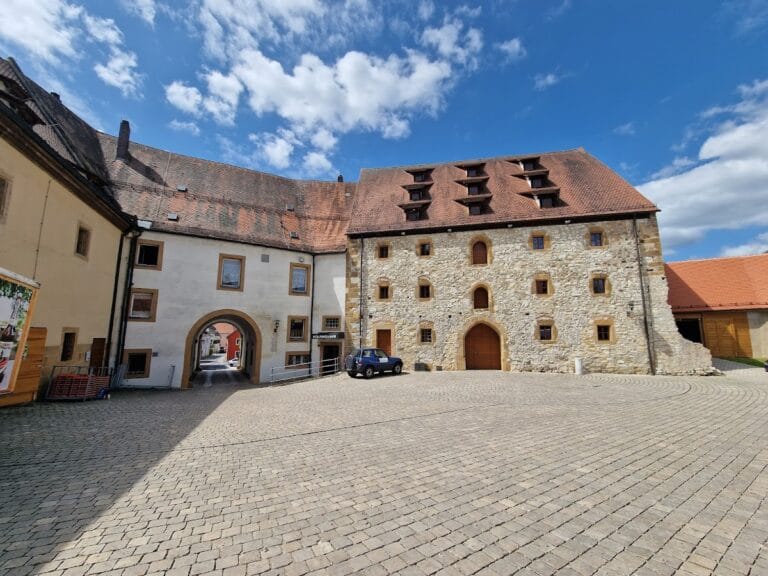
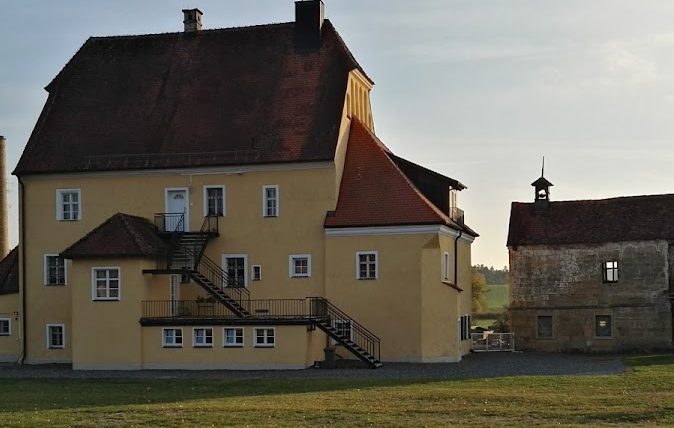
The former hammer manor is a three-storey solid masonry building erected around 1530. It has plastered elevations and a half-hipped roof, whose gable-end slopes stop short of the eaves. Beneath the roof hips, blind niches create an articulated upper façade, with some openings framed by eared and profiled surrounds. Several interior rooms contain yellow-glazed stoves from the Neoclassical period.
Servants’ house
The servants’ house is a two-storey sandstone ashlar building with a gabled roof. Belt courses divide its elevations, and some of its openings have eared surrounds. Its present form dates from the eighteenth or nineteenth century.
Chapel and waterworks
Catholic Chapel of St. Lawrence
The Catholic Chapel of St. Lawrence is attached to the southeast corner of the castle. It is a plastered stone hall building with a three-sided termination, a gabled roof, and a roof turret, a small tower-like structure rising from the roof. The chapel dates from the eighteenth or nineteenth century.
Reservoirs and hammer-mill setting
The former hammer mill drew its power from the Wiesennohe. Large reservoirs constructed around 1400 regulated the water used to drive the works. Archaeological remains in the area of the former hammer castle preserve the site’s association with late-medieval and early-modern iron hammering.