Ponte Milvio: A Roman Bridge Across the Tiber in Rome
Site at a Glance
- Popularity
- Very High
- Country
- Italy
- Primary era
- Classical
- Eras represented
- Classical, Medieval, Modern
- Civilizations
- Byzantine, Papal States, Roman
- Site type
- Military
- Remains
- Fortified Bridge
On this page14 sections
History
Ponte Milvio is a bridge across the Tiber in Rome, Italy. A bridge at this crossing is attested by 207 BC, although the date and builder of the original structure are uncertain. Its earliest form was wooden. Between 115 and 109 BC, Marcus Aemilius Scaurus, a Roman censor, an elected magistrate with public responsibilities, renewed or rebuilt it in stone.
Republic and early Empire
The bridge stood where the Via Flaminia and Via Cassia met the Tiber. The Via Flaminia linked Rome with Ariminum, the Roman name for modern Rimini, on the Adriatic coast. For centuries, Ponte Milvio served as a major northern entrance to Rome, with economic as well as strategic value. Its surroundings also became a military gathering ground. Legions trained there, commanders assembled troops for defence and campaigns, and returning forces camped nearby while they awaited the Senate’s decision on whether to grant a triumph, a formal procession honouring a victorious commander.
In 63 BC, letters carried by envoys of the Allobroges, a Gallic people, were intercepted at the bridge. They implicated members of the Catilinarian conspiracy, a failed attempt to overthrow the Roman Republic led by Catiline. Cicero presented the letters to the Senate the next day, and the conspirators were arrested at Ponte Milvio.
In 27 BC, Augustus, Rome’s first emperor, arranged repairs to bridges along the Via Flaminia. An arch bearing his statue and a separate arch with a four-horse chariot were associated with Ponte Milvio. Coins depicting the bridge were issued in 16 BC.
Constantine and late antiquity
In 312 AD, Constantine defeated his rival emperor Maxentius in a battle fought between Ponte Milvio and Saxa Rubra, a locality north of Rome. The victory led to Constantine’s rule. The Christian historian Eusebius of Caesarea related that Constantine saw a cross in the sky before the battle and later dreamed that Christ instructed him to use the sign against his enemies. His troops marked their shields and military banners with the Chi-Rho, a symbol formed from the first two Greek letters of “Christ,” and won the battle.
In 537, Belisarius, a leading general of the Byzantine Empire, the eastern continuation of the Roman Empire, had a tower with gates built at the bridgehead. The following year, fighting between the Goths and Belisarius’s forces damaged the bridge. The Gothic ruler Witichis fled across it with his troops in 538.
Medieval crossings and repairs
Ponte Milvio was a ceremonial point of entry for rulers and church leaders arriving in Rome. In 799, Pope Leo III crossed it on his return from a visit to Charlemagne and was welcomed by the Roman people and aristocracy. Charlemagne came to Rome the next year for his imperial coronation. Lothair I crossed the bridge in 823, and Arnulf of Carinthia did so in 896; both were received there before their imperial anointings at St Peter’s.
In 1121, Pope Calixtus II crossed with the captive Gregory VIII, a rival claimant to the papacy, while Romans mocked his prisoner. In 1312, anti-imperial troops blocked Henry VII’s route to St Peter’s, forcing him to withdraw. Sigismund entered Rome over the bridge in 1433 for his coronation by Pope Eugene IV.
A major restoration took place in 1149. A letter from the Roman Senate in 1152 described the bridge as restored to sound condition and required people entering or leaving the city to contribute gifts or tribute toward it. Fighting in 1404 between Roman Ghibellines and the forces of Pope Innocent VII damaged or burned wooden parts. The following year, Innocent kept control of the bridge rather than handing it to city authorities, appointed guards at its towers, and cited doubts about the city’s ability to maintain and protect it. Despite these measures, the bridge was badly damaged.
Pope Martin V commissioned repairs in 1429. Further major work under Popes Nicholas V and Calixtus III in the mid-fifteenth century replaced the wooden deck with a stone roadway, replaced the northern tower, and repaved the road between the bridge and Porta del Popolo.
Later alterations and cultural associations
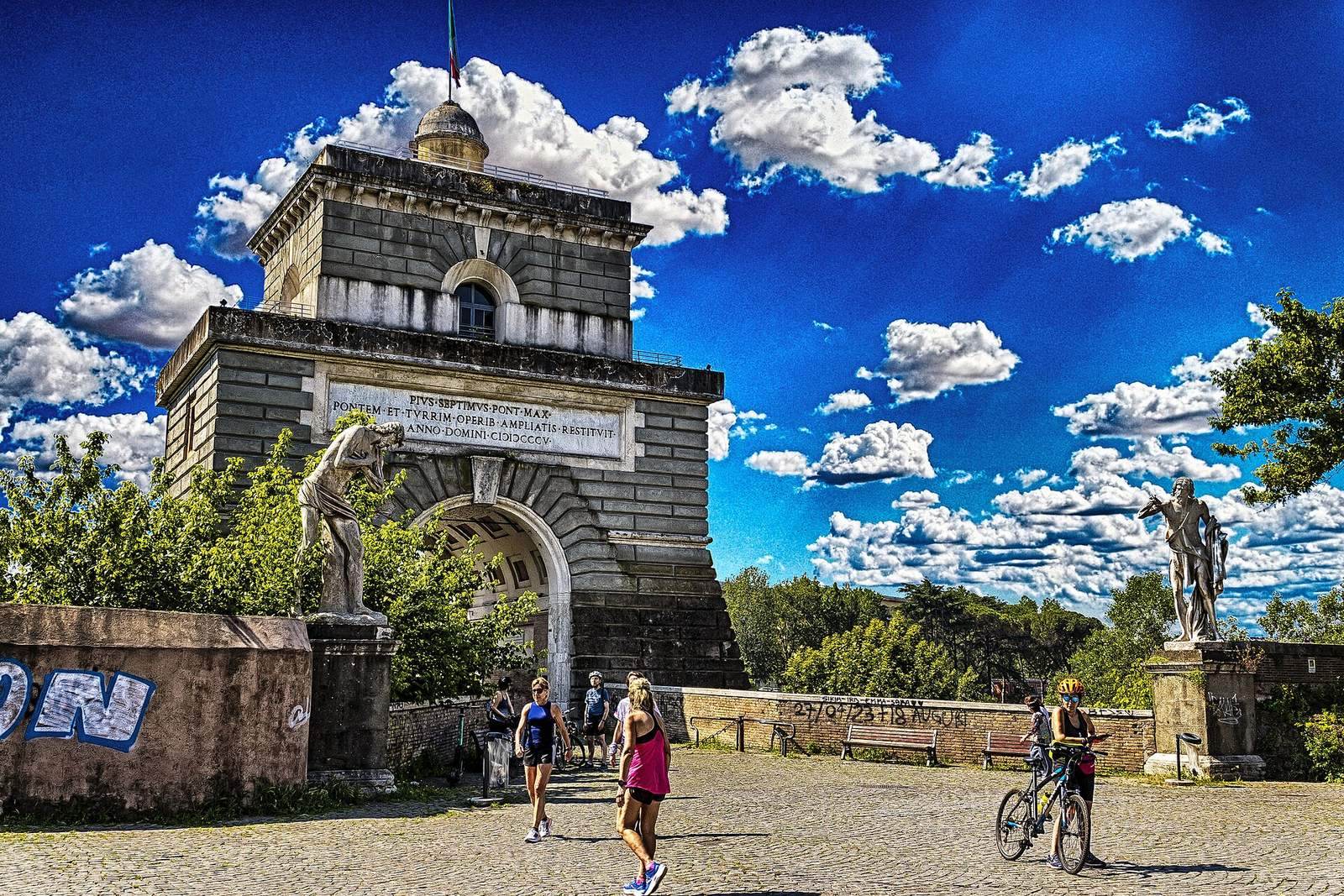
In 1805, Pope Pius VII commissioned the architect Giuseppe Valadier to redesign the bridge. In 1849, troops under the Italian military and political leader Giuseppe Garibaldi partially demolished it to hinder the French invasion. Pope Pius IX had the bridge restored from 1850 onward. Heavy military vehicles used it during the Second World War, the last armed conflict reported at the site. Ponte Flaminio opened nearby in 1951, and Ponte Milvio later became pedestrian-only.
Seventeenth-century Dutch and Flemish landscape painters, including Jan Both, depicted the bridge. In later life, the German writer Johann Wolfgang von Goethe recalled his journey back over Ponte Milvio after his stay in Italy with nostalgia. Modern restoration work has also included investigations to distinguish surviving Roman fabric from later construction.
Remains
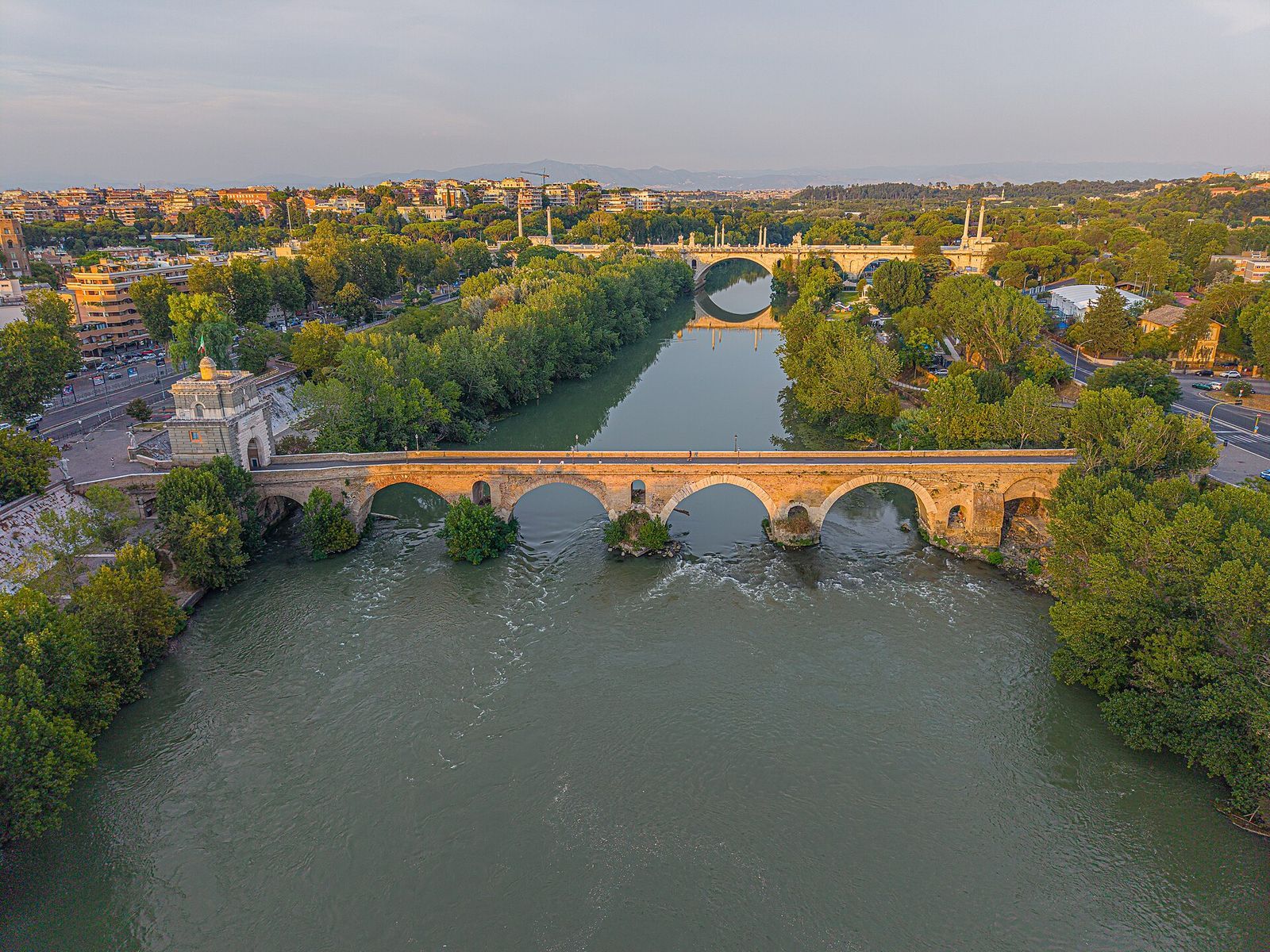
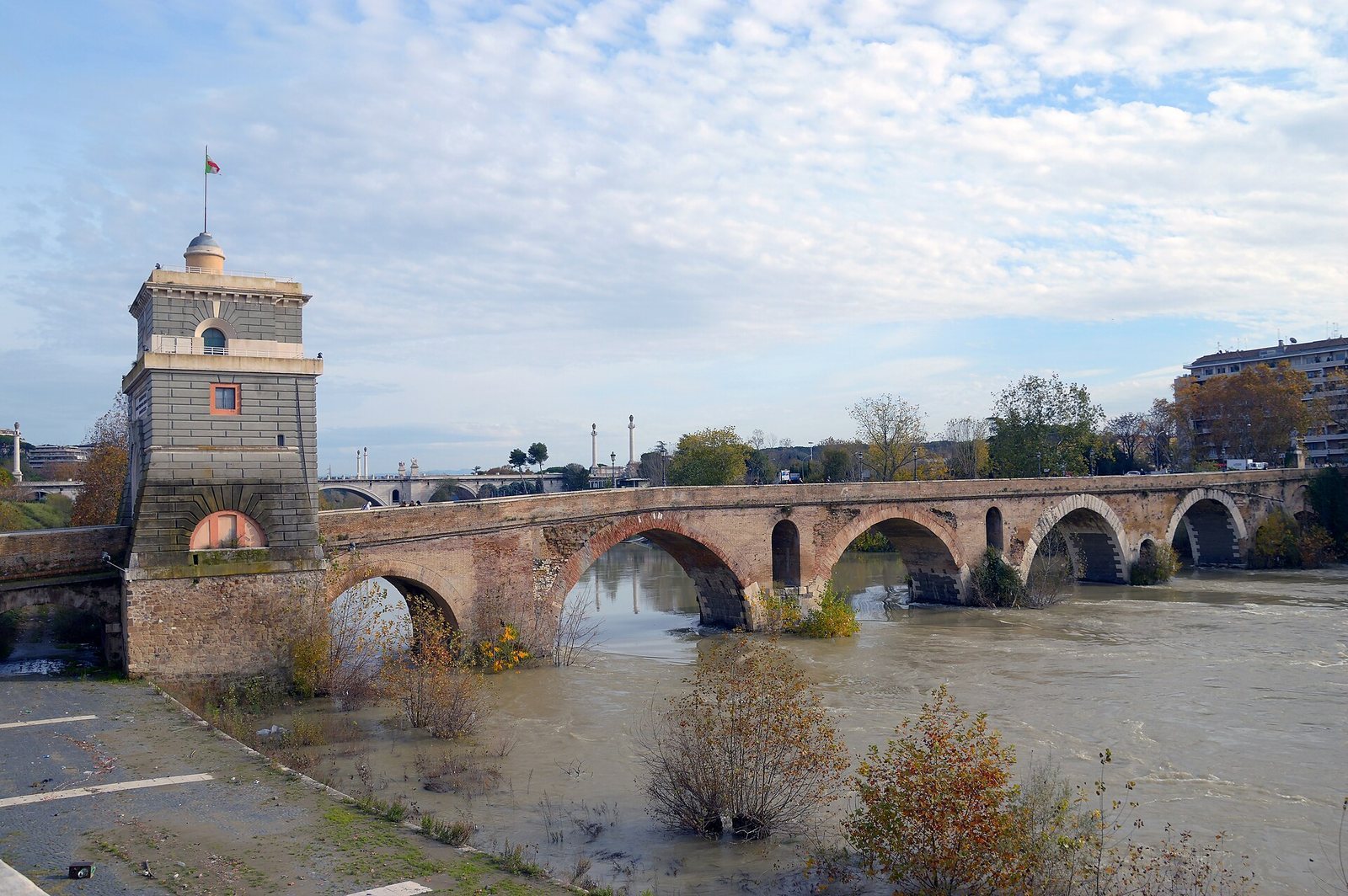
The stone-and-brick arch bridge crosses a stretch of the Tiber about 124 metres wide. It is 136 metres long and 8.75 metres wide, with six spans measuring approximately 7.25, 17.90, 18.40, 18.55, 17.85, and 9.30 metres from one end to the other. The four middle openings are about 18 metres wide, while the two end openings are about 9 metres wide.
Roman masonry
Arches and surviving fabric
Two central arches are identified as original Roman work, while two others are partly ancient. The second and third arches retain light-coloured Roman travertine facing attributed to the stone rebuilding of 109 BC. The first two river arches, their supporting piers, and sections of the masonry above them survive. Substantial remains of the first and second piers from the south belong to the early stone structure, along with part of an arch made from successive masonry courses that project inward. The third arch is only partly attributed to the Roman period.
Piers and facing
The piers have cores of tuff, a volcanic rock, quarried at Oscura and Aniene, with travertine, a form of limestone, facing their fronts, corners, and edges. A flexible lime layer separates the two types of stone. Except for the first and fourth piers, they are approximately eight by eight metres; measured widths range from 7.24 to 7.47 metres and depths from 7.56 to 7.71 metres. The first and fourth piers are 10 metres wide. Openings of different sizes in the piers allow floodwater to pass through.
Vault construction and repairs
Near the low-water level, travertine facing alternates blocks laid with their long faces and short ends exposed. Higher up, the facing consists of a single course of stone. The arch vaults use wedge-shaped stones of varying widths. Travertine forms their outer faces, while the inner faces include lower-quality masonry; on the undersides, travertine and tuff blocks alternate. The fourth vault is entirely brick, and the fifth has masonry only in its upper section. These arrangements are attributed to repairs in the fifteenth century.
Entrances and associated features
End spans and fortified entrance
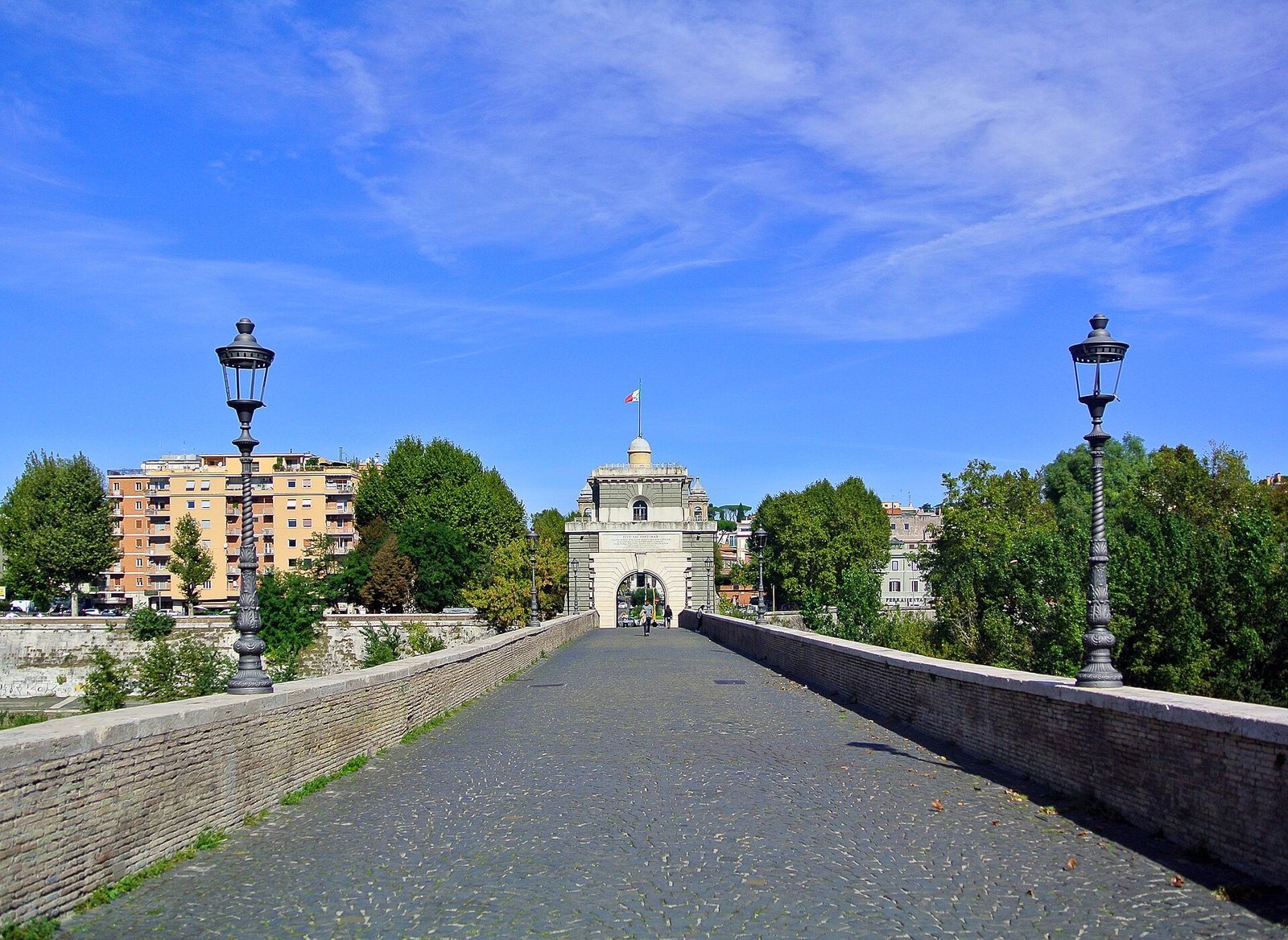
The end spans originally had timber structures above them and were later replaced by masonry vaults. In 1805, Valadier’s redesign replaced the wooden riverside spans with stone arches and gave the fortified entrance stepped pavilion towers with passage arches. The northern tower was rebuilt in a Neoclassical style. The tower at the right-bank entrance was known in the thirteenth century as Tripizone. A crenellated turret reinforced its front, while a side passage carried on an external pier let people pass when the main passage was blocked.
Shrine and sculpture
A small shrine to St Andrew was built near the bridge in the 1460s and later converted into an oratory, or small chapel. Statues of St John Nepomuk, a fourteenth-century Bohemian priest and martyr, and the Virgin Mary under the title of the Immaculate Conception, the Catholic belief that Mary was conceived without original sin, were made by Domenico Pigiani and installed on opposite sides of the roadway in 1850. Francesco Mochi’s sculptural group The Baptism of Christ, created in 1634, was later moved to the atrium of the Museo di Roma in Palazzo Braschi.
Vault surfaces and central lamp
Inspections exposed the upper surfaces of the vaults. Wear on them indicates that people used the sides as informal paths. Since 2006, couples inspired by Federico Moccia’s novel and film I Want You attached love locks to the central lamp and threw the keys into the Tiber. The accumulated weight damaged the lamp. The city provided alternative places for locks before removing the locks and their associated fixtures in 2012.