Castello di Dinazzano: A Medieval Hilltop Fortress in Italy


Site at a Glance
- Rating
- 4
- Popularity
- Very Low
- Country
- Italy
- Primary era
- Medieval
- Eras represented
- Medieval
- Civilizations
- Holy Roman Empire
- Site type
- Military
- Remains
- Castle
On this page7 sections
History
Castello di Dinazzano is a medieval hilltop defensive castle in Italy, located in the locality of Dinazzano within Casalgrande. Built between the twelfth century and 1443, it stood on the Reggio foothills above routes and territorial boundaries connected with Reggio and Modena.
Early records and division of the castle
Dinazzano is recorded in 968 together with Fogliano and Castellarano as part of the County of Parma. By 1180, the castle was divided into three shares. One-third belonged to the municipality of Reggio, giving it control of the route of the Secchia Canal and the boundary with Modena. A second third belonged to the Montemagno family, which transferred its share to Reggio in the same year so that the municipality could strengthen the castle. The remaining share was held by the lords of Sassuolo.
In 1275, Bernabò da Magreta sold the castle to Manfredo da Sassuolo, a member of the Della Rosa family. Reggio recovered Dinazzano in 1318 and later assigned it to the Da Fogliano family in 1335.
Este and Boiardo control
In 1409, the Da Fogliano family, allied with the military leader Ottobuono de’ Terzi, was defeated by Niccolò III d’Este and forced to surrender the castle. Dinazzano was first granted as a fief to the Della Sala family. Its territory later passed to the Boiardo family and became part of the County of Scandiano, a territorial jurisdiction centered on Scandiano in the Reggio Emilia area.
The castle was fortified again in 1443, its last recorded phase of strengthening. In 1474, disputes between Count Matteo Maria Boiardo and his cousin, Count Giovanni Boiardo, led to the division of the County of Scandiano. Giovanni received Arceto, Casalgrande, Dinazzano, Salvaterra, and Montebabbio, while Matteo Maria received Scandiano, Gesso, Torricella, and Sabbione. The Este dynasty, the ruling house that controlled territories including Modena and Reggio, confirmed Giovanni’s control of these lands in 1475 and again in 1490.
After Count Camillo Boiardo died without heirs in 1499, the territories divided in 1474 were reunited under Count Giovanni Boiardo. Dinazzano’s strategic function ended during the seventeenth century.
Remains
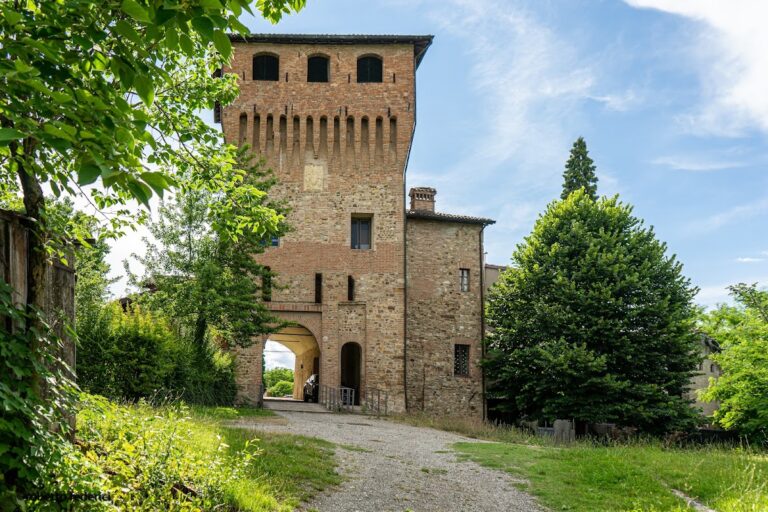
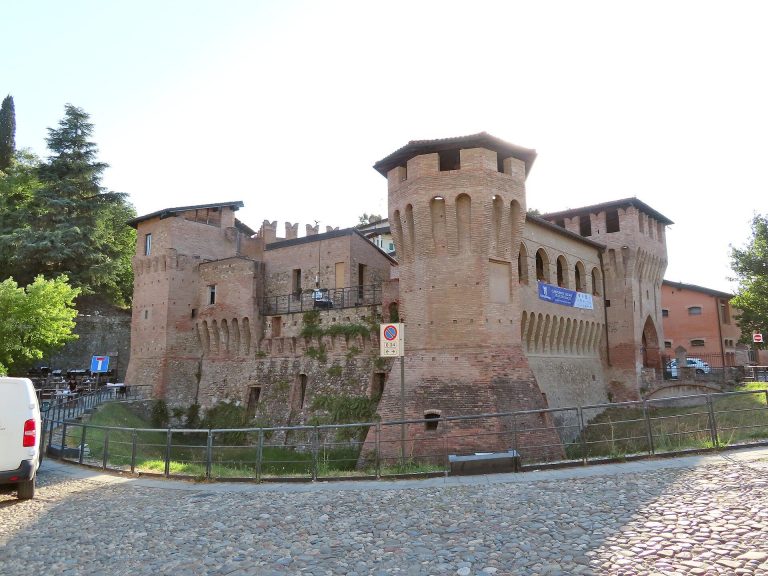
Castello di Dinazzano occupies a hilltop position at approximately 240 metres above sea level on the Reggio foothills. Its surviving fabric is primarily brick masonry. The ruined defensive walls once provided control over the Secchia Canal and the upper plain between Reggio and Modena, while the principal fortified tower remains in good condition.
Fortifications
Defensive walls
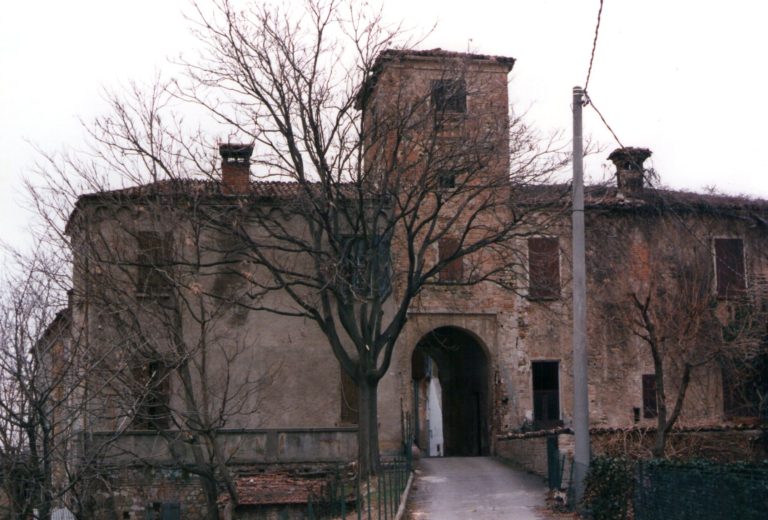
The castle walls survive in a ruined state and are dangerous and unstable. Their elevated position helped the fortress oversee the canal route and the upper plain between the territories of Reggio and Modena.
Keep
The mastio, or principal fortified tower, remains in good condition. Its tower is crowned with battlements and has machicolations, projecting openings through which defenders could discharge material onto attackers below.