Pieve di San Lorenzo: A Carolingian-Era Christian Complex in Italy


Site at a Glance
- Rating
- 4.4
- Popularity
- Low
- Country
- Italy
- Primary era
- Medieval
- Eras represented
- Medieval, Modern
- Civilizations
- Carolingian, Holy Roman Empire, Italian
- Site type
- Religious
- Remains
- Church
On this page12 sections
History
Pieve di San Lorenzo is a Carolingian-era Christian complex in Italy, located above Settimo Vittone and the Dora Baltea. Probably established during the second half of the ninth century, it developed as a medieval parish and castle church. The complex of the church and the Baptistery of Saint John the Baptist is one of the oldest surviving Christian centers in the Canavese, the historical region of northwestern Piedmont around Ivrea.
Carolingian Origins and Medieval Traditions
Tradition attributes the foundation to the Anscarids, a Frankish aristocratic dynasty associated with the March of Ivrea. This attribution is considered credible but has no documentary support. A romantic legend connects the site with Ansgarda, daughter of Anscarius I and the repudiated wife of Louis II the Stammerer, a ninth-century king of West Francia. According to the tradition, Ansgarda withdrew to the rocky height for contemplation and was buried there in 889. An apocryphal inscription in the baptistery and a sarcophagus in the forecourt helped preserve this association.
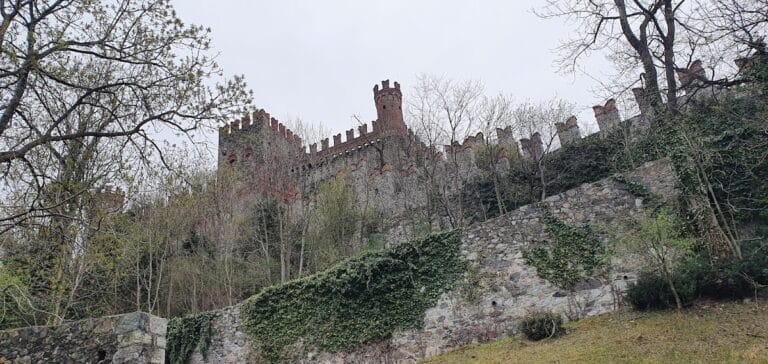
The complex stood near defensive structures that may have been built as early as the tenth century to protect the church. The later old castle was constructed over these defenses, and some of its surviving elements include windows decorated with terracotta. From its elevated position, the church and baptistery probably served travelers and pilgrims using the Via Francigena, the medieval pilgrimage route linking northern and western Europe with Rome. The site also formed a junction in the hillside mule-track network connecting upper settlements and vineyards with Montestrutto, Cesnola, and Torredaniele.
Parish and Castle Church
Because it occupied the castle height, Pieve di San Lorenzo probably functioned as a castle church. A document of 1232 refers to it as a church in the castle of Settimo Vittone. By concession of the local lords, it also became the parish church, a role it retained until 1661, when the parish moved to Sant’Andrea in the center of the settlement.
In 1657, Count Filippo San Martino of Agliè obtained what were believed to be the ashes of Anscarius, who had died in 898 and was regarded as the progenitor of the marquises of Ivrea. The remains were buried in Sant’Andrea. Pieve di San Lorenzo remains affiliated with Roman Catholic worship of the Roman rite and belongs to the Diocese of Ivrea. Its dedication is to Saint Lawrence the Martyr.
Restoration and Preservation
A restoration undertaken in 1896 and 1897 by the Regional Office for the Conservation of Monuments, directed by Alfredo d’Andrade, helped preserve the complex. During this work, a Romanesque-style bifora, or two-light window divided by a central support, was inserted into the facade. Further interventions in the final decade of the twentieth century recovered much of the church’s interior wall painting. The complex is listed among the monuments highlighted by the FAI, the Italian organization devoted to preserving and promoting cultural and natural heritage.
Remains
The church and baptistery occupy an elevated rocky site above Settimo Vittone and the Dora Baltea. They stand within a natural amphitheater enclosed by moraine hills, with vineyards arranged on dry-stone terraces and some olive trees near the buildings. The complex is principally constructed from cobbles and fragments of locally obtained stone. Its roofs are almost entirely covered with thin natural stone slabs known as lose.
Buildings and Landscape
Octagonal Baptistery
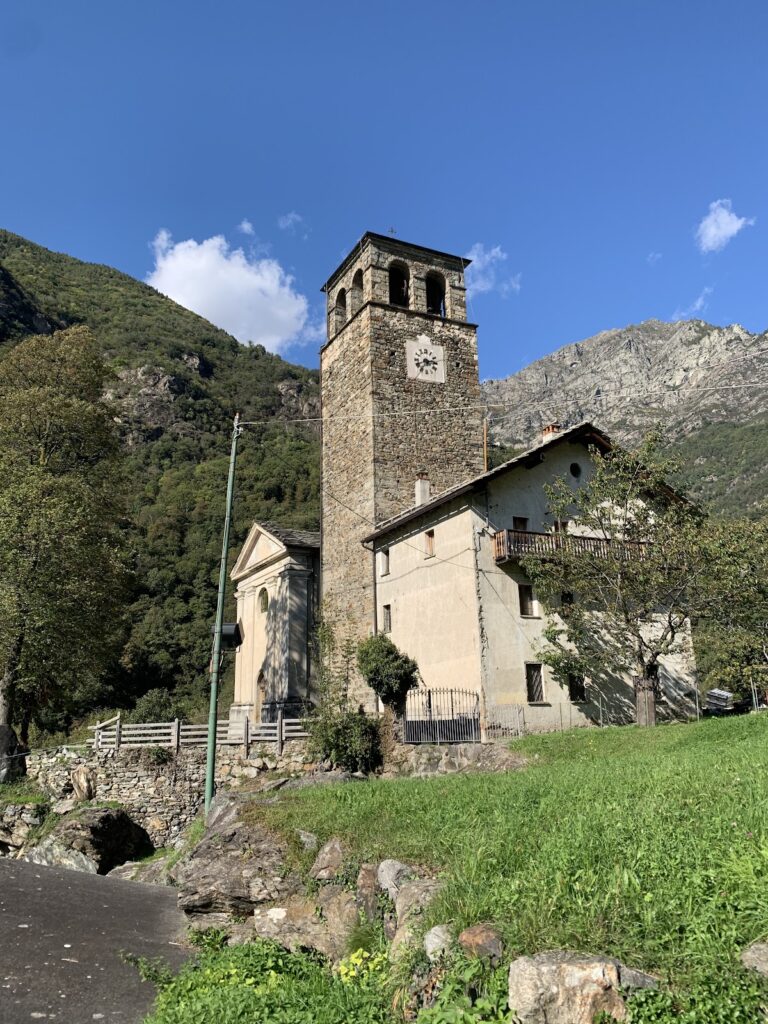
The baptistery has an octagonal plan and is covered by a segmented vault. A brick bell tower rises above the vault. Probably added in the thirteenth century, the tower is Romanesque in character. A rectangular apse projects beyond the octagonal body and serves as its presbytery, the area reserved for the altar and clergy. The baptistery was probably detached from the church at first. A passage was later constructed along its southern side to connect the two buildings.
Single-Nave Church
The church has a single nave and an apparent Latin-cross plan. Three niches open into the presbytery area, each covered by a barrel vault. The entrance is placed through a bell tower built against the nave. This tower was probably added in the thirteenth century and eliminated the original entrance.
Vineyard Terraces
The surrounding vineyard terraces are held by dry-stone walls filled with imported soil. Their pergolas rest on characteristic stone columns whitened with lime. These supports are known locally as tupiun, and form part of the cultivated landscape around the complex.
Medieval Frescoes
The church and its connecting passage contain a rich sequence of frescoes produced from the first half of the twelfth century to almost the end of the fifteenth century. Their irregular arrangement makes the chronological sequence difficult to follow, while several paintings survive in fragmentary or poor condition. Together, the paintings represent nearly three centuries of artistic development in the Canavese.
Church and Connecting Passage
A fragmentary Last Judgment occupies the upper part of the apsidal arch and probably dates from the twelfth century. Its Romanesque character appears in the surviving red cheeks and wide-open eyes. On the left wall of the apse, a fourteenth-century fresco shows a saint with a young devotee. The right wall carries a fourteenth-century Annunciation with saints.
The right wall of the nave contains a monumental, hieratic royal saint, possibly Saint Christopher, signed by Guglielmo da Orta and dated to the thirteenth or fourteenth century. The saint holds a branch bearing fruit, possibly a date palm. The same wall preserves fragments of a fourteenth-century Last Supper in its upper register. Its middle register includes a thirteenth-century Saint Michael the Archangel weighing souls, a fourteenth-century enthroned bishop exchanging scrolls with a monk, and a vision of Blessed Peter of Luxembourg from the first half of the fifteenth century.
The lower register presents a fourteenth-century scene of Saint Nicholas of Bari performing the miracle of the brine and a fourteenth-century Adoration of the Magi. The bishop and the Last Supper may have been painted by the same artist. On the counterfacade, a fragmentary fifteenth-century Saint George Killing the Dragon appears beside a probably fourteenth-century fragment of the Madonna of Mercy.
The left wall contains a fragment of the Martyrdom of Saint Lawrence and The Three Marys at the Tomb, attributed to Aimone Duce and dated to the first half of the fifteenth century. The latter painting has a miniature-like quality. In the passage linking the two buildings, an Adoration of the Magi is attributed to Giacomino da Ivrea and dated to the first half of the fifteenth century. The same passage contains a fragmentary Saint Francis Receiving the Stigmata, also attributed to him, and a fragmentary Saint Stephen by an unidentified fifteenth-century painter.
Avogadro Chapel
The small Avogadro Chapel on the right side of the presbytery contains the best-preserved group of frescoes in the complex. Giovanni Martino Avogadro di Casanova, parish priest during the 1460s to 1480s, commissioned the chapel, which dates approximately from 1460 to 1480. The Avogadro coat of arms appears on both sides.
On the barrel-vaulted ceiling, Christ Blessing appears in the form of God the Father within an almond-shaped field of light, surrounded by the four symbolic figures of the Evangelists. The rear wall shows a Pietà above a small window, flanked by Saint Lawrence and Saint Martin dividing his cloak with a poor man.
One side wall depicts Saint Lawrence presenting a commissioner to the Madonna. The commissioner’s face, identified as the parish priest Martino Avogadro, has been abraded. The opposite wall shows Saint Martha, probably, together with Saint Lucy and Saint Catherine of Alexandria.
The paintings are attributed to the artist known as the Master of the Avogadro Chapel Frescoes. The modeling of the bodies and the subdued colors reflect awareness of Piero della Francesca’s approach, while the faces and drapery are executed more approximately. Alongside works attributed to Guglielmo da Orta, Aimone Duce, and Giacomino da Ivrea, the chapel and the wider fresco cycle preserve the work of several unidentified painters.