Montestrutto Castle: A Medieval Fortress Rebuilt in Neo-Gothic Style


Site at a Glance
- Rating
- 4.4
- Popularity
- Low
- Country
- Italy
- Primary era
- Modern
- Eras represented
- Medieval, Modern
- Civilizations
- Holy Roman Empire
- Site type
- Domestic
- Remains
- Castle
On this page10 sections
History
Montestrutto Castle is a historic fortress in Italy, originating no later than the ninth century and surviving in a neo-Gothic form above Montestrutto at the entrance to the Valle d’Aosta. Its earliest role was probably that of a defensive tower protecting a nearby Benedictine monastery. The castle later became part of the political and military history of the Dora Baltea valley, before its twentieth-century reconstruction gave it the appearance seen today.
Episcopal and Savoyard control
The castle may have been established around 892. From the eleventh century until the middle of the thirteenth century, it was controlled by the bishop-counts of Ivrea. A bishop-count combined religious office with governmental authority over a territory. The Lords of Montestrutto received their privileges and authority from these bishops.
During the fourteenth century, Montestrutto entered the territories of the House of Savoy, the ruling dynasty that controlled lands in the western Alps and later established the Kingdom of Italy. In 1357, Amedeo VI of Savoy transferred jurisdiction over the castle to the Lords of Settimo Vittone, including members of the Enrico family. From then on, its history followed that of the wider Settimo Vittone castellata, a territorial grouping organized around a castle or network of castles.
Destruction and uncertain rebuilding
Montestrutto was among the valley fortifications destroyed or dismantled between 1553 and 1565 on the orders of Charles III, Duke of Savoy. The measure formed part of a strategic effort to remove obstacles that could assist the passage of French troops into Italy during the wars between France and Spain.
In 1577, the owners of Montestrutto, Settimo Vittone, Castelletto, and Catruzzione appealed to the local communities to reconstruct the fortifications. Whether Montestrutto was rebuilt afterward remains uncertain. Its precise role during the French assault on the village in 1704 is also unclear. The settlement suffered heavy damage during that attack and was affected by flooding.
The castle had apparently been at least partly rebuilt by 1800, when Napoleon destroyed it while removing barriers to his invasion of Italy. This repeated cycle of demolition and reconstruction shaped the later history of the property and left the surviving building as a largely modern interpretation of its medieval origins.
Twentieth-century reconstruction
In the early twentieth century, the Pecco family acquired the property from the Marchetti di Muraglio. General Cavaliere Fernando Pecco, Montestrutto’s first podestà, or chief municipal official, and a military engineer known in Italy as the “father” of modern military fortifications, rebuilt the tower on the charred remains of the earlier structure. He also added a short extension. Archival photographs place this work between 1901 and 1915.
The Broglio family purchased the castle in 1919. They demolished Pecco’s extension and commissioned its reconstruction in a medievalizing neo-Gothic style from the architect Vittorio Mesturino. Neo-Gothic architecture revived medieval Gothic forms during the nineteenth and early twentieth centuries. At Montestrutto, the approach also drew on late-medieval castles in the surrounding region. The castle and gardens were completed by 1926, and the Turinese painter Carlo Gaudina frescoed the interiors.
After financial difficulties forced the Broglio family to sell, the property briefly belonged to the Abbegg family, originally from Switzerland and later resident in Turin. In 1929, Rosario Scalero’s daughters acquired it and presented it to their father during one of his visits to the valley. Scalero was an Italian violinist, composer, and teacher associated with Philadelphia’s Curtis Institute of Music.
During his tenure at the Curtis Institute and after his retirement in 1946, Scalero used the castle for stays and taught many pupils there. Among them were Samuel Barber, George Walker, Nino Rota, Gian Carlo Menotti, and Leonard Bernstein. Following Scalero’s death in 1954, the property passed to his three daughters, including the translators Alessandra Scalero and Liliana Scalero. Alessandra was known for translating Virginia Woolf and other English and French authors, while Liliana translated works by Goethe, Nietzsche, and other German authors.
Roads and historical setting
The castle stands beside an ancient Roman road that later became part of the Via Francigena, the medieval pilgrimage network traditionally leading from Canterbury to Rome. The village’s original Roman name, Mons obstructus, referred to its position as a partial obstruction of access toward the Valle d’Aosta and the rest of the Alps.
Remains
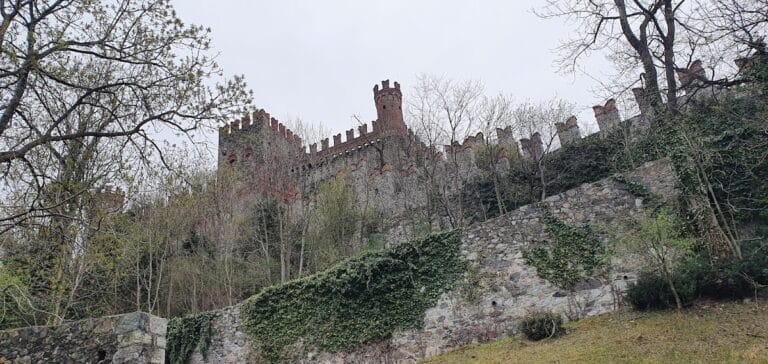
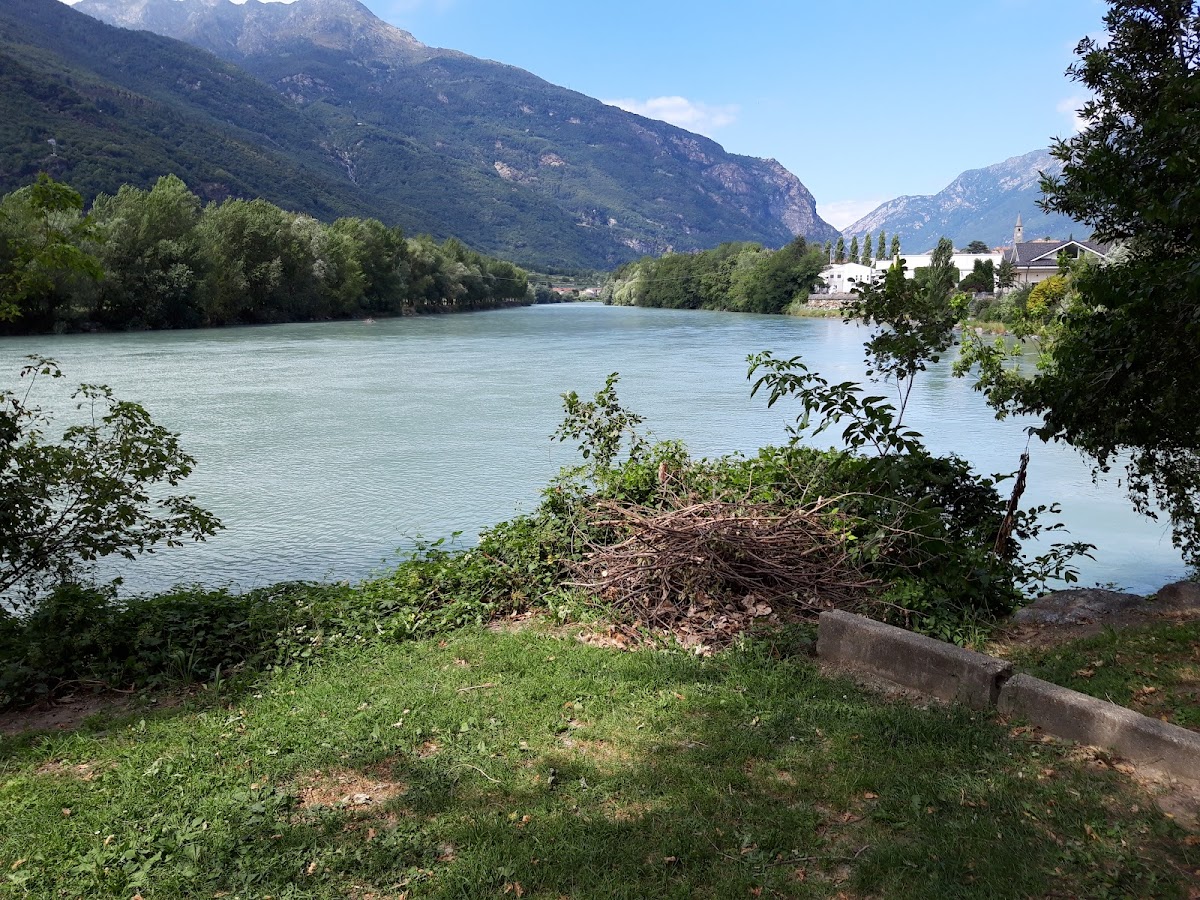
Montestrutto Castle occupies a rocky spur on the east bank of the Dora Baltea, above the village of Montestrutto in the commune of Settimo Vittone. The surviving complex is built in stone and is centered on the ninth-century defensive tower. Its present appearance is neo-Gothic, shaped by early twentieth-century rebuilding and by models taken from late-medieval castles in Piedmont, Liguria, Lombardy, and France.
Castle buildings and gardens
Defensive tower
The tower forms the core of the complex. Its original defensive function was connected with the protection of the neighboring Benedictine monastery. After the earlier structure was destroyed, General Fernando Pecco rebuilt the tower on its charred remains during the early twentieth century. The short extension added during his restoration was later removed when the Broglio family commissioned the castle’s reconstruction.
Neo-Gothic reconstruction
The Broglio rebuilding gave the castle its current medievalizing character. Vittorio Mesturino used nearby castles, especially Issogne, Fenis, and Montalto, as models for the interiors. Local carpenters, masons, and other artisans took part in the work, which also included the gardens. Carlo Gaudina later decorated the interiors with frescoes.
Church of San Giacomo
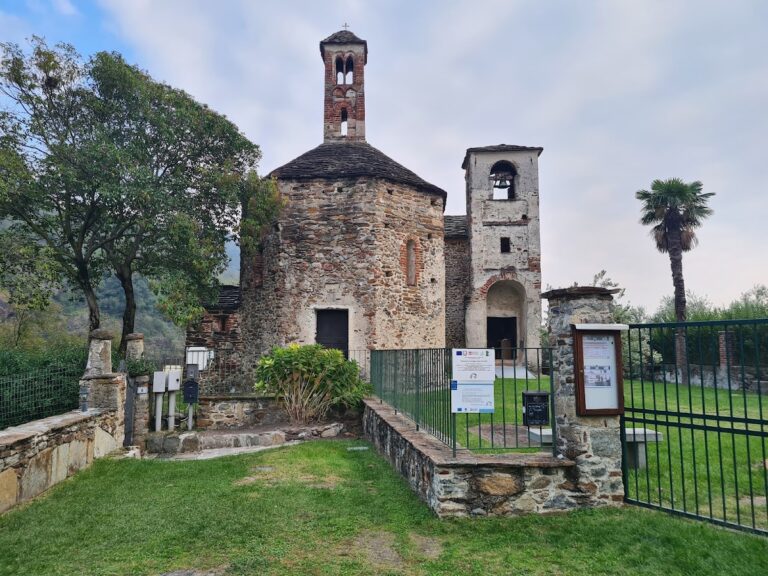
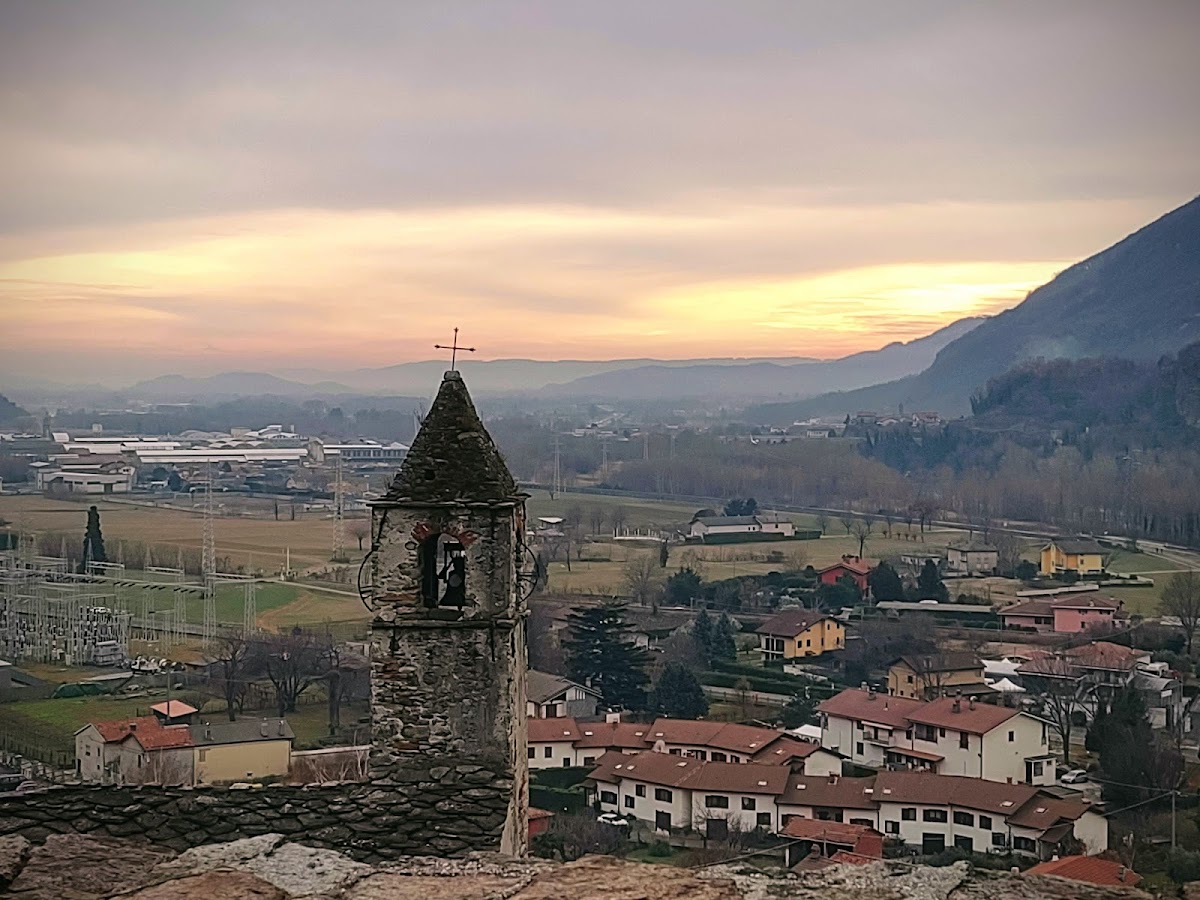
The castle complex includes the ancient church of San Giacomo. It forms part of the surviving group of buildings associated with the castle and its setting above the valley.