Pfarrkirche Wittichenau: A Late Gothic Parish Church in Germany


Site at a Glance
- Rating
- 4.9
- Popularity
- Very Low
- Country
- Germany
- Primary era
- Medieval
- External website
- Open
- Eras represented
- Medieval, Early Modern, Modern
- Civilizations
- German, Holy Roman Empire
- Site type
- Religious
- Remains
- Church
On this page12 sections
History
Pfarrkirche Wittichenau is a Roman Catholic parish church in Wittichenau, Germany, belonging to the parish of St. Mary’s Assumption in the Diocese of Görlitz. Built by the Catholic community as a late Gothic hall church around 1440, it became a richly furnished religious landmark in Upper Lusatia. Its vaulting was completed in 1527, and later generations expanded, restored, and refurnished the medieval building.
Rebuilding after the Hussite Wars
A predecessor church burned in 1429 during the Hussite Wars, a series of fifteenth-century religious and political conflicts that began in Bohemia and spread into neighboring regions, including parts of Lusatia. The present church was erected around 1440 as a substantial hall church. Its vaulting, completed in 1527, gave the building much of its late medieval structural character.
The church continued to develop over the following centuries. The southern vestibule has a medieval core and gained an upper story in 1678. An eastern sacristy, a southern baptistery, and a western vestibule were built in 1906. The former baptistery later became a confession chapel, while a northern vestibule was added in 1933.
Baroque devotion and local memory
Most of the interior furnishings date from the Baroque period, the seventeenth- and eighteenth-century style known for elaborate artistic and architectural design. The church preserves relics associated with Saint John Nepomuk, a fourteenth-century Bohemian priest and martyr, and Saint Boniface, an eighth-century missionary bishop and martyr.
In 1700, Pope Innocent XII gave an arm bone of Saint Boniface to the town chaplain Peter Laurenz Dubenka during a pilgrimage to Rome. The relic was intended as an aid against the frequent fires that affected the town. A votive panel from 1732, donated by Georg Schimon, contains earth from the grave of Saint John Nepomuk.
The church also preserves memories of figures connected with the region’s religious and political past. Four processional crosses were donated in 1719, including one decorated with acanthus ornament and four medallions. Johann Schadowitz was buried in the church in 1704. His memorial plaque identifies him as the historical model for Krabat, the Sorbian legendary magician and folk hero. Schadowitz served in the mounted Croatian Life Company of Elector Johann Georg II of Saxony, and his Croatian nationality contributed to the transformation of his name into “Krabat” and to the later development of the legend.
Restoration and later changes
The church underwent a comprehensive restoration in 1933 and 1934. From 1970 onward, alterations resulted in the removal of its colored windows and their replacement with plain glass. The surviving sections were restored and reinstalled in 2011 and 2012. These interventions form part of the building’s continuing history, in which medieval fabric, Baroque furnishings, and twentieth-century artistic work remain associated with the same parish church.
The west vestibule contains the 1754 tombstones of Friedrich Eberhard, Imperial Count of Solms, who died in 1752, and his wife Maria Carolina, who died around 1760. In the southeastern part of the churchyard stands a tomb monument donated in 1706 for the parents of the Meissen bishop Vitzk von Meissen. Its two deceased figures kneel within a small shrine-like architectural frame, although the monument is badly damaged.
Remains
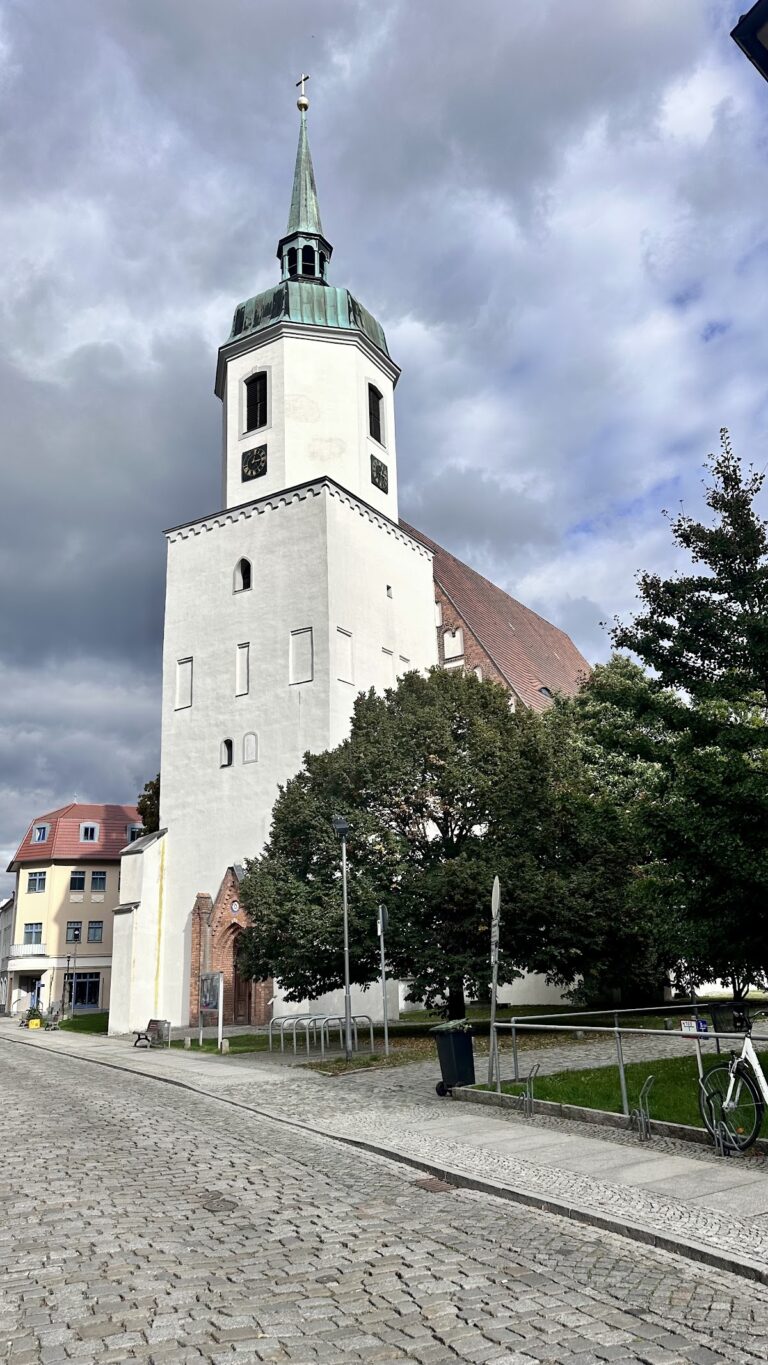
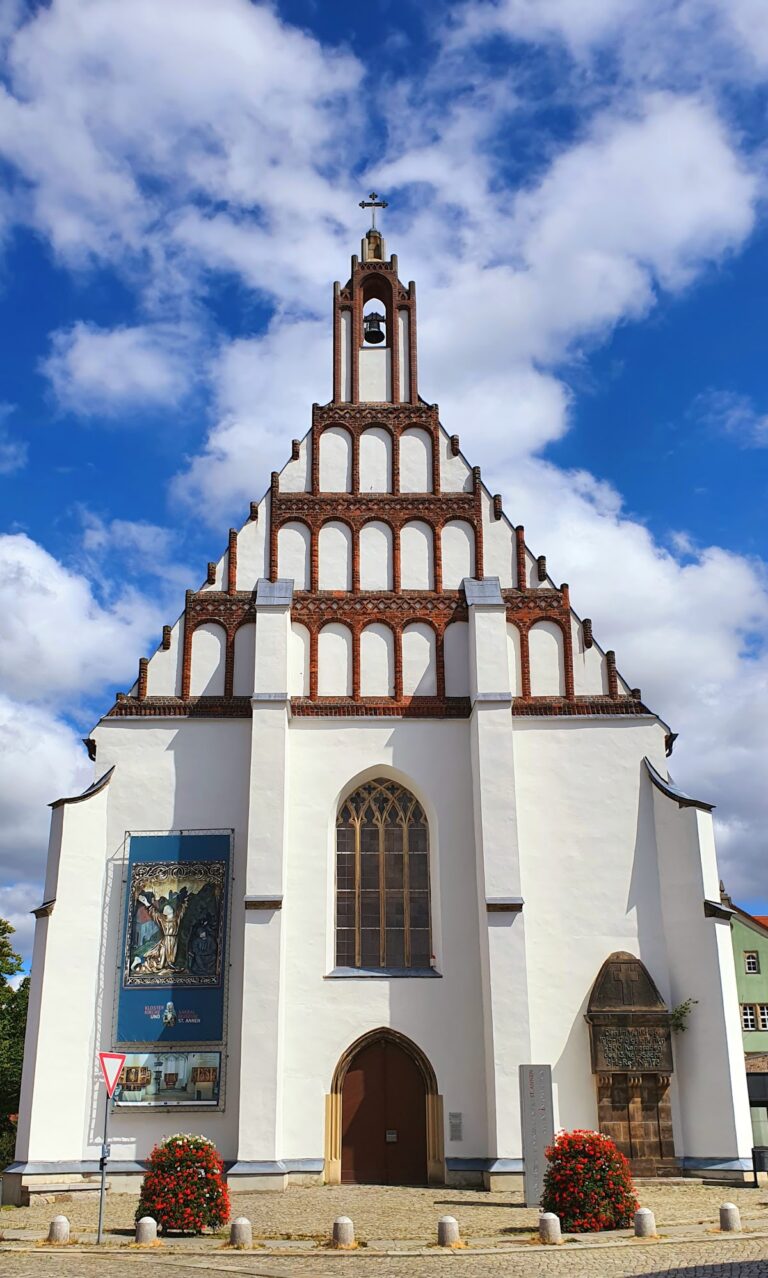
Pfarrkirche Wittichenau is a plastered, three-aisled and four-bay hall church, with a central nave rising above the side aisles in the form of a stepped hall. The building ends to the east in a five-eighths termination, a polygonal ending based on five sides of an octagon. Pointed-arch windows with renewed tracery, or ornamental stone window framework, and a gabled roof define the exterior. Stepped buttresses reinforce the walls.
Exterior and medieval structure
The west tower has a square ground plan and is shifted toward the north. Its lower section probably dates from the fourteenth century. The tall octagonal bell stage was added in 1846, followed by the half-story above it and the spire in 1867. A sandstone figure of the enthroned Christ giving a blessing stands on the southern vestibule. Dated 1710, the sculpture was donated by the sculptor Georg Vater.
Inside, octagonal piers carry the pointed-arch arcades between the central nave and side aisles. Half-pillars are attached to the side-aisle walls. At the eastern end, a single-bay choir with an ambulatory, a passage around or behind the choir, completes the plan. The central nave has a star vault, whose ribs form a star pattern, while the side aisles have net vaults with interlacing ribs.
The western bays of the side aisles contain galleries with vaults beneath them. The southern gallery has a probably late Gothic cell vault divided into compartment-like sections. The northern gallery has a groin vault dated 1614. Together, these elements show how the church’s medieval spatial arrangement incorporates later structural work.
Altars and baptismal furnishings
High altar
The wooden high altar was made in 1722 and 1723 by Mathias Wenzel Jäckel of Prague, a Baroque sculptor known for ecclesiastical sculpture and altar design. Set between the eastern free-standing piers, it has a tall aedicule, a small shrine-like architectural frame, openwork side wings, and a broad broken entablature. Its high upper section is crowned by the Eye of Providence, an eye within a radiating glory representing divine watchfulness.
The central painting shows the Assumption of the Virgin Mary. Heinrich Ledschbor painted it in 1870. Carved figures of John the Baptist and Saint George flank the painting, while the upper section contains a representation of the Trinity and figures of Saints Benno and Donatus. Figures of Saint John Nepomuk, dated 1758, and Saint Boniface, dated 1756, stand on the free-standing piers.
Ambulatory altars
The Rosary altar in the southern ambulatory dates from 1675. Its painting of the Rosary Madonna is framed by columns decorated with vine leaves. Saints Dominic and Catherine of Siena, shown in religious dress, worship the Madonna, while fifteen medallions around the scene represent the Mysteries of the Rosary, the meditations at the center of this Catholic devotional prayer. Carved figures of Joachim and Anne, traditionally regarded as Mary’s parents, stand on the retable, the decorated structure behind the altar.
The Nativity altar in the northern ambulatory dates from 1681. Its central relief presents the Adoration of the Magi in a richly populated carved scene dating from 1520 to 1530. The relief therefore predates the altar that now frames it and preserves an earlier work within the later Baroque furnishing scheme.
Baptismal font
The wooden Baroque baptismal font was made around 1725. It consists of a tapering hexagonal shaft and a circular basin. Its cover carries a finely carved Baptism of Christ group mounted on three volute feet, spiral-shaped architectural supports. The group was probably made by Mathias Wenzel Jäckel, who also created the high altar.
Sculpture, paintings, and memorial works
Other carved works include a Saint Veronica from the beginning of the sixteenth century, a double Madonna in a radiating halo from the second half of the seventeenth century, and a carved relief of the Agony in the Garden from the end of the fifteenth century. A fully three-dimensional sculpture of Maria Regina dates from around 1670 to 1680.
The sacristy contains a Baroque crucifix retaining its old finish and dating from the late seventeenth century. It also holds a painting of the Baptism of Christ made in 1597 by Andreas Dreßler of Kamenz. The painting formerly served as the central image of the altarpiece in the baptistery.
The west vestibule preserves the tombstones of Friedrich Eberhard and Maria Carolina, while the southeastern churchyard contains the damaged tomb monument for the parents of Vitzk von Meissen. The monument’s kneeling figures are placed within an aedicule, linking its memorial function to the architectural language also used by the high altar.
Stained glass and organ
The church’s stained-glass cycle was created from 1933 onward by the Dresden artist Hubert Rüther and manufactured by Beier and Walther in Dresden. The cycle forms an expressionist program of stained-glass art. Five nave windows present invocations from the Litany of Loreto, a Catholic litany using titles associated with the Virgin Mary: Mystical Rose, Gate of Heaven, Ark of the Covenant, Strong Tower of David, and Morning Star. They are arranged from southeast to northwest.
Four choir windows contain figures or symbols associated with Saints Elizabeth and Joseph, the Sacred Heart of Jesus, and the Heart of Mary. The organ-gallery windows depict sections of the Magnificat, Mary’s biblical hymn of praise in the Gospel of Luke. During the alterations begun in 1970, the colored window panels were removed. The surviving sections were later restored and reinstalled in 2011 and 2012, while reconstructions used Rüther’s full-scale charcoal cartoons, his watercolors, and historical photographs.
A two-manual mechanical tracker organ with 21 stops was built in 1981 by W. Sauer Orgelbau of Frankfurt an der Oder. In this type of organ, the keys operate the valves mechanically through connecting actions, while each stop controls a set of pipes with a particular tonal character.