Sant’Andrea Apostolo: Chioggia’s Historic Catholic Church


Site at a Glance
- Rating
- 4.5
- Popularity
- Low
- Country
- Italy
- Primary era
- Early Modern
- Eras represented
- Medieval, Early Modern, Modern
- Civilizations
- Italian, Venetian
- Site type
- Religious
- Remains
- Church
On this page21 sections
History
Sant’Andrea Apostolo is a Catholic church in Chioggia, Italy, and is described as the city’s oldest religious building. Its earliest traces date to the tenth century, when it had a Byzantine-style Latin-cross plan divided into three aisles by rows of columns. The church became an episcopal center in 1110, when the episcopal see was transferred from Malamocco to Chioggia.
Episcopal Church and Relic Shrine
After the transfer of the episcopal see, Sant’Andrea became the episcopal church. It housed the relics of Saints Felix and Fortunatus, Christian martyrs venerated as patron saints in the region. The relics remained there until the Church of the Nativity of Mary was enlarged and assumed the role of cathedral.
The relics returned to Sant’Andrea after the cathedral fire of 1623 and stayed there until 1659. They were brought back again in 1910 for the eighth centenary of the transfer of the episcopal see to Chioggia. These movements linked the church to the city’s episcopal history and to the public veneration of its patron saints.
Eighteenth-Century Restoration
By the beginning of the eighteenth century, the church had developed structural problems. Planned works were delayed in 1739, when the apse of the nearby Church of San Giacomo collapsed and funds assigned by the Cathedral Congregation were redirected to that emergency.
Francesco Grego, a canon of Sant’Andrea, organized fundraising himself, allowing work to begin in 1741. The project was attributed to the architect Andrea Tirali and carried out by Tranquillin Carisi. It radically restored and enlarged the existing church rather than replacing it with an entirely new building.
Pope Pius VI stopped in Chioggia in 1782. On that occasion, Sant’Andrea received the privilege of making a plenary indulgence available. In Catholic teaching, a plenary indulgence concerns the remission of the temporal consequences of sin when the prescribed conditions are met.
Parish Church and Later Conservation
In 1809 Sant’Andrea became an autonomous parish. Before then, a canon of the cathedral had administered it. Following restoration work, the church was reconsecrated on 21 September 1815. The high altar made that year carries an inscription recording the contribution of the Fishers’ Guild, an organized association representing people in the fishing occupation.
The church is also associated with the Chioggia artist Aristide Naccari, who was baptized there and received his funeral rites there. A commemorative plaque between the altars of Sant’Andrea and Sant’Anna records the connection. Later restoration campaigns included extensive interventions in 2001–2002 and from 2011 to 2014. These works stabilized the main structure, addressed rising damp in the walls, and adapted the presbytery for contemporary liturgical use.
Remains
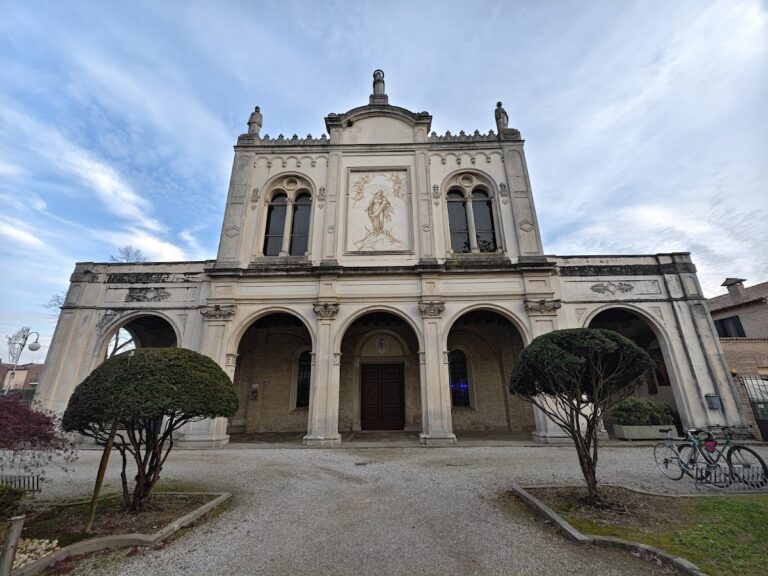
Sant’Andrea Apostolo retains a Latin-cross layout, with a long central axis crossed by a shorter transverse section and three aisles divided within the church. The building is approximately 21 metres wide and 40 metres long, while the dome rises to 17 metres. Its Baroque exterior, medieval campanile, decorated interior, altars, organs, and painted surfaces preserve evidence of successive phases from the tenth century to the twentieth century.
Exterior and Medieval Tower
Baroque Facade
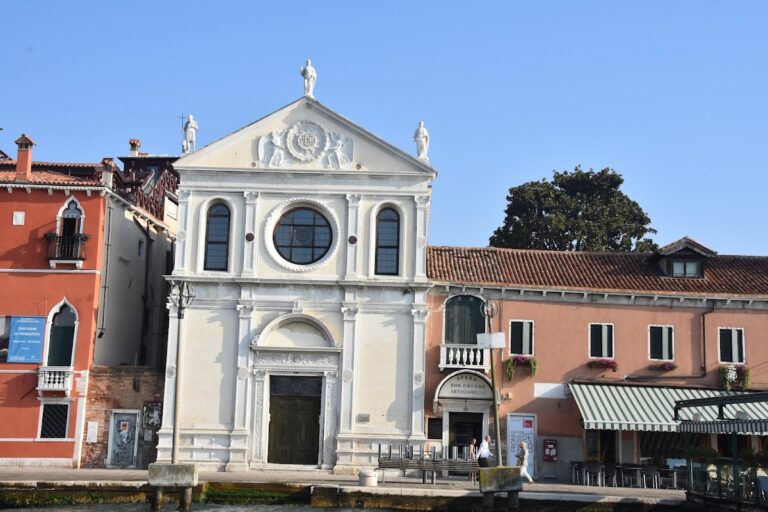
The Baroque facade is 15.80 metres high and has a gabled composition. Saint Andrew stands at the center of the semicircular pediment. Saints Peter and Paul occupy bases beside the central section, while Saints Vitus and Modestus crown the lateral sections. Saint Andrew was one of the Twelve Apostles of Jesus and is traditionally regarded as the brother of Saint Peter.
Campanile and Tower Clock
The campanile incorporates a medieval watchtower dating approximately from the middle of the tenth century. It contains the world’s oldest functioning tower clock, preserving a medieval defensive structure within the later religious complex.
Altars and Devotional Furnishings
Altar of Saint Vitus
The Altar of Saint Vitus contains marble elements acquired in 1751 from the Church of Saint Francis within the walls. Its altarpiece was painted by Palma il Giovane in 1595. The work is connected with the Tiepolo Baiamonte Conspiracy of 1310, a failed attempt by Venetian nobles to overthrow the government of the Republic of Venice. Chioggia’s podestà, or appointed civic governor, Ugolino Giustinian helped suppress the conspiracy, which was associated with the liturgical feast of Saints Vitus and Modestus. A marble statue of Saint John Nepomuk stands in front of the altarpiece.
Altar of the Annunciation
The Altar of the Annunciation contains a late-seventeenth-century altarpiece by Antonio Zonelli, a painter from Chioggia.
Altar of Our Lady of Sorrows
The Altar of Our Lady of Sorrows centers on a wooden statue carved by Antonio Chiesa in 1730. The statue was transferred from the Church of Saint Francis within the walls in the middle of the eighteenth century. The altar was later enriched with seven canvases by the Chioggia painter Antonio Vianelli, known as Toccia. Together they illustrate the Via Matris, a devotional practice meditating on the sorrows of the Virgin Mary through a series of stations or images.
The altar underwent several alterations in the late nineteenth century. In 1909, Aristide Naccari designed a major intervention that created a projecting niche extending 35 centimetres from the perimeter wall.
High Altar
The high altar was made in 1815 with assistance from the Fishers’ Guild, whose contribution is identified by an inscription on its base. The angels beside the altar came from the Church of the Humility in Venice.
Other Altars
The Altar of Saint Andrew has an altarpiece by Achille Brusomini Naccari and a wooden statue by an unidentified artist. The Altar of Saint Anne contains an altarpiece painted by Antonio Marinetti in 1770, while its altar table was replaced during the 2014 restoration. The Altar of the Sacred Heart has a wooden statue made by Vincenzo Moroder in 1960 and donated by De Stefani.
Baptistery and Interior Decoration
Baptistery
The baptistery occupies the left side chapel. Behind its baptismal font is an ancient late-fifteenth-century tabernacle used as a reredos, or decorative backdrop behind an altar. The work is attributed to Tullio and Antonio Lombardo. The Della Rosa family donated it to the church, and it bears both the family’s symbol and that of Bishop Bernardino Venier, who led the diocese when the donation was made.
Painted Surfaces and Sculptures
Several niches contain wooden statues painted to imitate marble. The ceiling and parts of the walls carry decoration made with both fresco and secco techniques. Fresco is painted onto fresh plaster, while secco painting is applied to dry plaster. The decoration includes geometric and naturalistic motifs, references to navigation and lagoon fishing, and large Latin inscriptions recounting episodes from the life of Saint Andrew.
Three medallions in the central aisle show The Calling, The Martyrdom, and The Glory of Saint Andrew. Giuseppe Cherubini painted them in 1929. In the mid-nineteenth century, Achille Brusomini Naccari decorated the transept with Marian symbols, biblical episodes, and scenes from the life of Saint Andrew.
The upper part of the dome represents the glory of Paradise. The areas above the windows show the theological virtues, and the spaces between the windows contain ranks of musical angels. The pillars depict the four Evangelists, in works by Giuseppe Cherubini. At the rear of the presbytery, the area around the main altar reserved for the clergy, a roundel depicts Saint Andrew by Antonio Marinetti. The apse ceiling shows the Ascension of Saint Andrew, begun by Giuseppe Ponga and completed by Giuseppe Cherubini.
Floors and Organs
Raised Floor
At the beginning of the seventeenth century, the floor was raised by 30 to 40 centimetres to protect the interior from high water. During the works of 2011–2014, it was removed because the cavity between the old and new floors had accumulated a dangerous level of moisture.
Principal Pipe Organ
The principal pipe organ was built by Gaetano Callido in 1804. Domenico Malvestio renovated it in 1914 and 1929, and an electric ventilator was added in 1948. The instrument has two 47-key manuals, or keyboards, with short octaves, an arrangement in which the lowest octave uses a reduced chromatic range. It originally contained 1,029 pipes: 567 for the positive manual, 426 for the expressive manual, and 36 for the pedals. It now has 989 pipes. Its original arrangement included 22 real stops operated by 33 draw levers, including a control for the full organ sound.
Portable Organ
The church also has a portable pipe-and-electronic organ commissioned in 2002 from Arte Organaria of Alessandro Girotto in Postioma. It has approximately 70 pipes, two 61-key manuals, and a concave-radial pedalboard with 32 pedals.