Ermita de San Pedro de Usún: A Medieval Monastic Site in Spain


Site at a Glance
- Rating
- 4
- Popularity
- Very Low
- Country
- Spain
- Primary era
- Early Modern
- Eras represented
- Medieval, Early Modern
- Civilizations
- Kingdom of Navarre
- Site type
- Religious
- Remains
- Church
On this page10 sections
History
Ermita de San Pedro de Usún is a historic Christian hermitage in Spain, located at Usún in Navarre, within the municipality of Romanzado. Its origins lie in the ninth-century pre-Romanesque monastic network of the Pre-Pyrenees, whose communities were founded in secluded places and influenced by the Carolingian world, the political and cultural sphere of the Carolingian dynasty and the Frankish empire.
Foundation in the ninth century
Originally known as the Monastery of Usún, the institution was one of Navarre’s oldest monasteries. Its church was consecrated to Saint Peter on 28 October 829 by Opilano, bishop of Pamplona, and the building was constructed during the first half of the ninth century.
Around 851, Saint Eulogius of Córdoba, a Christian cleric and writer, is believed to have visited Usún while travelling among the monasteries of the Navarrese Pyrenees. He made the journey after an unsuccessful attempt to reach Gaul, at the suggestion of the bishop of Pamplona. At Leyre and Siresa, he obtained Christian and classical works for Mozarabic communities, Christians living under Muslim rule in al-Andalus.
Royal patronage and ecclesiastical authority
In 924, Sancho Garcés I, the first monarch of the Kingdom of Pamplona, visited several monasteries while seriously ill. He believed that he recovered at San Pedro de Usún, although he died the following year. During his brief recovery, on 28 October 924, he gave the monastery and the nearby village of Usún to the Church of Pamplona. The gift also included vineyards at Arboniés near Sangüesa and lands at Ull on the Onsella, in Zaragoza.
The monastery received further donations from Sancho Ramírez, who ruled both the Kingdom of Aragon and the Kingdom of Pamplona, during the eleventh century. A papal document of 1146 placed Usún under the authority of Pamplona Cathedral. The institution later became associated with the cathedral office of archdeacon, a senior ecclesiastical official who assists a bishop and may oversee a defined territorial or administrative jurisdiction.
Juan Périz de Estella was one of the notable archdeacons of San Pedro de Usún. In 1330, he promoted the construction and decoration of the refectory at Pamplona Cathedral. An inscription beneath the refectory’s Crucifixion fresco identifies him as an official of the cathedral chapter and as archdeacon of San Pedro de Usún.
Transformation into a hermitage
A new monastery was built at the end of the eleventh century. After its monastic period, the institution passed under Pamplona Cathedral and eventually became a hermitage. A major remodeling in the eighteenth century destroyed the medieval building and produced the structure that largely corresponds to the present Ermita de San Pedro de Usún. The hermitage was reconstructed with archaeological rigor in 2006.
The site remains associated with Catholic worship, the Benedictine order, the Diocese of Pamplona and Tudela, and the dedication to Saint Peter. In his papal aspect, Saint Peter was the focus of a local appeal for rain during droughts. Worshippers carried his image outside the church in a prayer procession and threatened to throw it into the Salazar River if their prayers went unanswered. The pilgrimage took place on the Monday before Ascension and drew pilgrims carrying crosses.
Remains
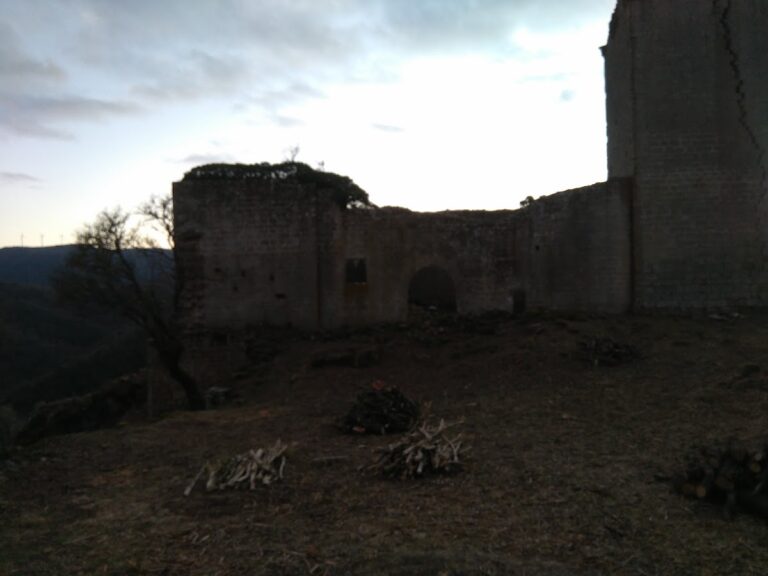
Ermita de San Pedro de Usún stands at the exit of the Arbayún Gorge, on a cliff above the left bank of the Salazar River. The surviving complex combines fragmentary remains of the early monastery with the eighteenth-century hermitage and a separate adjoining building. Its construction materials and forms reflect the different periods represented at the site.
Early monastic remains
Only part of a wall survives from the original pre-Romanesque monastery. It is built in a herringbone masonry pattern, with the stones arranged in sloping courses. Comparable masonry appears in the tenth-century walls of Javier and Pamplona and in the walled enclosure of Olite.
Surviving buildings
Hermitage church
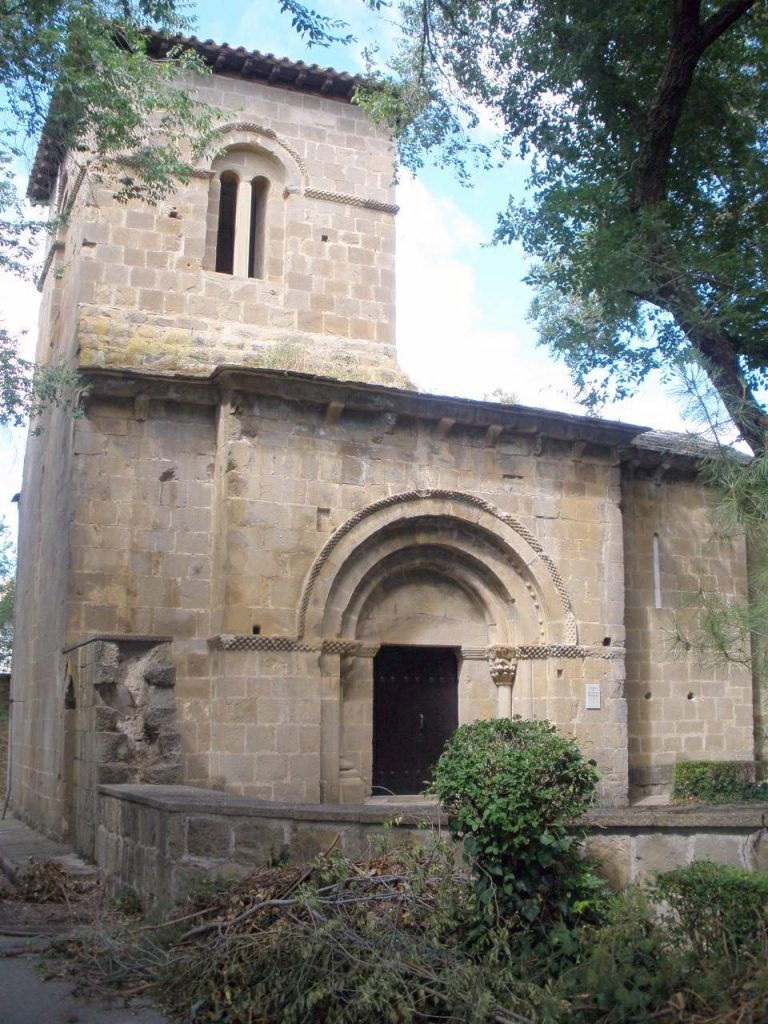
The present hermitage is a rectangular structure made from highly irregular rubble masonry and covered by a two-sided pitched roof. Its apse, the end of the church containing the sanctuary, has a straight termination. The south wall contains the only doorway, which is closed by a semicircular arch. A Romanesque chrismon, a Christian monogram incorporating the Greek letters chi and rho as a symbol of Christ, is set above the entrance. Four small heads project beyond its circle, including two human heads, and may represent the Tetramorph, the fourfold symbolic representation of the Evangelists.
The same south wall contains the building’s three rudimentary windows. A carefully worked cobbled pavement bears the date 1737, linking the surviving floor to the eighteenth-century remodeling.
Adjoining building
A separate building adjoins the hermitage on its eastern side and may have been intended to house pilgrims. Its features include a lintelled doorway, a roughly made twin window with pointed arches, and a skylight that serves as the only opening on the ground floor.
Devotional sculpture
Saint Peter is represented by a seated polychrome wooden sculpture. The painted figure wears the triple tiara and holds the keys. The Baroque carving may date from the seventeenth century.