Veitskapelle: A Late-Gothic Chapel in Stuttgart, Germany


Site at a Glance
- Rating
- 4.5
- Popularity
- Very Low
- Country
- Germany
- Primary era
- Medieval
- External website
- Open
- Eras represented
- Medieval, Early Modern, Modern
- Civilizations
- Holy Roman Empire
- Site type
- Religious
- Remains
- Chapel
On this page16 sections
History
Veitskapelle is an evangelical, late-Gothic chapel in Mühlhausen, Stuttgart, Germany, founded by the local noblemen Reinhart and Eberhart von Mühlhausen in 1380. Dedicated to Saint Vitus, also called Saint Veit, it was completed in 1385 and became a place of daily prayer closely connected with its founders and their links to Prague.
Foundation and Prague connections
Reinhart and Eberhart served the Württemberg count at the court of Emperor Charles IV, held senior offices, and acquired citizenship in Prague. They commissioned craftsmen from the building lodge of Prague’s St Vitus Cathedral and chose the same patron saint for their chapel. The foundation stone was laid on 21 May 1380. Eberhart died in 1384, before construction was complete, and the foundation required a daily requiem Mass, first for him and later for Reinhart. The building was completed in 1385, and its interior was painted in successive phases soon afterward.
Veitskapelle stood only a few metres from the former castle chapel of Heidenburg, the Walpurgis Church. That building had served as Mühlhausen’s parish church since at least 1275, giving the new chapel a place within an already established religious landscape. At its consecration on 28 September 1385, Veitskapelle received a winged altar made in the workshop of the Prague painter Theoderich of Prague.
Mühlhausen under changing lords
During the fifteenth century, Württemberg sold Mühlhausen to the Lords of Neuhausen, and the village passed to the Lords of Kaltental in 1461. Mühlhausen became a knightly village and later changed hands among several families before coming under the Lords of Palm in 1728. It did not return to Württemberg’s state territory until 1806. The village’s distinctive political status helped protect the chapel and its furnishings during the Reformation, the sixteenth-century movement that reshaped Western Christianity and church organization.
Engelbolt von Kaltental introduced the Reformation in Mühlhausen around 1567. Unlike in Württemberg more broadly, the change was not accompanied by the same opposition to religious images. The chapel therefore retained its medieval paintings and furnishings. The daily service established by the founders continued until 1783, preserving a religious practice that had linked the building to its original foundation for almost four centuries.
Decline, restoration, and wartime survival
The daily service ended completely after Russian soldiers used the chapel as a magazine while passing through the area in 1813. Veitskapelle was later used as a farm or utility building and fell into danger of decay. The Lords of Palm, who retained the chapel’s patronage until 1927, undertook a thorough restoration between 1874 and 1880 for the 500th anniversary of its foundation.
On 15 April 1943, an air raid by the Royal Air Force destroyed the nearby Walpurgis parish church and much of the surrounding housing. Veitskapelle lost part of its roof and its windows but survived. From May 1943, it served as the parish church of the evangelical congregation. Later twentieth-century work included the renovation of its valuable medieval furnishings in the 1980s. A conservation campaign from 2010 to 2012 renewed the roof, replastered the exterior walls with historical lime mortar, conserved the wall paintings, and repaired damage caused by earlier restorations.
Remains
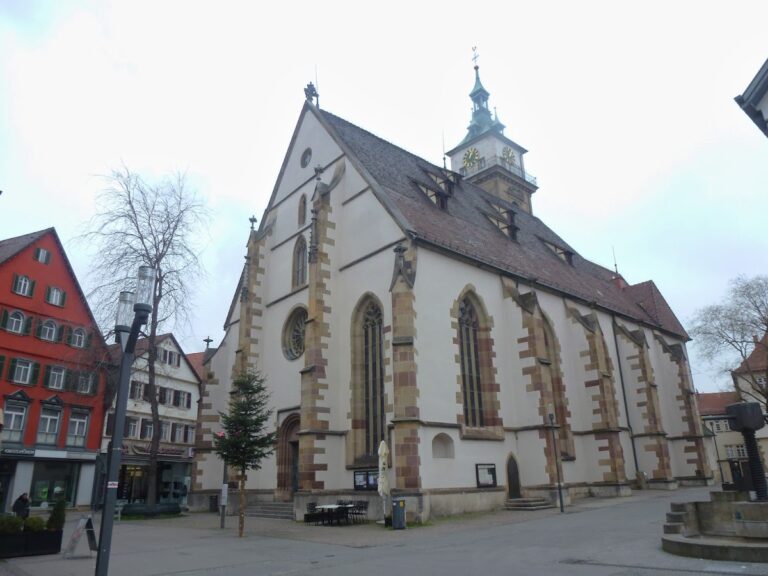
Veitskapelle has a simple longitudinal plan, with a rectangular hall-like nave and a vaulted choir. Together they measure about 23 metres in length and 11 metres in width. A square tower rises at the west end, while the choir terminates in a polygon and is lit by large Gothic windows with stone tracery. The roof timbers date from 1382 to 1383 according to dendrochronology, a method that dates wood by comparing its annual rings with established tree-ring sequences.
Exterior and painted interior
Portals and roof
The north and south Gothic portals carry the coat of arms of the Lords of Mühlhausen, a shield showing three mill irons. Inscriptions beside the arms commemorate the chapel’s foundation. The nave has a flat timber ceiling, while the choir is vaulted. The Gothic ceiling, the stone canopies above figures at the chancel arch, and the gallery installed in 1480 retain painted decoration from the chapel’s earlier artistic program. The southern canopy includes several coats of arms, among them that of Mühlhausen.
Wall paintings
The interior was painted in several phases between 1385 and 1440, and the paintings were never covered with whitewash. They are described as the best-preserved medieval wall paintings north of the Alps. Their subject is salvation history, extending from the Fall of Man to the Last Judgment. The nave originally held about sixty biblical scenes and a pictorial version of the Creed, the formal statement of Christian beliefs used in Christian worship. Fragments survive from a lower third row, whose place was supplemented by neo-Gothic ornament in the nineteenth century.
The earliest phase, dated to 1395, placed Christ, the Apostles, and the Prophets on the side of the chancel arch facing the nave. Each figure stands within an individual frame, carries a scroll with part of the Creed, and is identified by name. Fifteenth-century canopies later concealed parts of these paintings. Around 1440, the nave received two superimposed rows of scenes from the Old and New Testaments. The sequence begins with the Creation on the upper southern wall and ends with the Crucifixion above the right side altar at the chancel arch.
Choir paintings and imagery
Last Judgment
An inscription dates the choir paintings to 1428. Above the chancel arch on the west wall, the Last Judgment presents Christ within a mandorla, an almond-shaped frame used for sacred figures in divine glory. Mary and John the Baptist intercede beside him. Below, the dead rise from their graves, Peter leads the saved toward Paradise on the left, and devils pull the condemned toward Hell on the right.
Saints and biblical scenes
A Protective-Mantle Madonna occupies the northern side of the choir, while Peter receiving the saved into Paradise appears opposite it on the south. The spandrels contain scenes from the life of Mary. Lower wall paintings show the childhood of Jesus, fourteen scenes from the legend of Saint Vitus with explanatory German texts, and other saints. In the choir vault, angels fill the bay before the Last Judgment, alongside the symbols of the Evangelists and the Church Fathers Jerome, Augustine, and Ambrose. Bernard of Clairvaux appears in place of Gregory.
Altars and furnishings
Prague Altar
The first altar, known as the Prague Altar or Mühlhausen Altar, was presented at the chapel’s consecration in 1385. Its hinged wings could be opened or closed for different liturgical occasions. The feast-day panels show Saint Vitus with the Mühlhausen coat of arms and a martyr’s palm, beside Wenceslaus of Bohemia and Sigismund. Wenceslaus is associated with the transfer of Vitus’s relics to Prague. When closed, the wings show Christ as the Man of Sorrows above the kneeling founder Reinhart with his coat of arms, together with a Crucifixion group, the Annunciation, and the Coronation of the Virgin.
The reverse shows Reinhart and Eberhart von Mühlhausen beside another Crucifixion. The brothers hold scrolls bearing Latin prayers, while a German inscription records Eberhart’s death in 1384 and Reinhart’s altar foundation in the following year. The altar was displaced by the present high altar in 1510 and has been held by the State Gallery in Stuttgart since 1902.
High altar
The high altar installed in 1510 remains in the choir. Made in a Stuttgart workshop, it has a central shrine with five carved male saints arranged on a stepped platform. Saint Vitus occupies the centre, with Wenceslaus and Sigismund on one side and Hippolytus of Rome and Vitus’s teacher, Modestus of Lucania, on the other. The wings depict episodes from Vitus’s life and martyrdom. The cresting shows Vitus in a cauldron of boiling oil, the form associated with his martyrdom, between the martyrs Stephen and Lawrence of Rome. Christ with the Apostles appears on the predella, the horizontal base beneath the main altarpiece.
Side altars
Two similarly designed side altars stand beneath canopies in the nave beside the chancel arch. They probably came from the same workshop as the high altar and date from approximately the same period. The left winged altar presents Paul with a book and sword, Peter with the key to Heaven, and John the Baptist with the Lamb of God; its wings narrate the Baptist’s life.
The right altar has a shrine containing five female martyrs on a stepped platform: Dorothy, Catherine, Walburga, Barbara, and Agatha. Walburga stands at the centre, and the shrine is therefore believed to have come from the former high altar of the Walpurgis Church. It was removed during an eighteenth-century rebuilding of that church. Veitskapelle also contains epitaphs of the Lords of Kaltental, its church patrons, and artworks transferred from the destroyed Walpurgis Church, including an oil painting of Magdalena von Eyb, a benefactress of the community who was lady of the castle during and after the Thirty Years’ War.
Organ
The present organ was built by Horst Kenter in 1980. It has fourteen stops distributed across two manuals and a pedal, providing the chapel’s principal modern musical furnishing alongside its surviving medieval interior.