Dolmen D47: A Neolithic Passage Grave in Emmen, Netherlands
Site at a Glance
- Popularity
- Very Low
- Country
- Netherlands
- Primary era
- Stone Age
- Eras represented
- Stone Age, Modern
- Civilizations
- Dutch
- Site type
- Burial
- Remains
- Tomb
On this page5 sections
History
Dolmen D47 is a Neolithic passage grave, a burial chamber reached through a passage, in Haselackers, Emmen, the Netherlands. It dates to 3470–2760 BCE and is attributed to the Western Group, a regional grouping within the Funnel Beaker culture, a Neolithic culture named for its distinctive pottery.
Early references and ownership
The tomb appears on the Hottinger map dated 1788–1792. L. Willinge gave its first secure written mention in 1819. During the nineteenth century, the Dutch state acquired D47 from B. Jans, B. J. Haasken, and their associates in Noordbarge. It belonged to the state by 1878.
Nineteenth-century surveys
Leonhardt Johannes Friedrich Janssen, curator of the Dutch antiquities collection at the National Museum of Antiquities in Leiden, visited the tomb in 1847. His survey, published the following year, described Dutch megalithic tombs and included schematic plans. In 1874, his successor Willem Pleyte and photographer Jan Goedeljee systematically photographed Drenthe’s tombs; Pleyte also made lithographs from the photographs.
In 1877, Rijksmuseum director Conrad Leemans travelled independently through Drenthe, with Jan Ernst Henric Hooft van Iddekinge preparing plans of the tombs for him. Leemans’s report was not published. Concern in England that Dutch restoration work might obscure the tombs’ original appearance led the Society of Antiquaries of London, a learned society devoted to antiquities, to ask William Collings Lukis and Henry Dryden to survey them. They visited D47 on 22 July 1878, including it as Plan XXXVIII in their survey. Their report was not published at the time. Archaeologist Wijnand van der Sanden published their work in 2015 and judged it to be of high quality.
From 1904 to 1906, physician and amateur archaeologist Willem Johannes de Wilde made detailed plans, photographs, and descriptions of Dutch megalithic tombs; his notes on D47 are lost. Albert Egges van Giffen recorded the tomb in 1918 for his atlas of Dutch megalithic tombs.
Modern documentation and protection
D47 became a Dutch national monument in 1983, a heritage designation that provides legal protection. In 2017, photogrammetry, which uses photographs to make measurements or three-dimensional representations, recorded the tomb for an atlas project involving the Province of Drenthe, the University of Groningen, and the Gratama Foundation.
Remains
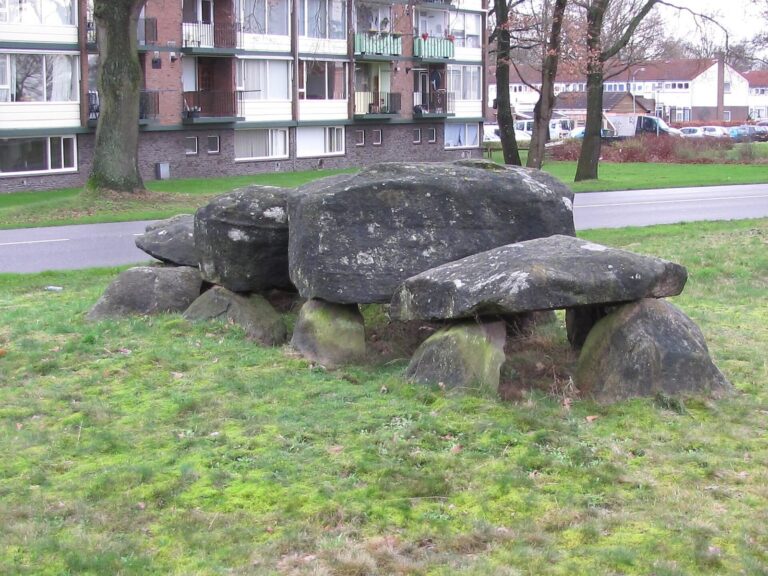
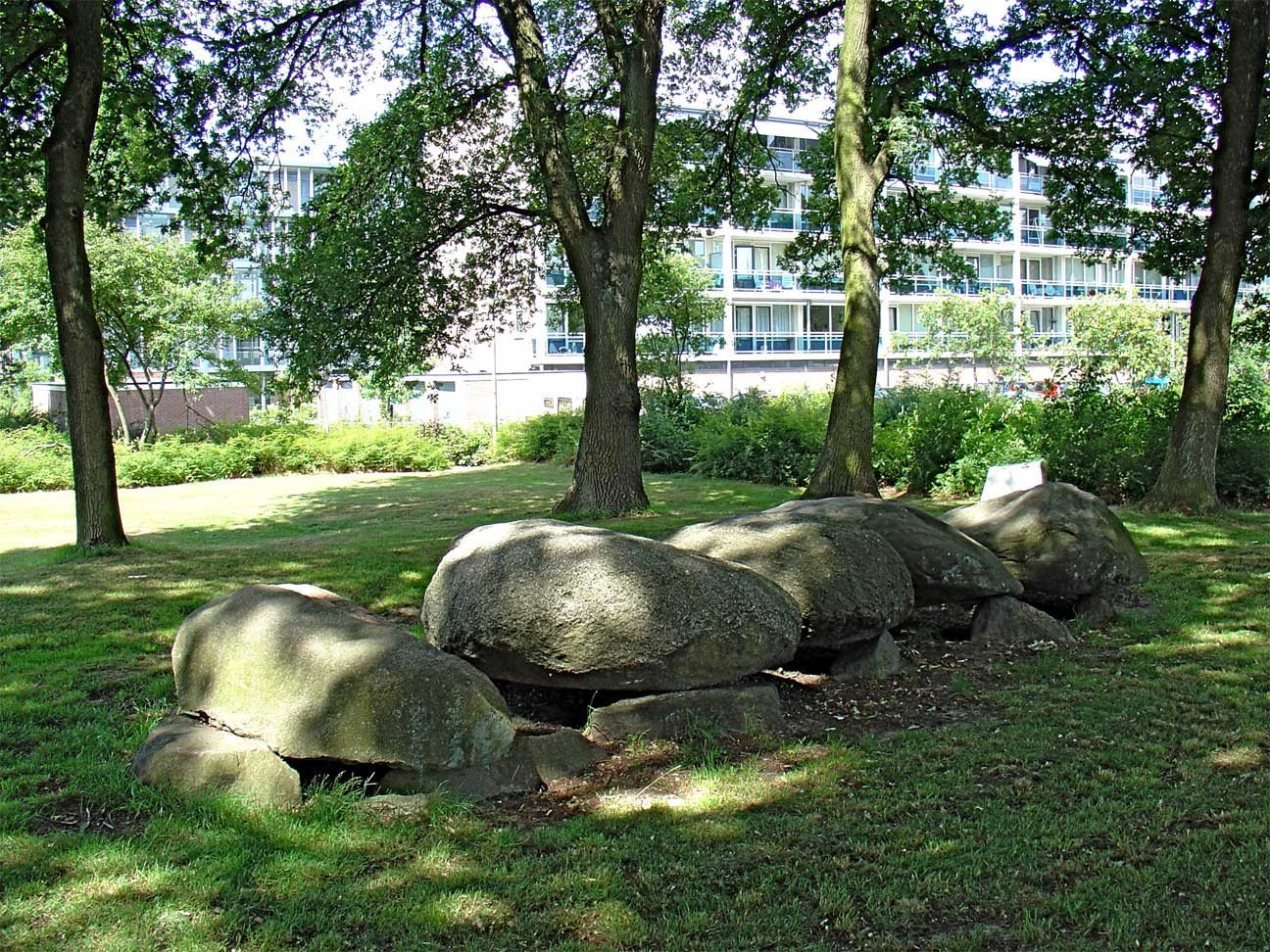
D47 stands on a green space in Haselackers, within Emmen’s Angelslo residential district. It has been situated in the middle of the district since about 1960, among apartment buildings. Nearby D46 lies about 330 metres to the north-northwest. The chamber is aligned south-southeast to north-northwest and measures 6.9 metres long by 2 metres wide.
Five pairs of side stones support the chamber, with a closing stone at each end. These ten supporting stones and two end stones are almost entirely below ground. The chamber now has five capstones. By 1918, only two of the original five remained. Restoration added a capstone brought from elsewhere in 1960, followed by two more in 1997, giving the tomb a complete appearance.
During their 1878 visit, Lukis and Dryden counted seven supporting stones and two surviving capstones. The western capstone remained in position, while the other lay inside the chamber. They also described a burial mound about 18 metres in diameter; van Giffen later noted remnants of it.
A complete funnel beaker recovered by Hofstede during a 1809 excavation of a megalithic tomb is now in the Drents Museum. It is uncertain whether the excavated tomb was D47 or nearby D46.