Patriarchal Palace: Episcopal Residence and Museum in Udine


Site at a Glance
- Rating
- 4.7
- Popularity
- Low
- Country
- Italy
- Primary era
- Early Modern
- External website
- Open
- Eras represented
- Early Modern
- Civilizations
- Venetian
- Site type
- Religious
- Remains
- Palace
On this page17 sections
History
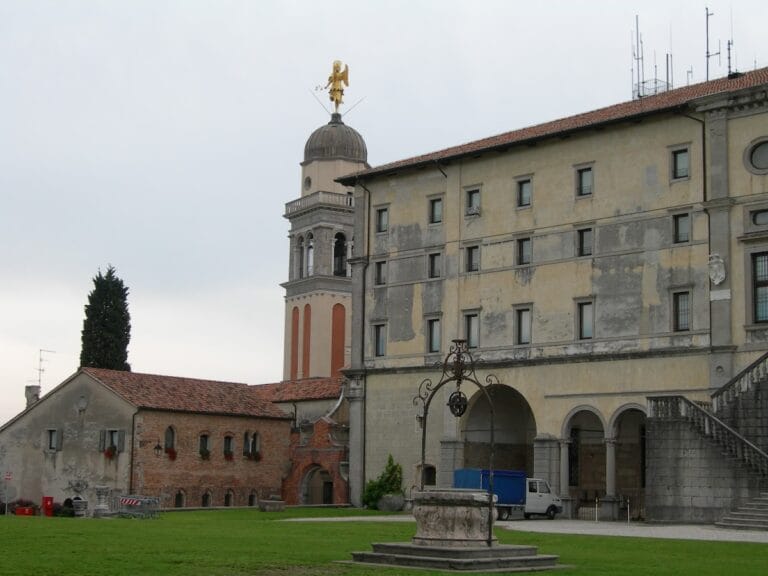
The Patriarchal Palace, also called the Archbishop’s Palace, is a sixteenth-century Renaissance residence in Udine, Italy, built for the patriarchs of Aquileia after they could no longer live in Udine Castle. The patriarchs were senior Christian bishops who held religious authority across the historical region of Friuli, and the palace became their principal residence in the city.
Sixteenth-century residence
The palace’s central body was constructed during the sixteenth century. Its role was closely connected with the position of the patriarchs of Aquileia, whose residence had to accommodate both their ecclesiastical authority and the ceremonial demands of their office. The building was later transformed through an extensive eighteenth-century rebuilding campaign.
Dionisio Delfino’s transformation
In 1708, Patriarch Dionisio Delfino commissioned the architect Domenico Rossi to expand and remodel the palace. The project included a new library wing, an oval staircase, the completion of the north wing, and the raising of the central body with a new portal. The ceremonial staircase was completed in 1725, giving the residence a more elaborate architectural and representational character.
Delfino also established the Delfiniana, or Archiepiscopal Library, in 1709. It was formally inaugurated in the summer of 1711 and became the first library in Udine opened to the public. Its holdings drew on the libraries of Giovanni Dolfin, Patriarch of Aquileia, Daniele Dolfin, who served as an apostolic nuncio, or papal diplomatic representative, in France, and Giovanni Battista Cornaro, the father of Elena Lucrezia Cornaro, regarded as Italy’s first woman to receive a university degree.
A separate library entered the palace’s institutional history in 1827, when Gregorio Bartolini and his sister-in-law Teresa Dragoni Bartolini donated the Bartoliniana to the episcopal curia of Udine. Its principal collection came from Count Antonio Bartolini, a bibliophile and collector of rare and valuable editions.
Museum and restoration
Archbishop Giuseppe Zaffonato founded the Diocesan Museum in 1963 to preserve and promote the ecclesiastical cultural heritage of the Archdiocese of Udine. The museum was first housed in the basement of the city’s archbishop’s seminary, while its transfer to the Patriarchal Palace had begun before the earthquake of 1976 severely damaged the building.
Following restoration, the Diocesan Museum and Tiepolo Galleries officially opened there on 29 April 1995. Since that year, the palace has served as their headquarters, alongside the Delfiniana, the Bartoliniana, and the historic rooms included in the museum route.
Remains
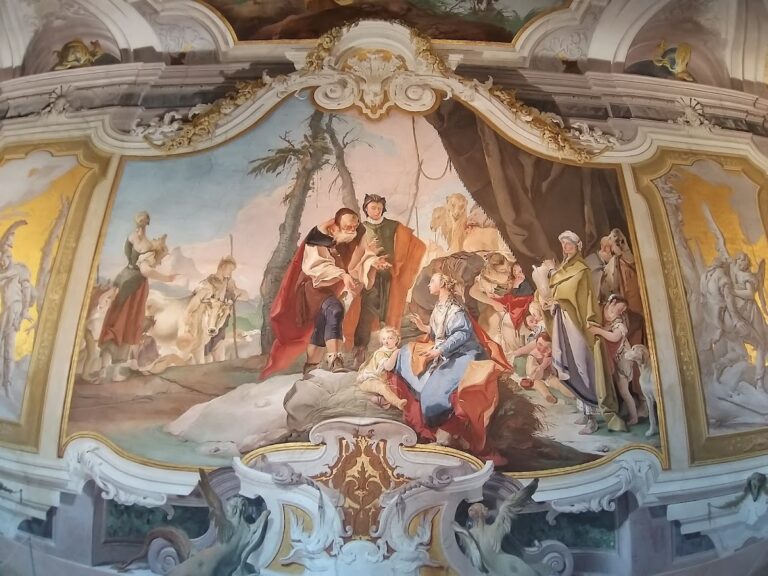
The surviving palace combines a Renaissance central body with eighteenth-century additions and richly decorated interiors. Its rooms, staircases, library, chapels, collections, and circulation spaces form the physical setting of the museum route. The building preserves architectural elements from both the sixteenth-century residence and Domenico Rossi’s later remodeling, while its painted decoration includes major works by Giambattista Tiepolo, an eighteenth-century Venetian painter known for large theatrical fresco compositions.
Staircases and ceremonial spaces
Ceremonial staircase
The grand ceremonial staircase, completed in 1725 and designed by Domenico Rossi, has a ceiling fresco of the Fall of the Rebel Angels painted by Giambattista Tiepolo in 1726. Grisaille, a technique using shades of gray to imitate sculpture, surrounds the central composition with scenes of the creation of humanity and the Fall of Humanity.
Spiral staircase
A spiral staircase dating from 1708 leads to the piano nobile, the principal ceremonial residential floor of an Italian palace. Its small dome was frescoed by Louis Dorigny, adding a distinct painted feature to the route between the palace levels.
Library and decorated rooms
Palace library
The piano nobile opens onto the palace library commissioned by Dionisio Delfino in 1708. Its decoration includes Portrait of the Patron and Triumph of Wisdom, two ceiling paintings by Niccolò Bambini. Eighteenth-century carved wooden shelving holds the Delfiniana’s approximately 11,000 volumes, including 514 manuscripts and 115 incunabula. Incunabula are books printed in Europe before 1501, during the early period of movable-type printing.
Blue Room
The Blue Room, also known as the Canopy Room, retains Renaissance decoration devoted to the Stories of the New Testament. Giovanni da Udine painted these frescoes between 1558 and 1560.
Red Room
The Red Room, also called the Ecclesiastical Tribunal Room, has a vaulted ceiling decorated with the Judgment of Solomon and the Prophets. Giambattista Tiepolo painted the frescoes in 1729.
Guest Gallery
The largest and most richly decorated room is the Guest Gallery, or Galleria degli ospiti. Between 1727 and 1728, Tiepolo painted scenes from the stories of the patriarchs Abraham, Isaac, and Jacob, including Rachel Hiding the Idols.
Other ceremonial rooms
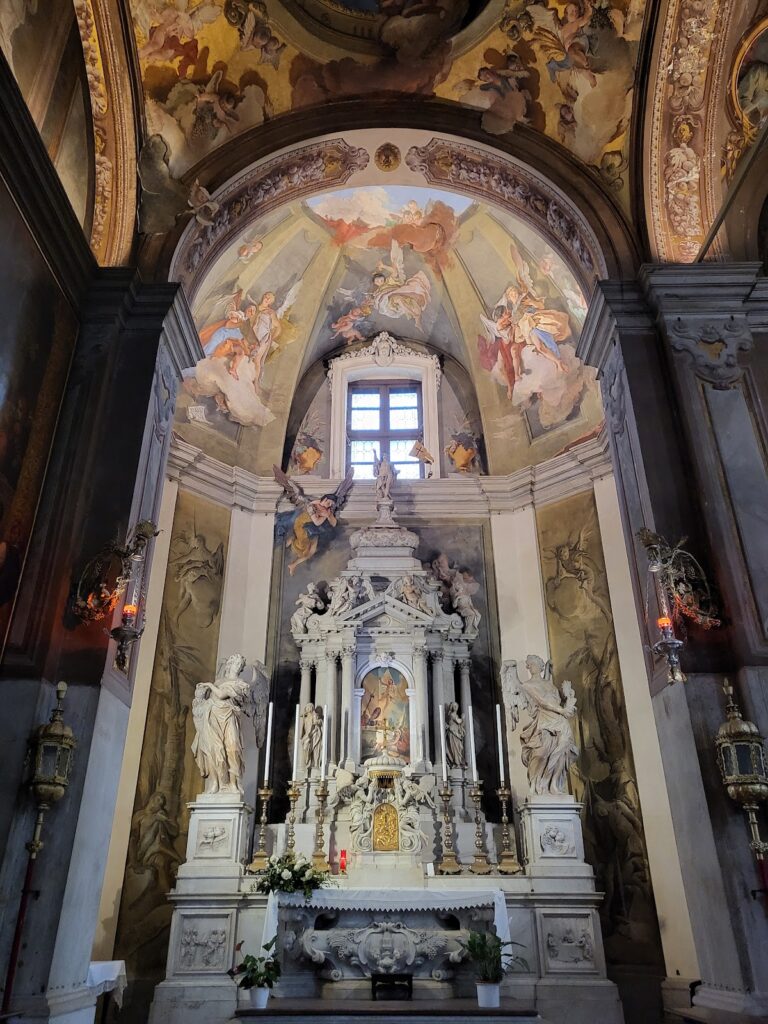
The museum route also includes the Throne Room and the Palatine Chapel. A Palatine Chapel is a private chapel associated with a palace or ruler’s residence. The chapel altar has a Madonna and Child by Palma the Younger, while the palace also preserves a private chapel and a patriarchal throne. The Yellow Room houses the numismatic collection of the patriarchs of Aquileia, a group of coins, medals, and related monetary objects.
Museum collections
Lapidary and sculpture rooms
The ground floor contains a lapidary displaying carved stone objects, including a pre-Romanesque stone pluteus. A pluteus is a carved screen panel once used to separate areas within an early Christian or medieval church.
Six first-floor rooms contain the museum’s wooden-sculpture collection, including 53 Friulian works made between the twelfth and eighteenth centuries. Among them are a fifteenth-century polychrome wooden sculpture of Saint Catherine of Alexandria by an anonymous sculptor from Friuli and the polychrome carved wooden Altar of Saint Barbara, made by Domenico da Tolmezzo during the second half of the fifteenth century.
Libraries
The separate Bartoliniana contains approximately 10,000 volumes, including 40 incunabula. Together with the Delfiniana, it preserves the book collections associated with the palace’s ecclesiastical and scholarly history.
The Diocesan Museum’s wider collection comprises approximately 700 works of sacred art from churches of the Diocese of Udine. These objects, together with the frescoed rooms and historic libraries, connect the palace’s former residential function with the religious and artistic heritage now conserved within it.
Nearby sites