Udine Cathedral: Cathedral of the Archdiocese of Udine in Italy


Site at a Glance
- Rating
- 4.6
- Popularity
- Medium
- Country
- Italy
- Primary era
- Early Modern
- External website
- Open
- Eras represented
- Medieval, Early Modern, Modern
- Civilizations
- Holy Roman Empire, Venetian
- Site type
- Religious
- Remains
- Cathedral
On this page19 sections
History
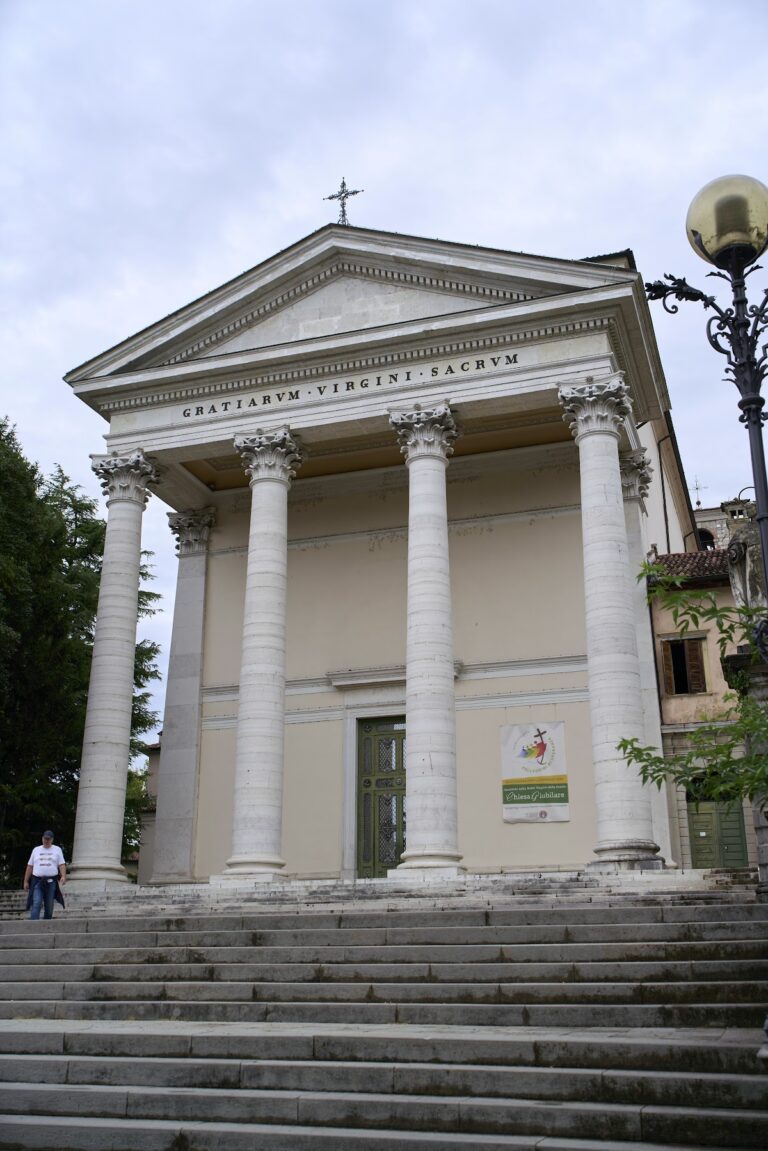
Udine Cathedral, formally the Metropolitan Cathedral of Santa Maria Annunziata, is a Roman Catholic church in Udine, Italy, and the seat of the Archdiocese of Udine. Built under the influence of the Franciscans in the thirteenth century, it has a Romanesque exterior with Gothic elements and a predominantly Baroque interior. The cathedral has been an Italian national monument since 1940.
Foundation and medieval rebuilding
Construction of the present cathedral began in 1236 at the request of Bertoldo of Andechs-Merania, patriarch of Aquileia. The church was initially dedicated to Saint Ulrich of Augsburg, and it was already being used for worship by 1257. After a series of modifications, it was consecrated in 1335 under the title of Santa Maria Maggiore.
A major earthquake in 1348 severely damaged the building, although religious services continued. Reconstruction did not begin immediately. In 1368, the Venetian master Pierpaolo dalle Masegne was commissioned to undertake the work, linking the cathedral’s later medieval fabric to the artistic networks of the Venetian territories.
Baroque transformation
The cathedral was almost completely reshaped in the eighteenth century by Domenico Rossi. The renovation was completed in 1735, when Patriarch Daniele Delfino reconsecrated the church as Santa Maria Annunziata. The Manin family financed the refurbishment of the presbytery, creating the marked contrast between the medieval exterior and the richly redecorated interior.
Delfino also shaped the cathedral’s artistic program through commissions and decisions concerning its chapels. He commissioned the Chapel of the Holy Trinity and personally financed the Chapel of Saints Hermagoras and Fortunatus. Contemporary documents state that he proposed the subject and composition of Giambattista Tiepolo’s altarpiece in the latter chapel and asked the painter to follow a work by Cesare Vecellio at Pieve di Cadore.
The cathedral’s collections preserve the memory of the Patriarchate of Aquileia, a major ecclesiastical jurisdiction in northeastern Italy whose patriarchs also exercised substantial political influence. The later Venetian political and religious order is represented as well. In the Chapter Room, a fresco cycle includes the suppression of the Patriarchate and the creation of the archiepiscopal sees of Udine and Gorizia.
Tower and later interventions
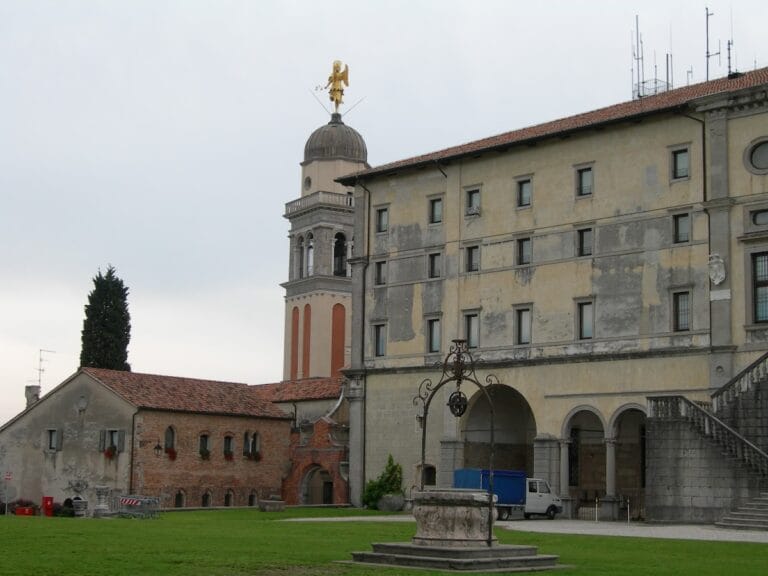
The attached campanile, or Italian bell tower, was begun in March 1441 to a design by Cristoforo da Milano under the supervision of Bartolomeo delle Cisterne. The original plan called for a tower competing in height with the castle bell tower and carrying a statue of the Virgin facing the angel on the castle tower. This would have evoked the Annunciation across the city. The ambitious scheme was abandoned, especially because building materials were in short supply, and the completed campanile remained broad and squat.
An early twentieth-century restoration sought to give the facade a fourteenth-century appearance. The suspended porch over the main portal, added in 1926, belongs to this intervention and has been described as a conspicuous historical false reconstruction. The cathedral complex continued to preserve evidence of successive religious, political, and artistic phases rather than a single period of construction.
Chapels and devotional foundations
The first chapel on the left, dedicated to Saint Mark, was established toward the end of the fifteenth century by Antonio Loredan, lieutenant of Friuli, and the Council of Udine. Giorgio Massari remodeled it in 1720. The Chapel of Saint Joseph was built in 1500 by order of the Council of Udine as a vow for protection against Turkish incursions after the devastation of Friuli in 1499. The body of Blessed Bertrando of Saint-Geniès, a medieval patriarch of Aquileia, was placed beneath its altar in 1971.
The Chapel of the Divine Providence was commissioned on 4 April 1720 by the confraternities of San Nicolò di Rauscedo and San Girolamo degli Schiavoni. It was first dedicated to those saints, but the image of the Madonna of Divine Providence was installed on 8 September 1789 at the request of the tailors’ confraternity. The Chapel of Saints John the Baptist and Eustace, originally in the presbytery, was built by the Arcoloniani family. During the eighteenth-century renovation it was moved with the family tomb, and the family arms were placed on the altar.
The Chapel of Saint Nicholas was built around 1330. During the eighteenth-century transformation it was joined to the adjoining Chapel of the Body of Christ, forming a single space. Its original structure was restored in 1953. The Chapel of the Body of Christ contains the seal from the tomb of Patriarch Nicholas of Luxembourg, marble inscriptions transferred from the deconsecrated church of Santa Lucia, and the remains of Blessed Elena Valentinis, which were transferred to the cathedral in 1845.
The present arrangement of the sacristy was designed and carried out by Luca Andreoli in 1776. It comprises the Room of the Mansionaries, the Chapter Room, and the vesting room. Mansionaries were cathedral officials responsible for assisting with the administration and regular service of the church. The crypt, reached by a stairway from the choir, contains the tombs of Archbishop Alfredo Battisti, Bishop Lucio Soravito De Franceschi, and Archbishop Pietro Brollo.
Remains
The cathedral has a Latin-cross plan with three naves divided by pillars. Four interconnected chapels open along each side, producing the effect of two additional aisles. Its exterior retains a Romanesque character with Gothic elements, while the interior reflects the extensive eighteenth-century Baroque transformation. The campanile rises from the pre-existing baptistery, whose base now forms part of the Cathedral Museum.
Medieval portals and baptistery
Portal of the Redemption
The fourteenth-century Portal of the Redemption is attributed to an unidentified German master. Its pointed arch and sharply pointed gable are crowned by the patriarchal eagle, while high-relief figures represent the Redemption. The suspended porch above it was added in 1926 during the restoration that sought to recreate a medieval appearance for the facade.
Portal of the Coronation
The Portal of the Coronation was made by a German sculptor between 1395 and 1396. Its stone decoration has deteriorated severely because the material is particularly vulnerable to weathering and smog. The surviving imagery includes Saints Zeno, Barbara, Peter, Anthony Abbot, and Mary Magdalene, together with the Annunciation, the Holy Spirit, the Ecce Homo, and the arms of Francesco da Nimis, Udine, and the Battuti confraternity. The architrave shows the Nativity, the Adoration of the Magi, and Herod’s Massacre of the Innocents, while the tympanum depicts the Coronation of the Virgin.
Baptistery and campanile
Along the rear side of the baptistery on Via Vittorio Veneto, separated by one of its large windows, stand fourteenth-century statues of the Annunciate Virgin and the Archangel Gabriel by an unidentified artist. The baptistery has a Gothic vault and contains the ark of Blessed Bertrando. Above it, the campanile preserves the broad, squat form resulting from the abandonment of the original taller design. The Cathedral Museum occupies the tower’s base and includes the baptistery, the Chapel of Saint Nicholas, and the Chapel of the Body of Christ.
Nave, pulpit, and organs
The nave contains a bust of Pope Pius IX by Vincenzo Luccardi and a statue of Archbishop Zaccaria Bricito by Luigi Minisini, both dated 1858. The wooden pulpit, supported by marble pillars, was designed by Giuseppe Torretto in 1737. His pupil Mattia Mauricer carved its parapet with scenes of Saint Hermagoras preaching, baptizing the Aquileian virgins Thecla, Euphemia, Dorothea, and Erasma, and suffering execution with Saint Fortunatus. Hermagoras and Fortunatus were regarded as the protomartyrs of Aquileia, meaning the community’s earliest or traditionally first martyrs.
Above the central portal is a gilded wooden equestrian statue of Count Daniele Antonini by Girolamo Paliario. Antonini, a mathematician and man of letters, was killed by a cannon shot during the siege of Gradisca in 1616.
Two organs stand on opposite sides of the nave. The northwestern instrument, on the epistle side when viewed from the altar, was made by Vincenzo De Columbi of Casale Monferrato in 1549 and rebuilt by Francesco Dacci in 1758. The northeastern organ, on the Gospel side, was made by Pietro Nacchini in 1745. Their doors preserve examples of Venetian Renaissance painting.
The present doors of the Nacchini organ date from 1528 and were painted by Giovanni Antonio de’ Sacchis, known as Pordenone. They show episodes from the lives of Saints Hermagoras and Fortunatus, including the baptism of the four Aquileian virgins, Hermagoras before the prefect Sebaste, his restoration of Alessandra’s sight, his flagellation, the sentence of death against the two saints, and their removal to the tomb. The outer panels are eighteenth-century copies, while the originals are kept in the sacristy.
The doors of the other organ, now visible in the church, were made by Francesco Floreani and Giovanni Battista Grassi in 1556. Floreani painted scenes of Christ healing the sick, the Epiphany, Christ among the Doctors, and the healing of a paralytic. Grassi painted the Nativity, the Circumcision, and the Annunciation. Earlier doors by Pellegrino da San Daniele are held by the Civic Museums.
Chapels and altarpieces
Saint Mark and Saint Joseph
The Baroque altar in the Chapel of Saint Mark has high-relief figures of Saint Mark, Saint Sebastian, and Saint Roch. Giovanni Martini signed its 1501 altarpiece, which shows Saint Mark with Saints John the Baptist, Stephen, Jerome, Hermagoras, and Anthony Abbot, together with Blessed Bertrando. A letter dated 12 July 1501 criticized the saint’s martial appearance, which may incorporate a portrait of Antonio Loredan.
The chapel’s predella, the painted zone beneath an altarpiece, contains a Madonna della Salute icon of the Virgin and Child, extensively changed by repeated unsystematic restorations. Domenico Ruggeri painted two smaller works, one with Saints Roch and Sebastian and another with Saints Lucy and Omobono. Maffeo Verona painted the Marriage of the Virgin and the Death of Saint Joseph, while Andrea Urbani decorated the ceiling.
The Chapel of Saint Joseph contains Pellegrino da San Daniele’s altarpiece of Saint Joseph holding the Christ Child. A kneeling devotee is traditionally regarded as a self-portrait of the painter. The predella shows the Flight into Egypt and the Adoration, also by Pellegrino da San Daniele. Restoration has substantially altered the painting.
Divine Providence and the Relics
In the Chapel of the Divine Providence, Giuseppe Torretto made the angels above the altar and the relief of Saint Nicholas giving alms to a beggar, with Saint Jerome praying. The main image is a fifteenth-century copy of the Roman Madonna of Divine Providence, associated with the title Salus Populi Romani.
The altar of the Chapel of the Relics was redesigned by Francesco Riccati from an earlier altar dedicated to the Madonna of Reggio. Giovanni Bonazza made the statues of Pope Saint Gregory and Bishop Saint Quirinus on its base, while Torretto carved the reliefs of the Annunciation and the Visitation. The chapel contains a triptych by Fred Pittino representing Saint Thérèse of the Child Jesus, the Sacred Heart of Jesus, and Blessed Elena Valentinis. Beneath the altar table lies Elena Valentinis, an Augustinian tertiary of Udine who lived from 1396 to 1458. Max Piccini made the mask covering her face and hands.
Pietro Antonio Novelli painted the vault with the Trinity and, below it, the patrons and protectors of Aquileia and the Patriarchate, including Saints Felix, Peter, Mark, Pius I, Andrew, Hermagoras, Fortunatus, and Blessed Bertrando. A probably fifteenth-century wooden Italo-Rhenish crucifix on the right wall once stood at the centre of the iconostasis, the screen separating the sanctuary from the main body of the church, in the presbytery apse.
Holy Trinity and Saints Hermagoras and Fortunatus
The Chapel of the Holy Trinity contains an altar by Francesco and Simone Perioto and Tiepolo’s 1738 altarpiece of the Trinity. Two former organ doors by Pomponio Amalteo show the Healing at the Pool of Bethesda and the Resurrection of Lazarus. Urbani’s frescoes depict Justice, Temperance, and Prudence, as well as scenes of Abraham, Moses, Isaiah, and the Baptism of Jesus.
The Chapel of Saints Hermagoras and Fortunatus has an altar by Francesco and Simone Perioto and Tiepolo’s 1736 painting of the two saints. Its landscape background is identified as the most original feature of the work. Urbani painted the vault as an architectural illusion of a dome, from which an angel descends with a palm and a laurel crown, symbols of martyrdom and glory.
Saints John the Baptist and Eustace
The Chapel of Saints John the Baptist and Eustace contains an altarpiece by Francesco Salvatore Fontebasso. Saint John stands while Saint Eustace kneels before a stag bearing a crucifix between its antlers. The vault shows the four Evangelists, the prophets David, Moses, Jeremiah, and Ezekiel, and the Agnus Dei. The Arcoloniani family arms remain on the altar.
Blessed Sacrament and presbytery
The Chapel of the Blessed Sacrament contains Tiepolo’s monochrome frescoes of the Sacrifice of Isaac, the Appearance of the Angel to Abraham, and singing angels shown in foreshortening. Tiepolo also painted the panel of the Resurrection. Former northern organ doors with Pomponio Amalteo’s Expulsion of the Merchants from the Temple hang on the walls.
The presbytery’s main altar was made by Giuseppe Torretto and is dominated by the Virgin and the Archangel Gabriel at the Annunciation. Beneath the altar table is a figure of the mortally wounded Blessed Patriarch Bertrando. Torretto made one of the flanking angels, while the other came from his workshop or from one of his collaborators. Giuseppe Pozzo designed the side altars dedicated to the Name of Jesus and the Name of Mary, whose angels were made by Orazio Marinali.
Dossals and Manin mausoleums
Two wooden dossals, decorated backings with ceremonial seating, served dignitaries during religious ceremonies. The left-hand dossal was used by the patriarch and the bishops of the metropolitan province of Aquileia. The right was reserved for the Venetian lieutenant and his retinue. The ecclesiastical dossal bears carvings of Isaiah, Moses, David, Elijah, and the Ark of the Covenant. The civic dossal presents allegories and biblical scenes associated with wisdom and good government.
Contemporary documents attribute the carvings to Francesco Picchi of Udine and Matteo Calderini of Venice. Comparisons with drawings in the Patriarchal Seminary of Venice led some scholars, including Carlo Someda de Marco, to propose that Andrea Brustolon may have been responsible for at least the designs.
Behind the dossals are the Manin family mausoleums, designed by Domenico Rossi with Giuseppe Torretto. Torretto supervised the statues, some carved by him and others by his workshop. Their program celebrates the wealth, fertility, military strength, commerce, magnanimity, faith, equity, tranquillity, and power associated with the Venetian Republic, the maritime state that governed Venice and territories in northeastern Italy, including Friuli.
On the left mausoleum, Torretto’s groups personify the opulence and fertility of Venetian territory, together with the Republic’s military strength and wise administration. Antonio Corradini made the upper figures of Christian Faith and Power. The right mausoleum includes groups by Pietro Baratta, modeled on Torretto, representing the Republic’s generosity toward conquered peoples and its commercial connections. Tommaso Bonazza is associated with the upper figures of Equity and Tranquillity. Four vases topped by dragons stand above the mausoleums, with the dragons symbolizing fidelity and vigilance.
Sacristy and Cathedral Museum
The Room of the Mansionaries contains two former organ-gallery panels by Pordenone, showing Saint Hermagoras baptizing the four Aquileian virgins and Saints Hermagoras and Fortunatus being taken to the tomb. Other works include paintings by Giovanni Battista Grassi and Jacopo Palma the Younger, a work attributed to Frans Hals, and a crucifix by Giambattista Tiepolo.
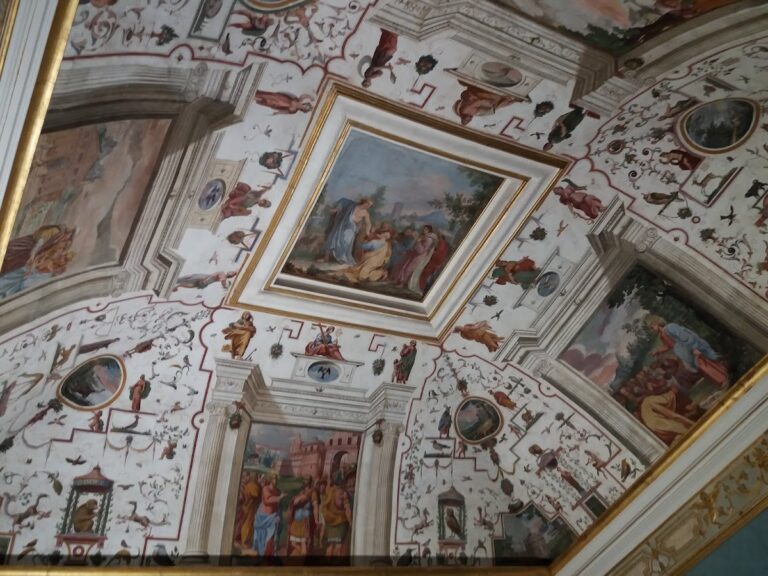
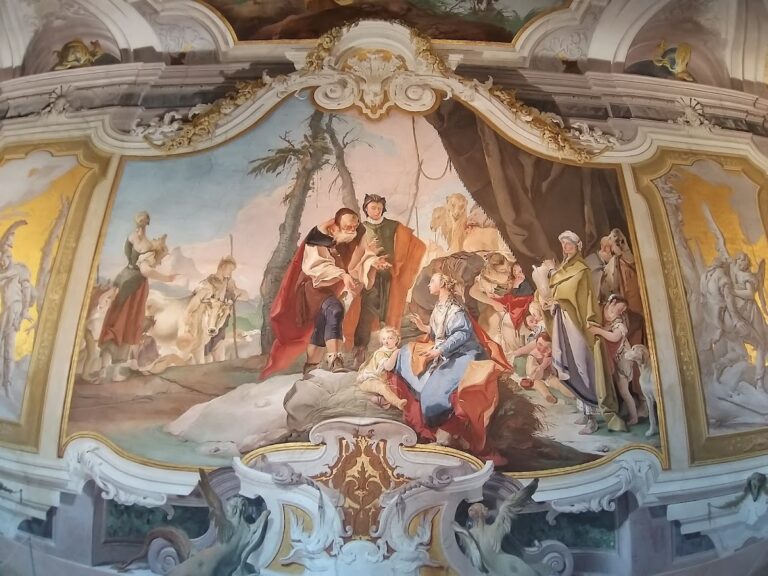
The Chapter Room was used for meetings of the cathedral chapter. Pietro Antonio Novelli painted its frescoes, while Giuseppe Morelli created the decoration. The ceiling fresco, The Church Pays Homage to Faith, includes the four Evangelists. Scenes from the history of the Patriarchate of Aquileia cover the walls. The room also contains Torretto’s marble Assumption and busts of Patriarchs Dionysius and Daniele Delfino with stone inscriptions.
The Chapel of Saint Nicholas contains some of the cathedral’s oldest paintings, including fourteenth-century frescoes by Vitale da Bologna and his workshop, particularly Cristoforo da Bologna. Vitale painted scenes from the life of Saint Nicholas of Myra during his stay in Udine in 1348 and 1349. They include the Redeemer surrounded by angels, Saint Nicholas in Glory, his funeral, and miracles involving a child saved from the sea, a kidnapped child placed in brine, a peasant and a Jew before a judge, and a peasant revived after being run over by a cart. The last scene is fragmentary and nearly illegible.
Other frescoes show Saint Nicholas, Saint Anthony Abbot, Saint Christopher, two unidentified saints, and a highly fragmentary Christ Pantocrator, an image of Christ as universal ruler. Additional fourteenth-century paintings by an anonymous artist depict Saint Nicasius, the Virgin enthroned with the Child, and Saint Eligius. The lower zones contain figures and scenes of Saints Francis, Clare, Catherine of Alexandria, Lucy, James, John the Evangelist, John the Baptist, Peter, and Blaise. The artist was strongly influenced by art from the German region.
The Chapel of the Body of Christ retains frescoes of Saint James and another unidentified saint. Above them are badly damaged remains of a fourteenth-century composition devoted to Christ’s infancy, sacrifice, and glorification. Fragments include the Virgin and Child, part of a Crucifixion, and a circular medallion showing God the Father and angels.
The Cathedral Museum also preserves a pectoral cross containing bone fragments attributed to Saint Caesarius, a deacon and martyr, and Saint Felix of Valois. Emperor Ferdinand I of Austria gave the cross to Emmanuele Lodi, bishop of Udine from 1819 to 1845, on 19 September 1844. Lodi later offered it to the altar of Saints Hermagoras and Fortunatus, patrons of the diocese and city of Udine.
Nearby sites