Pamplona Town Hall: Seat of the City Government
Site at a Glance
- Popularity
- Medium
- Country
- Spain
- Primary era
- Early Modern
- Eras represented
- Early Modern, Modern
- Civilizations
- Kingdom of Navarre, Spanish
- Site type
- Civic
- Remains
- Town Hall
On this page12 sections
History
The Union charter and first municipal house
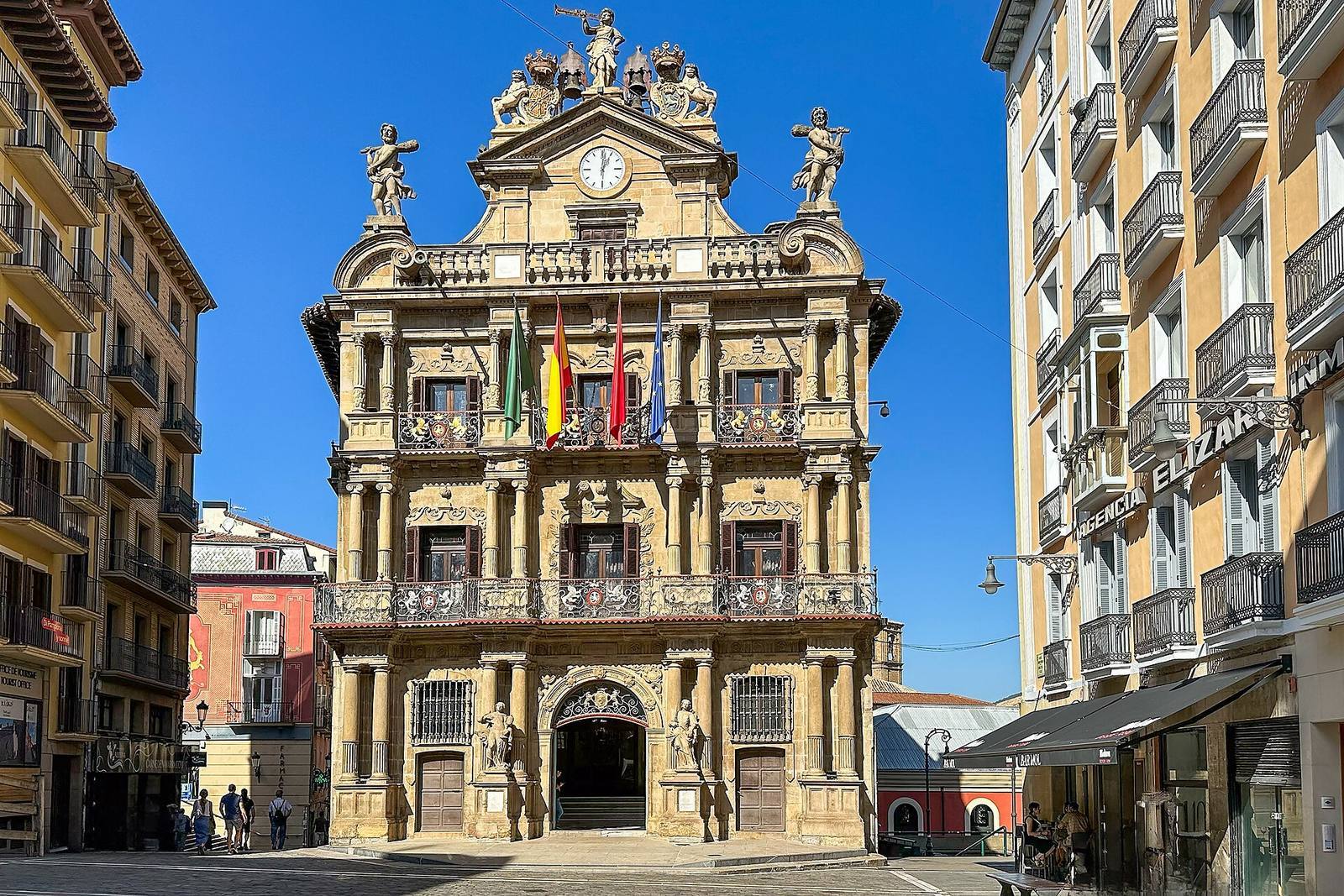
Pamplona Town Hall stands on the northwestern side of Plaza Consistorial in Pamplona, Spain, and remains the seat of the city’s municipal government. Its history is closely tied to the 1423 union of Pamplona’s three medieval boroughs and to the construction of a civic center for the newly united city. The present building combines an eighteenth-century Baroque façade, an elaborate European design with lighter Rococo ornament, and a structure rebuilt in the twentieth century.
On 8 September 1423, Charles III of Navarre, known as Charles the Noble, issued the Charter of the Union. The royal decree brought together Navarrería, the Burgo of San Cernin, and the Población of San Nicolás. It ordered a municipal house and council chamber in neutral ground between the boroughs, so the united city could conduct its business from a central location.
The charter proposed a site in the ditch between the Tower of Galea and the Burgo gate, also known as Portalapea, on the Navarrería side, while allowing the council to choose another place. Municipal officials called jurors were to meet there, and the alcalde, a municipal magistrate, was to hold audiences. Before the new house was ready, meetings could take place at the Hospital of the Church of San Cernin or in the existing council house shared by the Burgo and the Población. A bell in the Tower of Galea or another location was to summon the officials and, when needed, the united city.
The first town hall was built well after the 1423 order, though its exact construction date is unknown. By 1483, work was under way in Navarrería opposite the Chapitel, a medieval public market building. From the sixteenth century, the town hall was also known as the house of the municipal government and as the council house.
The eighteenth-century rebuilding
By the mid-eighteenth century, the original building was in poor condition and at risk of collapse. Work on a larger replacement began in late 1751, and the old structure was demolished in 1753. During construction, the municipal government temporarily moved to the Palace of the Constable, named for the office of a senior royal official.
The replacement building was completed between 1751 and 1760. The council sought a more elaborate façade than the first, simpler proposal, and the final design combined Baroque forms with Rococo decoration. Construction of the façade took place from 1755 to 1759. Defects in its arched basement ceilings later prompted legal disputes and expert inspections. In the mid-nineteenth century, geographer and politician Pascual Madoz judged the architectural effect to be in poor taste.
Twentieth-century reconstruction and later history
A major reconstruction began in 1951, and the rebuilt town hall was inaugurated on 8 September 1953. The municipal government continues to operate from the site.
Excavations in Plaza Consistorial in 2015 uncovered remains of the Tower of Galea. Dating to the eleventh century, the tower formed part of the Burgo of San Cernin’s defenses before its demolition in the sixteenth century. Its position had previously been thought to be at Casa Seminario.
Remains
Exterior and façade
The three-storey town hall occupies its original site near the center of Pamplona’s historic center. Its north-facing rear façade looks onto Plaza de Santiago. The surviving eighteenth-century front is built of ashlar, carefully cut stone blocks; the remainder of the present building belongs to the reconstruction begun in 1951.
Composition and ornament
The façade is divided into three vertical sections, with straight-topped openings framed by pairs of freestanding columns. The column designs progress through the Doric, Ionic, and Composite orders, the last combining Ionic and Corinthian elements. Their shafts vary between smooth and fluted, with some lower sections grooved or ornamented. A paneled base supports the composition, and balconies separate its levels. The lowest balcony runs across the full front. The horizontal bands above the columns carry alternating raised blocks and panels at one level, and projecting supports at another. Foliage, geometric patterns, and mirrors framed with shell- and rock-inspired decoration add further detail.
Sculpture and crowning
A curved, divided crown at the top of the façade contrasts with the triangular gable above the clock, which is fronted by a stone balustrade. Statues of Hercules, the hero of Greco-Roman mythology, flank the upper composition with clubs in hand and represent civic virtues. Prudence and Justice stand on pedestals beside the entrance. Above them, Fame, an allegorical figure of renown, blows a trumpet; stone lions hold the painted coats of arms of Navarre and Pamplona. Lion motifs also decorate the balcony railings.
Entrance and central balcony
The ground-floor entrance has a rounded arch in the late Baroque style. An inscription over the arch reads, in translation, “The door is open to all, much more so the heart.” The central balcony on the second storey is where the Chupinazo, the rocket opening the Sanfermines, is launched at noon each 6 July. The Sanfermines is Pamplona’s annual festival in honor of Saint Fermín.
Interior rooms and civic objects
Reception salon and chapel
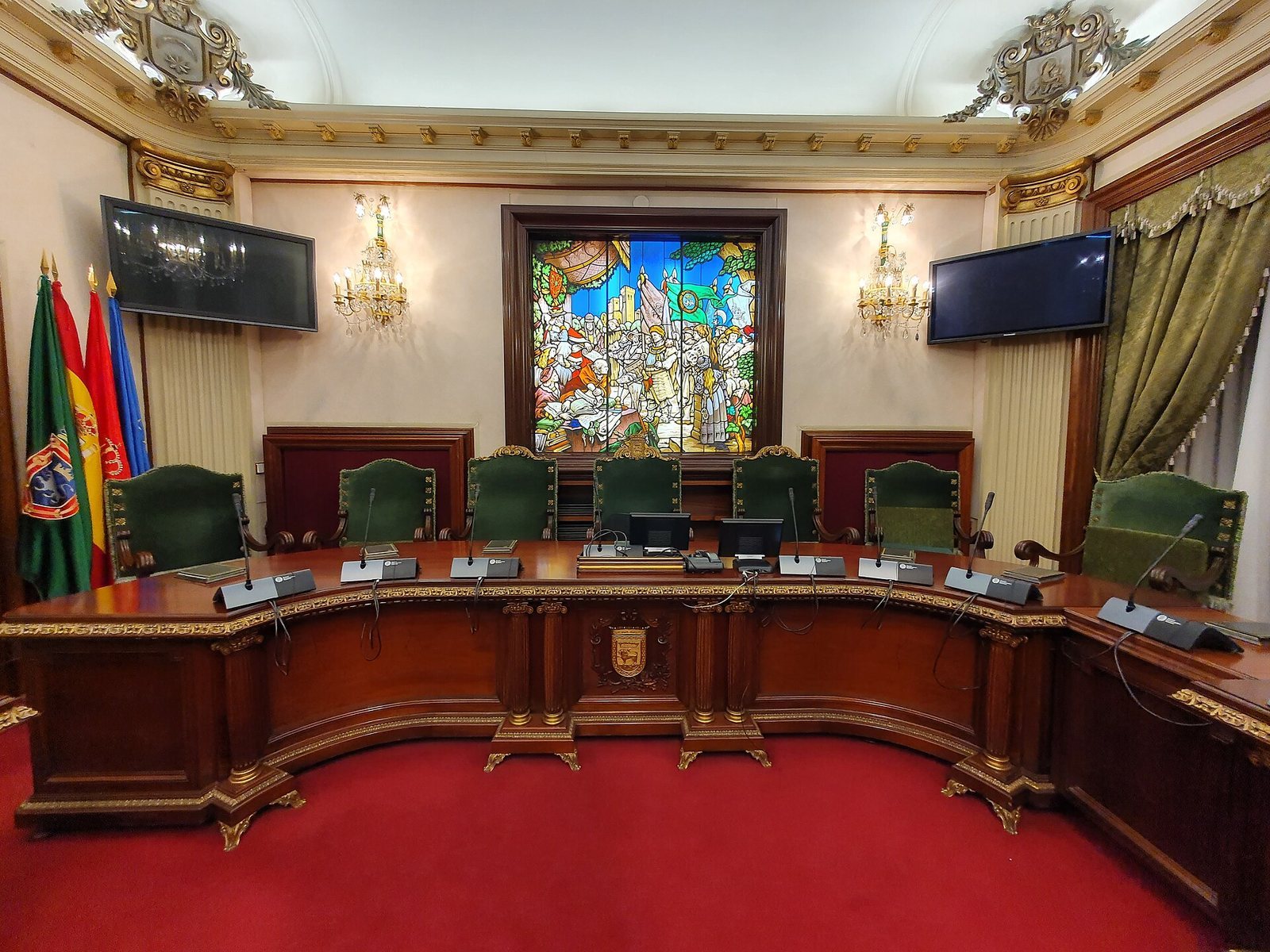
The interior includes a reception salon, the mayor’s office, a council chamber, and a chapel associated with the salon. Depictions of Queen Isabella II, violinist and composer Pablo de Sarasate, and tenor Julián Gayarre appear in the reception salon. The chapel holds relics of Saints Fermín and Saturninus, as well as a silver cross regarded as a foremost example of sixteenth-century Pamplona silverwork.
Council chamber and municipal emblems
A modern stained-glass window in the council chamber depicts the signing of the 1423 Charter of the Union. Two large wooden shields carved and painted in several colors bear Bourbon arms and Baroque foliage. Made in 1735, they came from the former building that housed the Royal Council of Navarre, a royal governing and judicial body. One is displayed on a mezzanine beyond the entrance hall, and the other decorates a side of the council chamber. The mayor’s office holds seven keys to the gates of the former walled city, an embroidered official flag, and three silver ceremonial staffs that serve as civic emblems.