Forte di Monte Enna: An Italian Armored Fortification


Site at a Glance
- Rating
- 4.2
- Popularity
- Very Low
- Country
- Italy
- Primary era
- Modern
- Eras represented
- Modern
- Civilizations
- Italian
- Site type
- Military
- Remains
- Fort
On this page8 sections
History
Forte di Monte Enna is an Italian armored fortification near Schio in Italy, built around 1910 as part of the defensive system facing the Austro-Hungarian frontier during the period before the First World War. It was intended to replace the obsolete Forte Monte Maso and protect routes through the Leogra Valley and across the Santa Catarina Pass.
Construction and defensive role
The fort belonged to the Monte Enna–Monte Civilliana fortified group in Sector I, Schio, within the Agno–Assa defensive barrier. Its main task was to cover the road to Schio through the Leogra Valley and the cross-route from Ressalto over the Santa Catarina Pass toward the south. Its long-range targets included Monte Pasubio, Monte Baffelan, and the area around Piano delle Fugazze.
Italian specialist literature places the fort in full operational service by 6 December 1914, although the precise construction date remains uncertain. It was the only Italian work whose planning, construction progress, and armament the Austro-Hungarian intelligence bureau, the military office responsible for gathering information on opposing preparations, could not fully establish.
Disarmament during the First World War
In 1915, the Austro-Hungarian army withdrew from the forward area and frontier for tactical reasons, establishing a defensive line farther back. This change removed the fort’s original purpose. It was disarmed, and its guns were taken away for installation in field positions. Their exact locations are unknown, and Forte di Monte Enna no longer appeared in the armament lists of 29 June 1915.
It remains uncertain whether the fort’s guns fired on Italian trenches at Monte Giove on 13 June 1916. If they did, the shots may have fallen short. Rumors instead alleged that the firing had been deliberate, intended to “encourage” the defenders. The commander was relieved of his post and brought before an investigative commission.
Later military use
The fort itself was not shelled. After its defensive role ended, the Italian army used it as an ammunition depot until abandoning it in 1927. It probably suffered damage from blasting experiments or demolition exercises carried out after the First World War.
Remains
Ridge setting and battery block
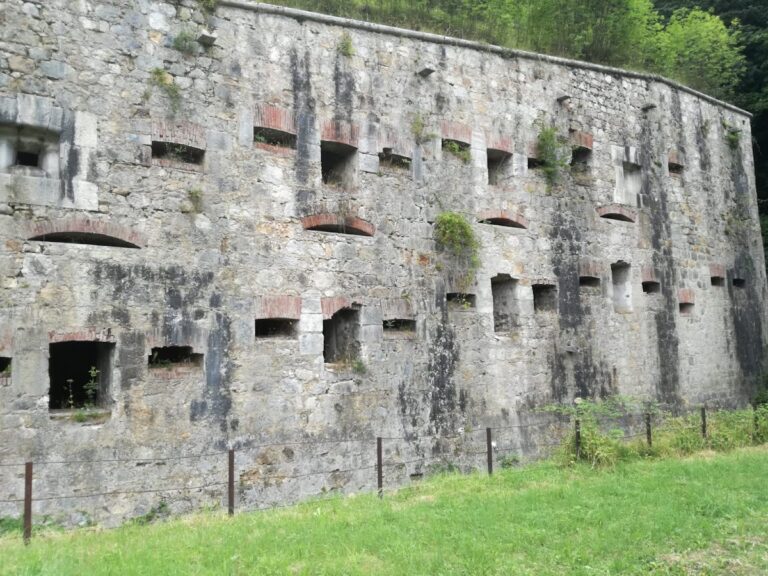
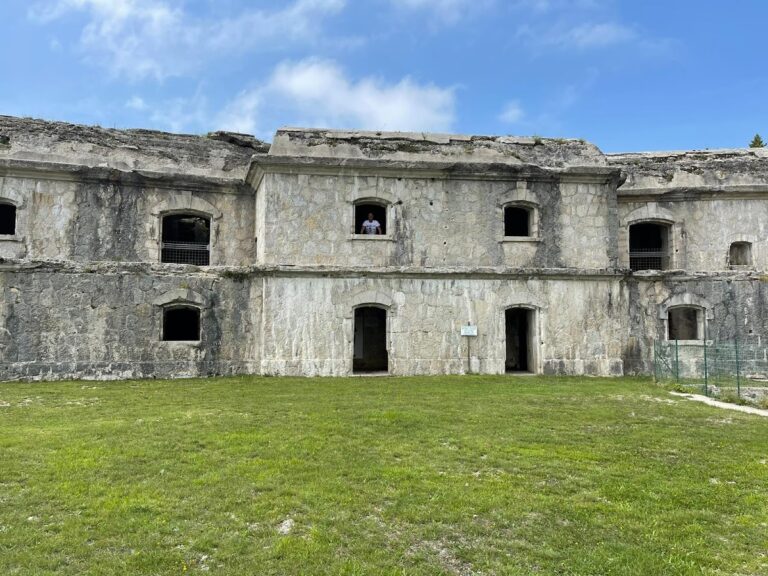
Forte di Monte Enna stands on a ridge of Monte Enna at an elevation of 975 meters, north of Torrebelvicino in the Province of Vicenza. The battery block, the section housing a coordinated group of artillery positions, extended from north to south, while the principal direction of fire was west. The fort was described as the most modern Italian armored fortification of its type. Its armament comprised four 149 mm guns, supplemented by four 75 mm guns in an attached battery, a secondary artillery installation connected with the main fort.
Armored gun positions
The precise design and manufacturers of the guns and armored gun cupolas remain uncertain. One technical description identifies four 149 mm A/L 36 guns with 5.36-meter-long barrels, mounted in 140 mm armored cupolas made by Armstrong, Mitchell & Co. at Pozzuoli. This account corresponds to a 1914 reference describing three-part cupola shells.
A different Austro-Hungarian description gives the cupola shells a total thickness of 180 mm, made up of 160 mm shell armor and a separate 20 mm inner lining. That specification would indicate two-part cupolas by Schneider-Creusot, fitted with 149 mm S/L 36 guns. These installations were comparable to replacement systems introduced at Forte Monte Verena and Forte Campolongo in 1913.
Surviving condition
The fort survives with damage probably caused by postwar blasting or demolition exercises. The removal of its guns in 1915 also altered the artillery installation that had defined its original defensive function.