Palazzo Sipari: A Historic House Museum in Pescasseroli, Italy


Site at a Glance
- Rating
- 4.7
- Popularity
- Very Low
- Country
- Italy
- Primary era
- Modern
- External website
- Open
- Eras represented
- Modern
- Civilizations
- Kingdom of the Two Sicilies
- Site type
- Domestic
- Remains
- Elite Residence
On this page7 sections
History
Palazzo Sipari is a historic residence and house museum in Pescasseroli, Italy, built in the late Renaissance-Neoclassical tradition and completed in 1839. It occupies the site of a baronial palace that belonged to the Massa family of Sorrento, the feudal lords of Pescasseroli, until 1838. The present building was commissioned by Pietrantonio Sipari, a member of the town’s emerging pastoral bourgeoisie, after he chose not to complete the purchase of the ducal palace of Alvito.
Construction and the Sipari family
Pietrantonio Sipari purchased the surviving parts of the earlier baronial building and constructed the palace that stands today. The residence remained in the possession of the Sipari family for more than a century and a half. Its last owner, Marchesa Maria Cristina Sipari, died in 2006. She was the second daughter of Erminio Sipari, an Italian parliamentarian, and the granddaughter of Pietrantonio Sipari.
Benedetto Croce and distinguished guests
Benedetto Croce, the Italian philosopher, historian, and public intellectual, was born on the palace’s second floor on 25 February 1866. During the late nineteenth and early twentieth centuries, Palazzo Sipari received King Vittorio Emanuele III, who reigned as king of Italy from 1900 to 1946, as well as Duke Amedeo of Aosta, a member of the House of Savoy. Other members of the royal family, government figures, and political and cultural personalities also visited the residence.
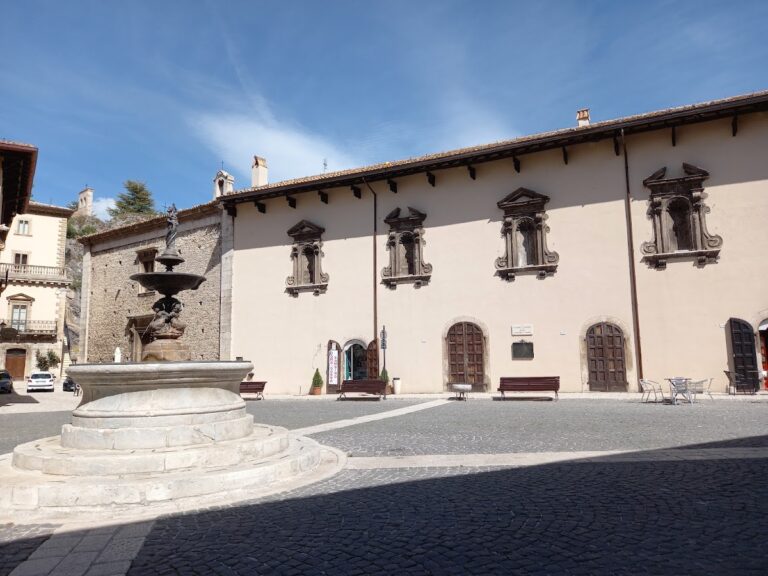
Two marble plaques on the main facade commemorate Benedetto Croce and his cousin Erminio Sipari. A third plaque, installed in November 2013, honors Maria Cristina Sipari and her role in creating the house museum. The palace was declared to be of particular artistic and historical interest in 1967 and placed under the protection of the Abruzzo Superintendency for Archaeology, Fine Arts and Landscape, the state authority responsible for safeguarding archaeological, architectural, artistic, and landscape heritage.
The house museum and archive
Maria Cristina Sipari decided in July 2005 to establish a house museum in the palace. A house museum preserves a historic residence while presenting its former occupants and associated domestic and documentary collections. The Erminio Zel Sipari Foundation, a nonprofit organization established in 2005, manages the museum and its archival spaces. Since 2007, the Sipari Foundation has also organized cultural events in the building.
Palazzo Sipari now functions as a museum. Its library and historical archive preserve original documents concerning the intellectual and political activities of Erminio Sipari and Benedetto Croce. The former Sipari stables, located opposite the palace, contain the historical museum of the National Park of Abruzzo, Lazio and Molise.
Remains
Palazzo Sipari is an approximately 1,000-square-metre building arranged over a ground floor and three upper floors. Its elegant classical forms belong to a late Renaissance-Neoclassical architectural tradition. The stone portal is framed by architectural orders and leads into a courtyard with a well. From the courtyard, access is provided to the interior and, at the rear left, to the noble section of the palace and its monumental staircase.
Interior rooms and collections
The ground floor contains vaulted rooms, former servants’ quarters, and a library with original wooden structures. The library houses the historical archive of Pescasseroli, which is protected as heritage. The first floor preserves the rooms used by the Sipari family in daily life, with their different functions explained during guided visits.
On the second floor, the room in which Benedetto Croce was born forms part of the museum. The floor’s large salons are used for cultural events. Throughout the house museum, objects from the everyday life of the Sipari family are displayed alongside texts and documents preserved in the library and archive.
Annexed church
The Church of Madonna dell’Addolorata is annexed to Palazzo Sipari. It contains the remains of several members of the Sipari family, linking the residence to the family’s burial history.
Nearby sites