Palazzo Ricasoli Firidolfi: A Renaissance Palace in Florence
Site at a Glance
- Rating
- 5
- Popularity
- Very Low
- Country
- Italy
- Primary era
- Early Modern
- Eras represented
- Early Modern, Modern
- Civilizations
- Duchy of Florence, Grand Duchy of Tuscany, Holy Roman Empire, Italian, Republic of Florence
- Site type
- Domestic
- Remains
- Elite Residence
On this page7 sections
History
Construction and Ridolfi Ownership
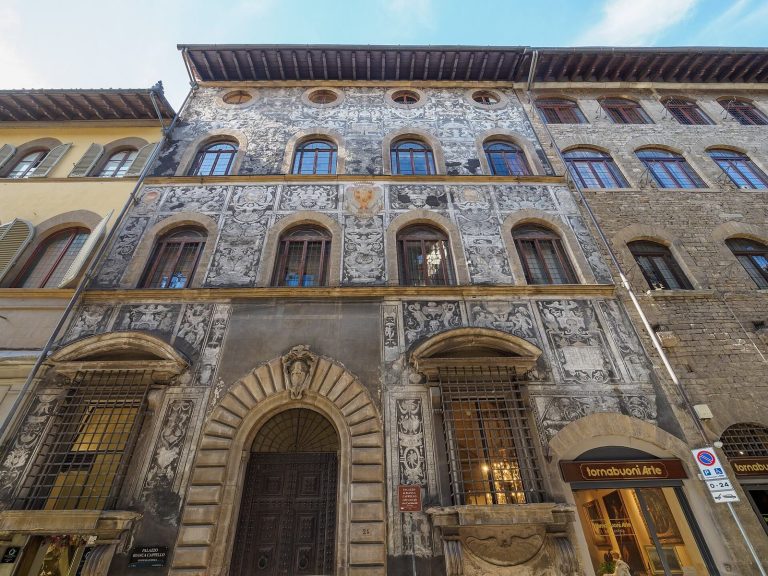
Palazzo Ricasoli Firidolfi is a palace on Via Maggio in Florence, Italy, built around 1520 for Giovanni Francesco Ridolfi, a holder of senior civic office. Its design is attributed to the circle of Baccio d’Agnolo, a Florentine Renaissance architect. The building, later known as Palazzo Ridolfi, occupied land already containing properties belonging to the Velluti, Migliori, and others.
In 1756, another Gian Francesco Ridolfi sold the palace to Maria Lucrezia Firidolfi, born Michelozzi. It remained in her family until 1818, when Lucrezia, the last of the Firidolfi, married Gian Francesco Ricasoli. The marriage established a new Ricasoli-Firidolfi family line, although the two families had a distant common origin. In the early twentieth century, inheritance transferred the property to the Ricasoli Corsini family.
Restoration and Heritage Recognition
Engineer Felice Francolini designed a restoration of the façade and courtyard in the late nineteenth century, assisted by Alberto Ricasoli Firidolfi, an architect and pupil of Niccolò Matas. The palace appeared on Italy’s 1901 national list of monumental buildings considered part of the country’s artistic heritage. Work on the eaves followed in 1904, and in 1928 a grille on Via de’ Vellutini was altered to project outward.
Remains
Street Façade and Carved Details
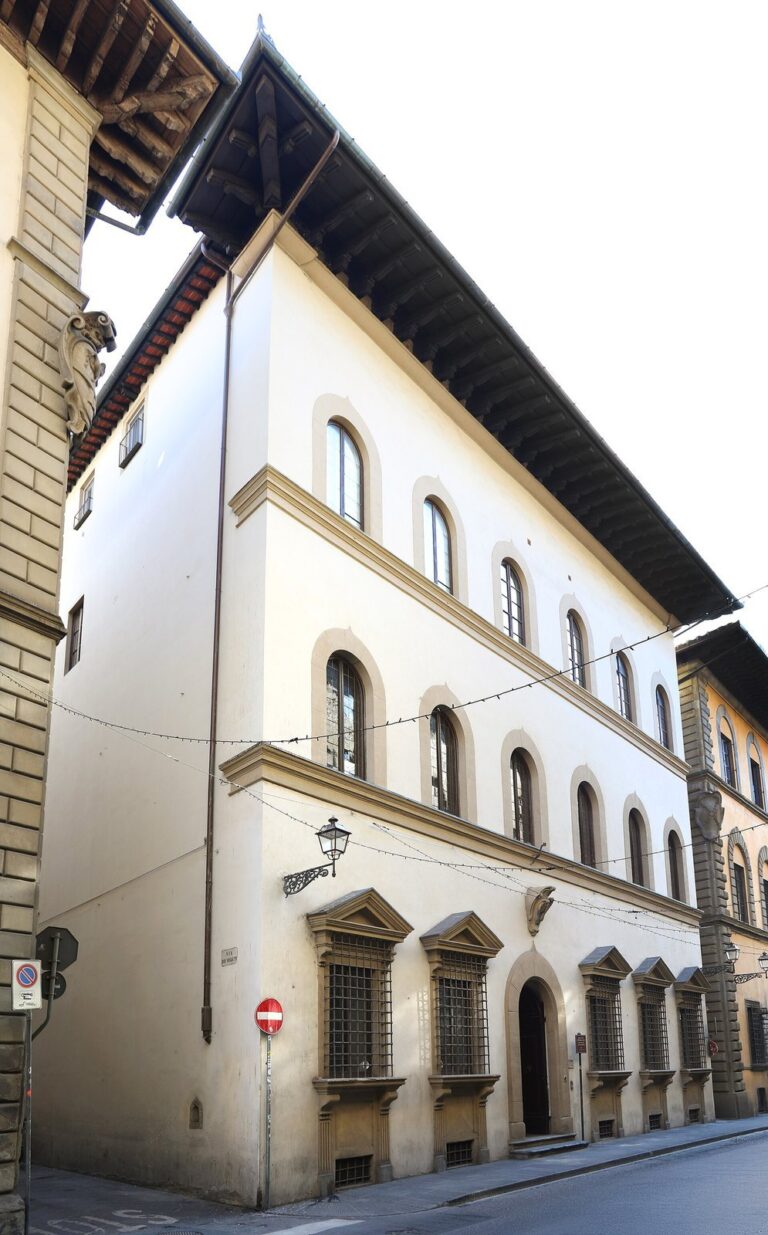
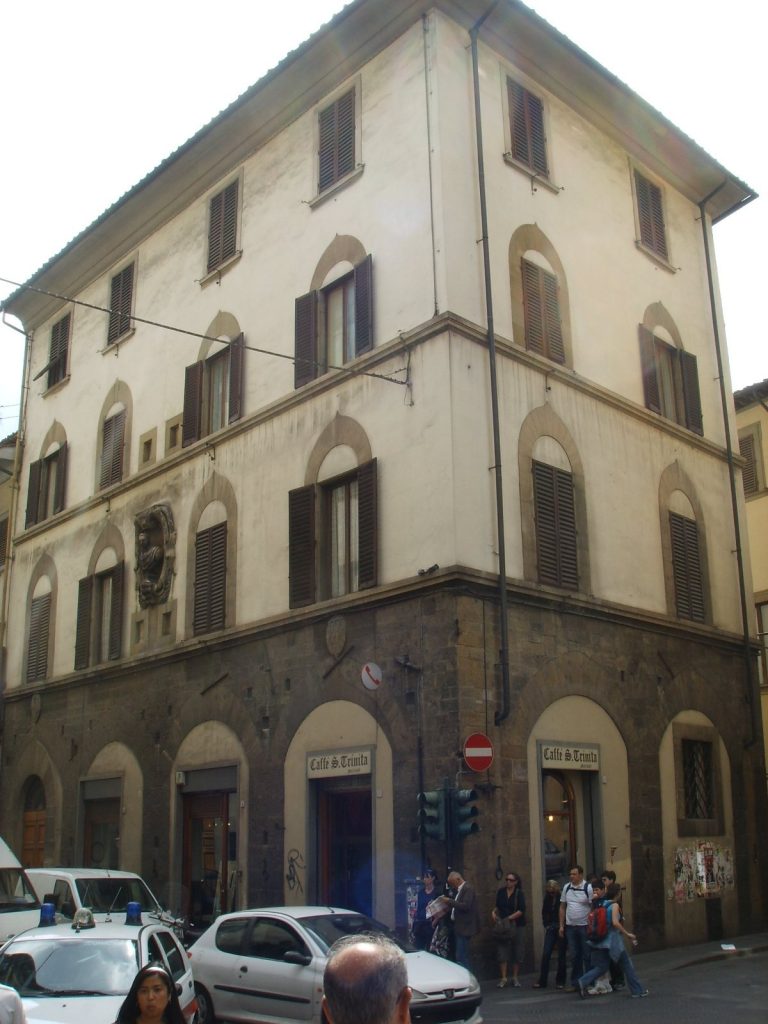
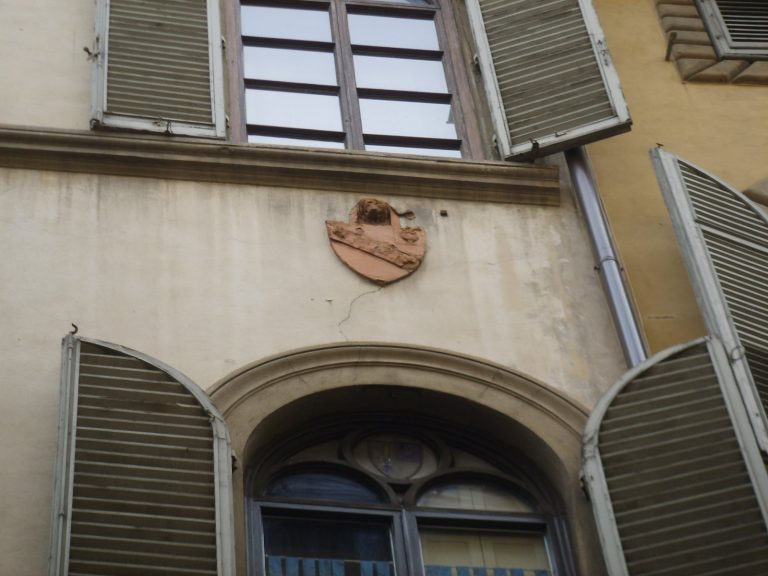
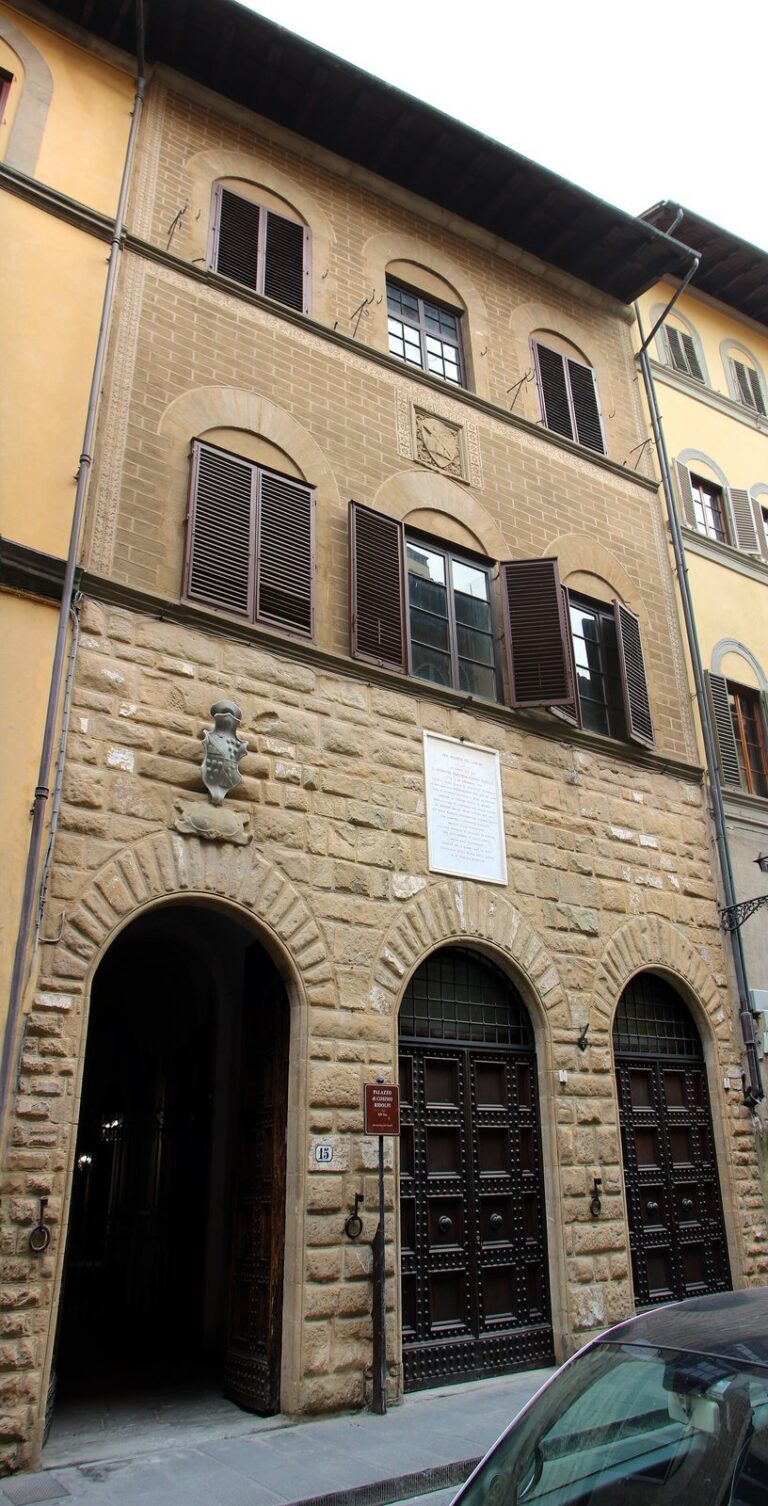
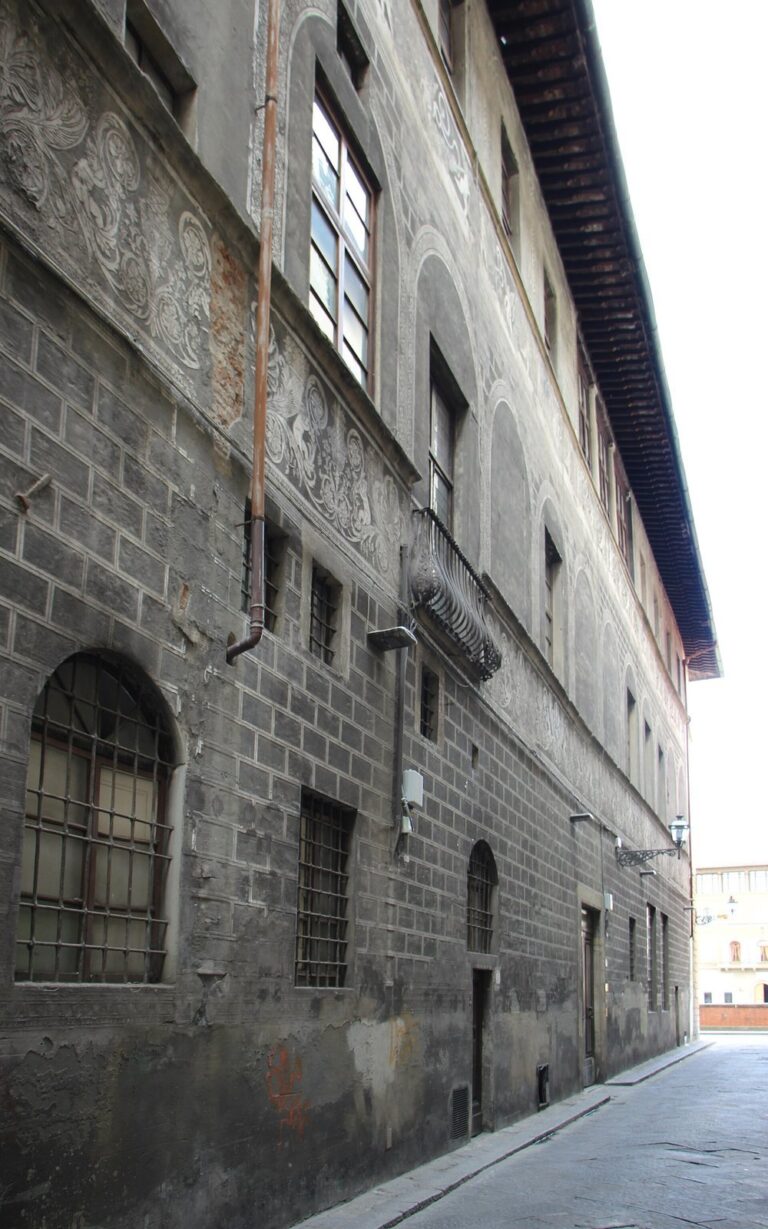
The palace stands at the corner of Via Maggio and Via de’ Vellutini. Its three-storey façade is arranged in six window divisions, with the fifth closed. The ground-floor windows with projecting, bracket-supported sills were added later, probably in the early seventeenth century. Above them, arched windows are set in rough-faced gray sandstone, over a strongly projecting horizontal stone band. Stone blocks mark the corner, which also carries an iron flagpole bracket with a ring. An acanthus-leaf corbel decorated with fluttering ribbons once supported a shield bearing the Ridolfi arms. A central shield combines the Ricasoli and Firidolfi arms: six horizontal gold and red bands crossed by a blue lion, shown here without colors, and a silver field crossed by a red diagonal band bearing an eight-pointed gold star. The Firidolfi arms also appear on an associated gate.
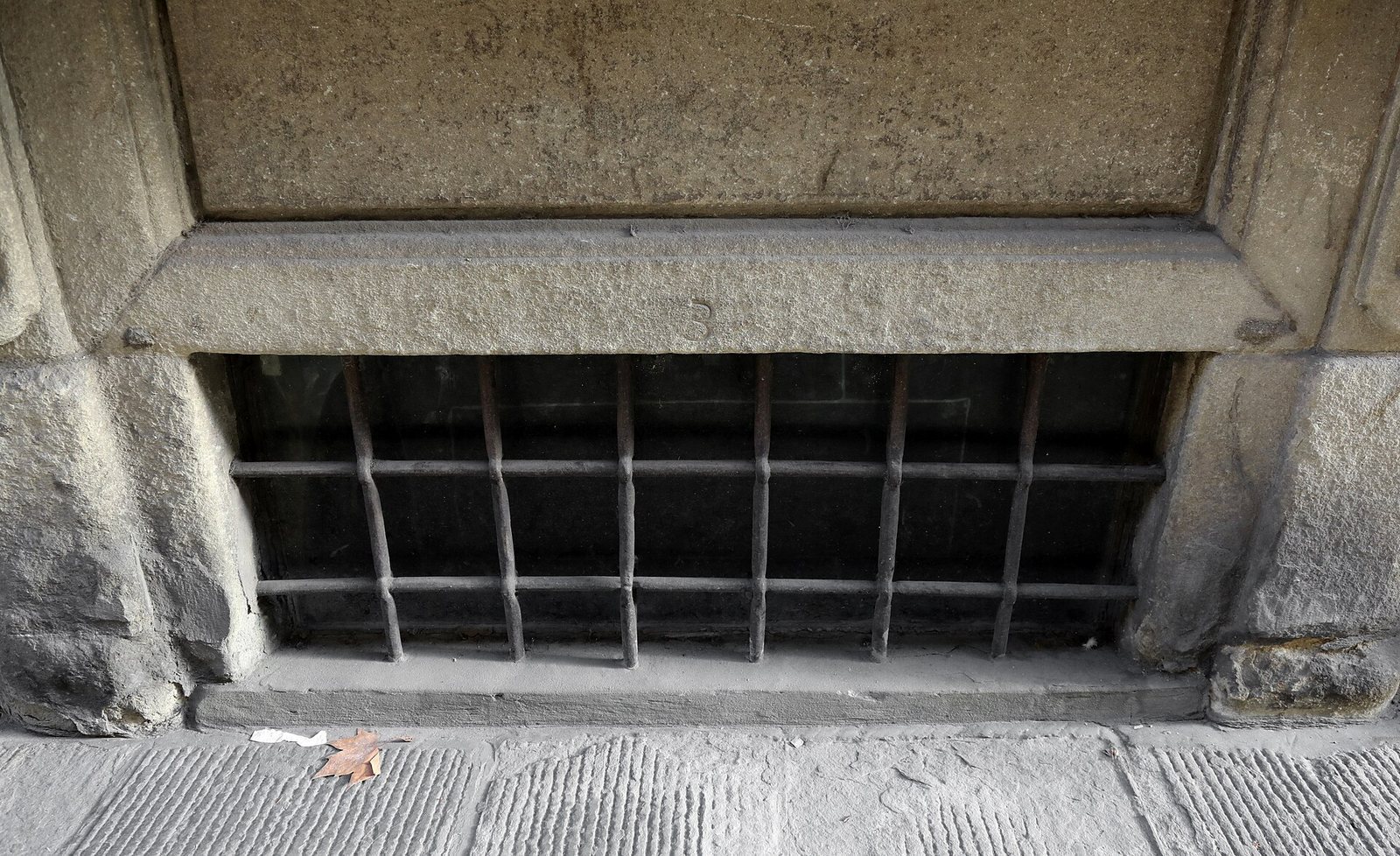
At the façade’s left end, a small opening near ground level served as a wine window. Numbered barred cellar windows may have helped manage stored goods; the grille of window 4 has a flask-shaped opening, probably used for direct wine sales. A finely carved stone coat of arms made for the palace, supported by two putti, was removed and is identified with a sculpture on the Ridolfi palace at number 17 on the same street. Giorgio Vasari, a painter, architect, and writer on artists, recorded the work by Jacopo Sansovino, an Italian Renaissance sculptor and architect. Florentine art writer Francesco Bocchi praised its workmanship.
Courtyard and Secondary Court
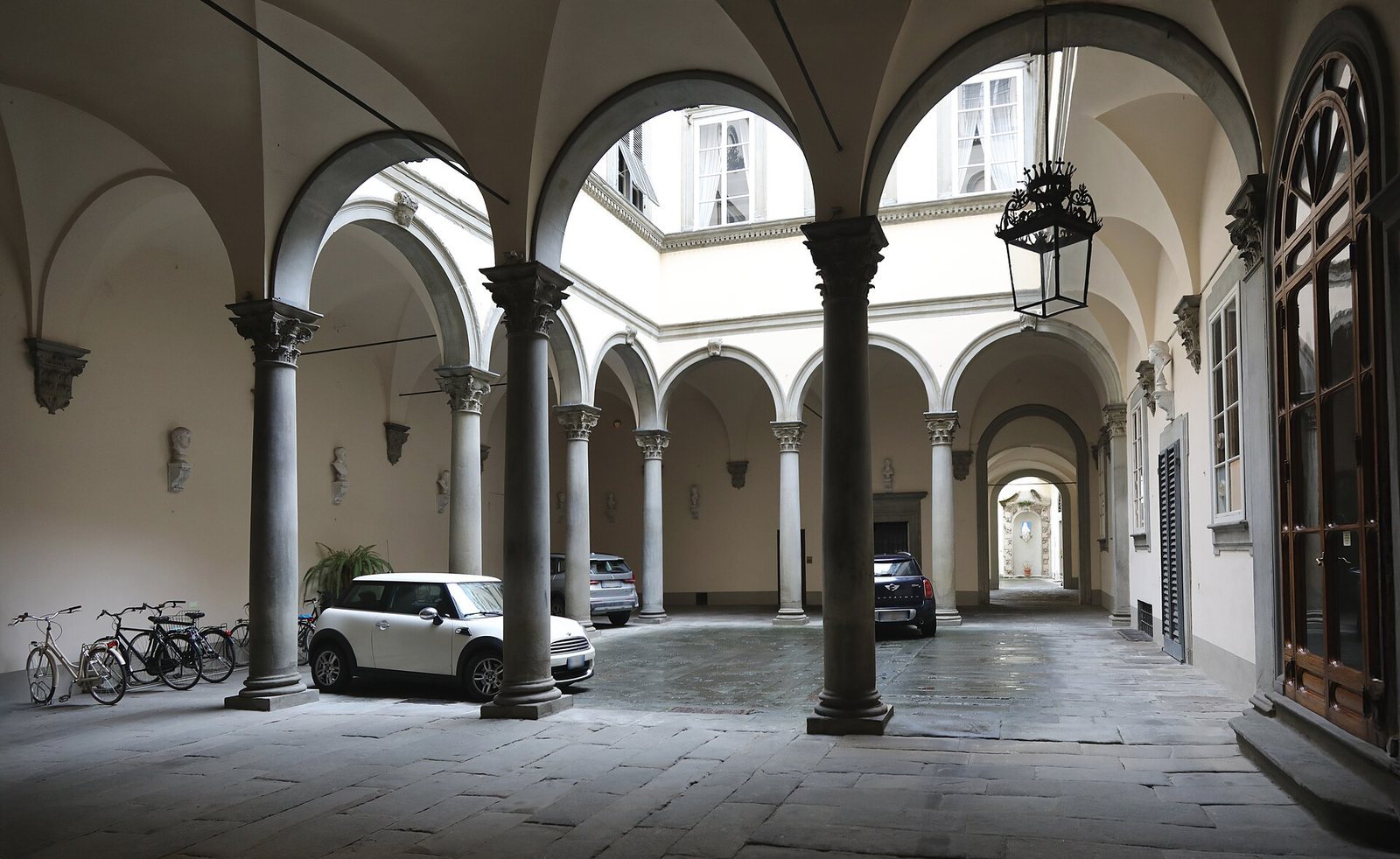
The main courtyard has covered walkways on three sides. On the fourth, half-vaults and arches support the upper floor’s projection. Gray sandstone columns and brackets carry elaborately carved composite capitals, which combine features of classical column styles. Their decoration includes the Ridolfi arms and a figure interpreted as Saint John the Baptist, the family’s protector. Brackets and plaster busts also adorn the courtyard, whose elevations have toothed horizontal bands and stone mouldings. Engaged half-columns on the plastered upper walls mark the former position of a now-closed open gallery. At the far end, an arch aligned with the main entrance leads to a smaller second court, where a wall fountain bears sponge-like decoration in the later Renaissance Mannerist style.
Chapel and Interior Decoration
A small chapel contains scenes from the New Testament, including portraits of members of the Ridolfi family. Its decoration has repeatedly been attributed to Giorgio Vasari and dated to the 1560s. The altar holds a Madonna and Child with Saint John by Rossellino, an Italian Renaissance sculptor. A separate room was described in the first half of the nineteenth century as having wall paintings by Florentine painter Pietro Rabbuiati, regarded by connoisseurs as a masterpiece of his work.