Palazzo Poggi: A University and Museum Palace in Bologna


Site at a Glance
- Rating
- 4.7
- Popularity
- Low
- Country
- Italy
- Primary era
- Early Modern
- External website
- Open
- Eras represented
- Early Modern
- Civilizations
- Papal States
- Site type
- Civic
- Remains
- Palace
On this page8 sections
History
Palazzo Poggi is a sixteenth-century Mannerist palace in Bologna, Italy, built between 1549 and 1560 as the residence of Alessandro Poggi and his brother Giovanni Poggi, who later became a cardinal. Its design is attributed to Bartolomeo Triachini, although Pellegrino Tibaldi has also been proposed as the architect. The building later became closely associated with the Institute of Sciences, an educational institution that helped shape the University of Bologna and became a model for Enlightenment education in Europe.
Construction and decoration
The palace took its present form through work commissioned by Cardinal Giovanni Poggi. Giovanni also engaged Pellegrino Tibaldi to decorate the building and the Poggi family chapel. Tibaldi, a Bolognese painter and architect who had moved to Rome in 1547, returned to Bologna in 1555 and produced frescoes that are regarded among his masterpieces.
The Institute of Sciences
Palazzo Poggi entered a new phase in the early eighteenth century, when it became connected with Bologna’s scientific and artistic academies. The Accademia dei Pittori was ceremonially founded on 2 January 1710 in the house of Luigi Ferdinando Marsili, a Bolognese scholar, naturalist, and military scientist. Pope Clement XI approved its statutes in October 1711, after which it became the Accademia Clementina. A New Academy established in Bologna on 12 December 1711 joined the Institute of Sciences and Liberal Arts, which was renamed the Academy of Sciences of the Institute of Bologna in 1714.
The academies occupied the palace’s first floor. The Academy of Sciences was installed above them, with an astronomical observatory placed higher still. Marsili’s institutional foundation gave the palace an enduring educational and museum role. The Institute enjoyed the protection of Pope Benedict XIV, the Bolognese pope born Prospero Lorenzo Lambertini, and became an important component of the University of Bologna.
Napoleonic reorganization and later recovery
During the Napoleonic period, the Institute’s scientific equipment was distributed among different university faculties, while its historical collections were divided between several museums. Its library remained in Palazzo Poggi and became the nucleus of the future University of Bologna Library.
In the late twentieth century, the University of Bologna began a cultural project to recover and reunite the Institute’s dispersed collections in their historic setting. Palazzo Poggi is now one of the university’s principal buildings, houses the rectorate, and is recognized as Italian cultural heritage.
Remains
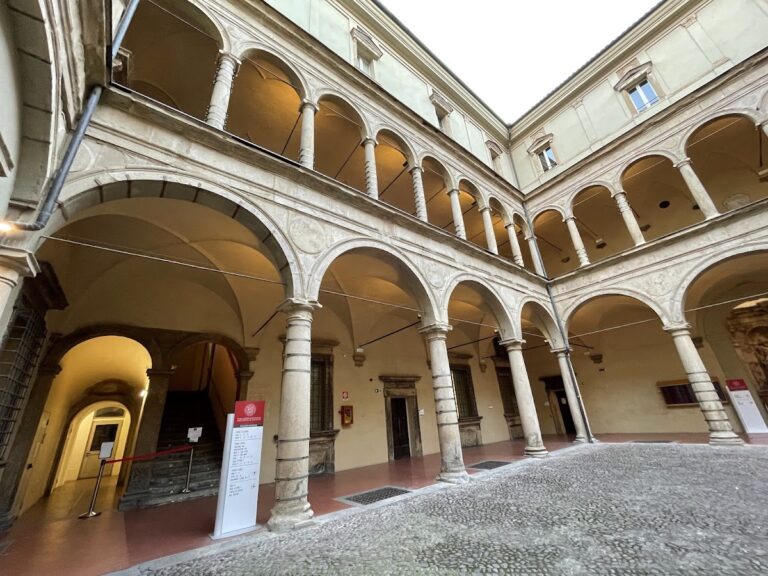
Palazzo Poggi is a sixteenth-century Mannerist complex organized around a large square courtyard. Its principal architectural elements include a loggia and a monumental staircase leading to the piano nobile, the palace’s main formal floor. Later additions associated with the Institute of Sciences extend the complex’s academic and scientific character, including the observatory tower, library building, and Great Hall.
Palace structure and frescoed rooms
The surviving palace retains its courtyard-centered plan, loggia, and monumental stairway. Its interiors contain frescoes from the Mannerist and early Baroque periods. Prospero Fontana painted the Rooms of Moses and David and the Sphinxes room, while Tibaldi decorated the Rooms of Susanna and the Zodiac. Niccolò dell’Abbate painted the Rooms of Camilla and Landscapes, the concert hall with scenes from the Labors of Hercules, and putti with grapes. Fontana, Nosadella, and Ercole Procaccini the Elder worked on the Grotesques and Telamons rooms. Together, these decorations combine symbolic subjects with naturalistic elements.
Observatory and Institute buildings
The astronomical tower known as La Specola was constructed between 1712 and 1725. A separate library building followed in 1744, designed by Giuseppe Antonio Torri and Carlo Francesco Dotti. The Institute’s monumental Great Hall was added to the north side of the palace and opened in 1756. These structures preserve the physical expansion of the complex as its academic and scientific functions developed.
Academic rooms and collections
The ground floor includes the Aula Carducci, named for the poet and literary scholar Giosuè Carducci, who lectured there on Italian language and literature for forty years. The Hercules Room contains a statue of the mythological hero made by Angelo Piò in 1730. Palazzo Poggi also houses university museums, the University of Bologna Library, and a picture gallery with more than 600 portraits. Its associated holdings include natural-history collections, the collections of Luigi Ferdinando Marsili, the Institute of Sciences’ Museum Diluvianum, obstetric and anatomical materials, physics and chemistry collections, geography and military-architecture displays, a gallery of ships, and the Institute of Sciences Library.
The anatomical collections include wax models made by Ercole Lelli, Giovanni Manzolini, and Anna Morandi Manzolini. They also include La Venerina, an anatomical wax model by Clemente Susini. These works form part of the material history of the scientific teaching and collecting activities associated with Palazzo Poggi.