Palazzo Bentivoglio: A Bentivoglio Family Palace in Bologna
Site at a Glance
- Rating
- 4.7
- Popularity
- Very Low
- Country
- Italy
- Primary era
- Early Modern
- External website
- Open
- Eras represented
- Early Modern
- Civilizations
- Papal States
- Site type
- Domestic
- Remains
- Palace
On this page8 sections
History
Palazzo Bentivoglio is a historic palace in Bologna, Italy, associated with the city’s powerful Bentivoglio family and its later collateral branches. The family dominated Bolognese politics during the later fifteenth century, when Sante Bentivoglio commissioned the original palace on Strada San Donato, now Via Zamboni, in 1460. Giovanni II Bentivoglio completed the building.
The Bentivoglio palace and its destruction
The original residence served as the palace of Bologna’s noble Bentivoglio family, who later held the title of marquises. Its scale, household organization, and lavish decoration reflected the family’s political position. Giovanni II was the principal Bentivoglio ruler during this period, and the palace became closely associated with his household and government.
In November 1506, the Bentivoglio were expelled from Bologna with the support of Pope Julius II, who was pope from 1503 to 1513 and played an important role in their removal. Their political enemies and the city’s new rulers treated the palace as a symbol of what they regarded as the family’s tyrannical rule. The Bolognese Senate ordered the destruction of every Bentivoglio emblem and sign of their former domination.
Popular anger brought about the demolition of the original palace in spring 1507. Its destruction was regarded as a major loss to the history of Italian art. Contemporary chroniclers and later scholars tried to reconstruct its appearance from descriptions that often celebrated its magnificence. The site is now occupied by the Teatro Comunale and the Giardino del Guasto, created in 1975 by the architect Rino Filippini on the former palace garden. Via del Guasto preserves the memory of the demolition, while a building opposite the theater formerly housed the palace stables.
The later palace
A second Palazzo Bentivoglio was built nearby on Via Belle Arti by Costanzo Bentivoglio, a descendant of a collateral branch that did not dominate the city’s politics. Construction began in 1551. The design is attributed to Bartolomeo Triachini, and Giovanni Battista Falchetti completed the palace during the first half of the seventeenth century.
The later building acquired a major gallery in 1769, when Senator Fulvio Bentivoglio became gonfalonier, a leading municipal official in Bologna. This palace carries the family name into a later period, although its history belongs to a different branch and to a new phase of Bolognese architecture.
Remains
The surviving architectural evidence belongs chiefly to the later palace on Via Belle Arti, while the earlier residence is known through descriptions and the historical traces preserved in the surrounding streets and garden. Together, these remains and references show the contrast between the vast fifteenth-century household of Giovanni II and the later palace built by his descendants.
The original palace
The original palace stood on Strada San Donato, now Via Zamboni. Its principal facade was described as approximately 30 metres long, while each side facade exceeded 140 metres. The building was also known as the Domus Aurea, or “Golden House,” because pure gold covered the capitals and cornices of its facade.
The ground floor contained rooms for the male members of the Bentivoglio household. Giovanni II’s richly frescoed apartments occupied the upper floor, alongside the similarly lavish apartments of Ginevra Sforza and the other women of the household. The complex also included quarters for guards and armed retainers, guest rooms, warehouses, and weapons stores. Its 244 rooms included five large halls used to receive distinguished guests and friends, hold feasts, and stage celebrations.
Painted rooms and garden loggia
The palace’s noble rooms were decorated with frescoes by prominent artists of the period. In a loggia connecting the third courtyard with the garden, Lorenzo Costa painted the Fire of Troy. Francesco Francia decorated Giovanni II’s room with scenes from the story of Judith and Holofernes.
The later Palazzo Bentivoglio
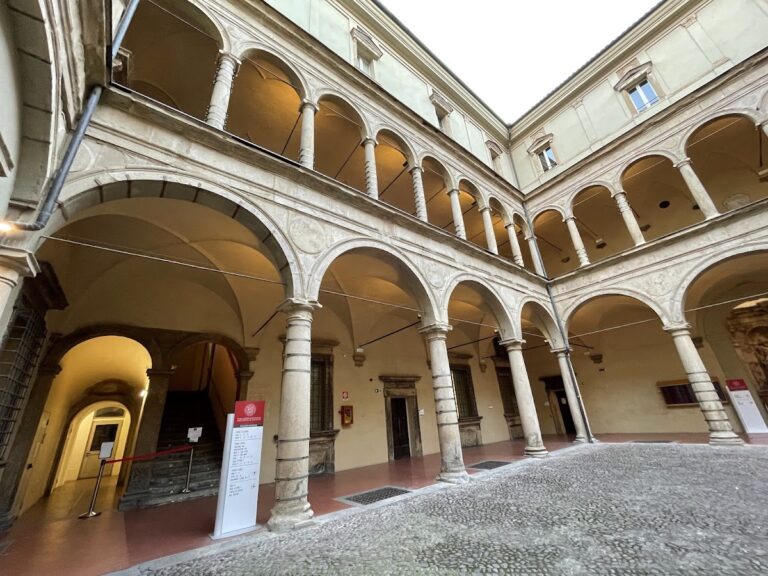
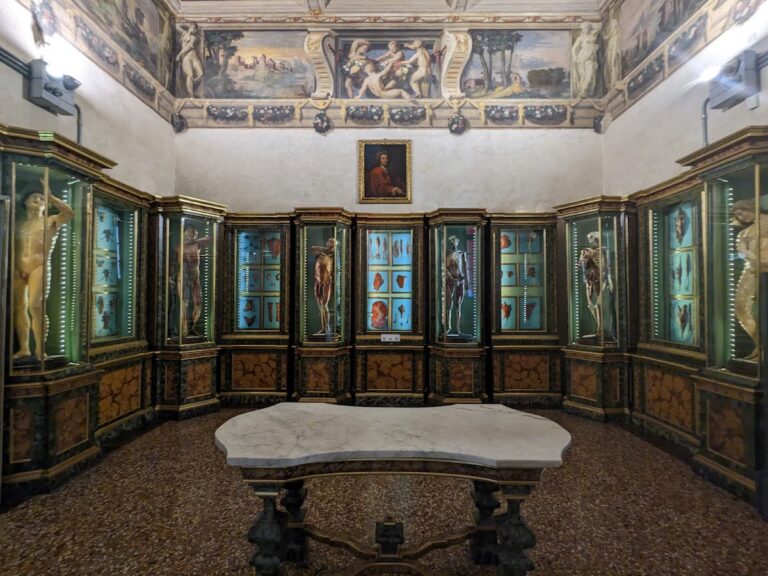
The later palace has a spacious entrance courtyard enclosed by a double loggia designed by Domenico Tibaldi. Several rooms on the upper floor retain ceilings and friezes associated with the Tibaldi school, linking the interior decoration to the artistic environment of its period.
The gallery
The palace also contains a large gallery painted in Antonio Bonetti’s chiaroscuro manner, a technique using strong contrasts of light and dark to give forms a sense of depth. Sculptures by Ubaldo Gandolfi complete the gallery’s decoration.
Nearby sites