Chiesa dei Santi Vitale e Agricola in Arena: A Historic Parish Church in Bologna


Site at a Glance
- Rating
- 4.6
- Popularity
- Low
- Country
- Italy
- Primary era
- Early Modern
- External website
- Open
- Eras represented
- Classical, Medieval, Early Modern, Modern
- Civilizations
- Italian, Papal States, Roman
- Site type
- Religious
- Remains
- Church
On this page7 sections
History
Chiesa dei Santi Vitale e Agricola in Arena is a Roman Catholic church in Bologna, Italy, whose present single-nave form was created in a late-sixteenth-century rebuilding with a classically styled facade. It belongs to the Archdiocese of Bologna and is the parish church of the same name in the Bologna-Centro vicariate. The church is dedicated to Vitale and Agricola, Christian martyrs and saints whose traditional association with the site gives the building its historical identity.
Roman and Early Medieval Origins
Local tradition places the church on the site of the arena of Roman Bononia, where gladiatorial spectacles were held. The same tradition identifies the arena as the place where Vitale and Agricola were killed, although this association remains a matter of local belief. The early medieval church was built within a Benedictine monastery, a monastic institution governed by the Rule of Saint Benedict. It was aligned parallel to the Via Salaria, the road leading toward Ravenna that is now called Via San Vitale, and originally contained three naves.
The parish preserves a catalogue of its Curiati fathers reaching back to 1276. Investiture deeds written beside each name support the authenticity of the manuscript, giving the parish an unusually long record of its successive clergy.
Rebuilding and Parish Changes
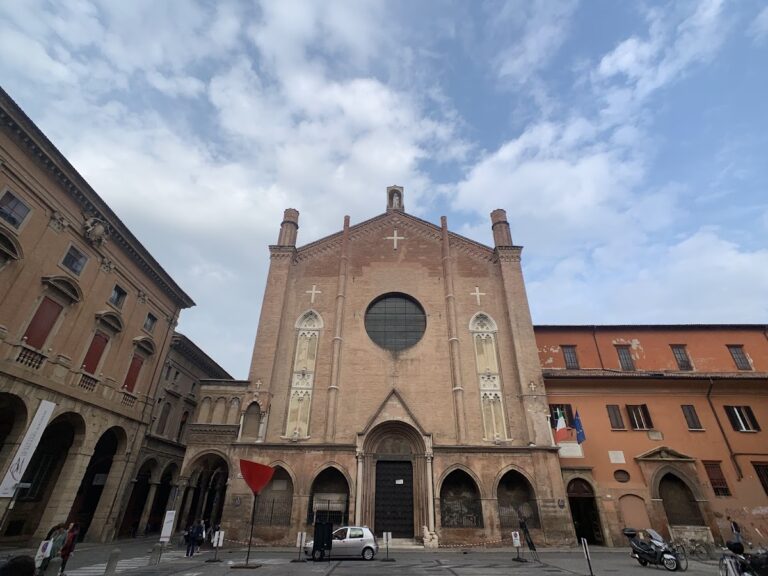
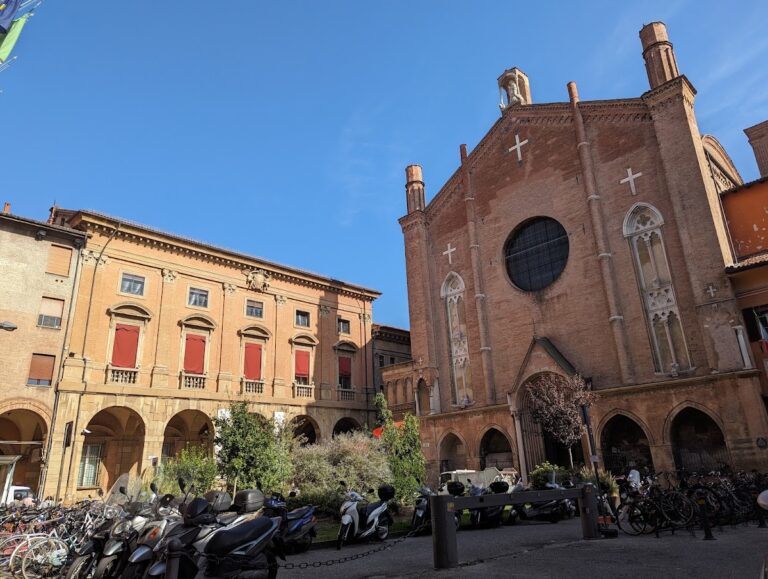
Toward the end of the sixteenth century, the church underwent a complete rebuilding. Its facade was moved to the street, while the interior was reorganized from three naves into a single nave. The work was completed in 1641, when the church was reconsecrated.
The parish was suppressed in 1806. During this period, its crypt was used by the Orto delle Esperidi, a literary circle whose name referred to the Hesperides of Greek mythology, figures associated with a garden of golden apples. The circle was linked with Countess Rossi Martinetti, who, together with her husband, had acquired the adjoining Benedictine monastery and transformed it into a luxurious palace.
The parish was re-established on 24 April 1824. Restoration undertaken in 1872 and 1873 gave the church the facade seen today. The Early Christian crypt was rediscovered in 1890, restored, and reopened in 1892. The church’s dedication is also expressed by the two crossed palm branches beneath the cross on its spire, a traditional Christian emblem of martyrdom.
Remains
The surviving complex combines a single-nave church, a connected late-fifteenth-century chapel, a slender bell tower, and an Early Christian crypt. Its facade is integrated with Bologna’s porticoes and partly conceals the tower, while the interior contains paintings, a historic organ, and a group of bells with an unusual musical arrangement.
Church and Bell Tower
The main church has one nave and a classically styled facade set into the line of the porticoes. A slender bell tower rises behind it and ends in an elongated spire. Immediately below the cross are two crossed palm branches, the traditional sign of the martyrdom of Saints Vitale and Agricola. On the choir loft, an elevated gallery at the entrance end of the church, stands an organ built by Alessio Verati in 1856. Its richly carved and gilded wooden case dates from the previous century. Giuseppe Rotelli modified the instrument in 1939, and it is now abandoned. Above the high altar is Luigi Busi’s Martyrdom of Saints Vitale and Agricola, painted in 1876 and set within a gilded altarpiece decorated with caryatids, sculpted human figures used as architectural supports.
The bell chamber contains four bells hung from wooden headstocks, together with a wooden frame for manual ringing in the Bolognese style. The largest, cast by Tommaso Antonio Mariani in 1699, has the note C4, measures 80 centimetres across, and weighs 362 kilograms. A bell cast by Leone Vernizzi in 1528 sounds D4, measures 70.5 centimetres, and weighs about 250 kilograms. The bell in E4 was cast by Anchise Censori in 1606, measures 62 centimetres, and weighs 153 kilograms. The smallest, also cast by Mariani in 1699, sounds F-sharp 4, measures 54.8 centimetres, and weighs 126 kilograms. Their pitches are separated by whole tones, forming the unusual scale called a tritone or Lydian scale. An electronic system with horn-shaped loudspeakers is also installed in the bell chamber for ordinary weekday and feast-day services.
Chapel of Santa Maria degli Angeli
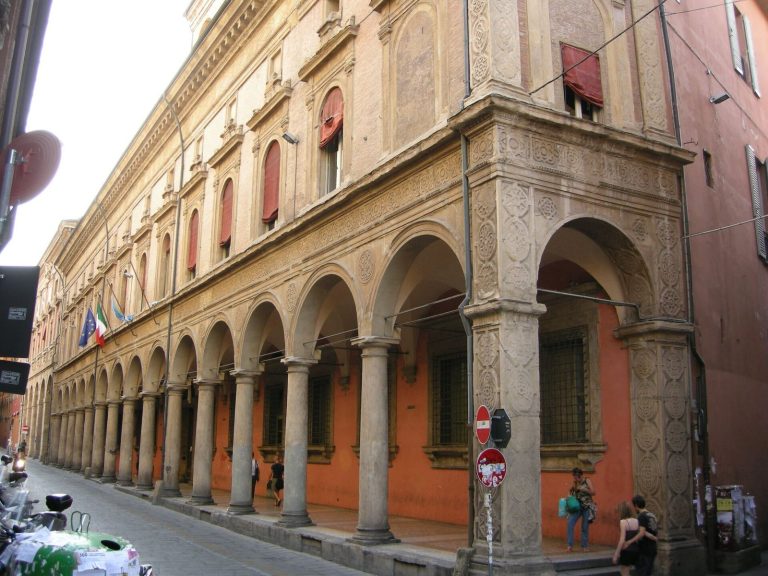
The Chapel of Santa Maria degli Angeli was built toward the end of the fifteenth century by Gaspare Nadi and originally stood apart from San Vitale e Agricola. Its portal on Via San Vitale is traditionally attributed to Andrea Marchesi, known as Formigine. Two arches now connect the chapel with the church’s nave. Within the right-hand arch, a painted wax Holy Family by Angelo Pio is displayed in a case.
The chapel altar carries a wooden altarpiece with three works. At the centre is a copy of Sano di Pietro’s Madonna of Divine Love, whose original was stolen in 1972. Bartolomeo Ramenghi’s Visitation of the Virgin to Saint Elizabeth occupies the left side, while a Nativity attributed to Giacomo Francia is placed on the right. An oil painting of the Flight into Egypt by Alessandro Tiarini, made in the early 1620s and formerly in the church of San Tommaso on Strada Maggiore, hangs on the chapel’s right wall.
Cross and Early Christian Crypt
At the entrance to the Chapel of Santa Maria degli Angeli, on the left side of the nave, stands a cross mounted on a column. It was once incorrectly identified as one of the four crosses of San Petronio. The cross originally stood in a small chapel in front of the church dedicated to Saints Hermes, Aggaeus, and Caius. After that chapel was demolished in 1798, the cross was moved, later transferred to the Certosa, and eventually returned to San Vitale e Agricola.
The church also preserves an Early Christian crypt, an underground or partly underground space dating from the formative centuries of Christianity. Rediscovered in 1890, it was restored and reopened in 1892, adding an early Christian layer to the remains beneath the later church.