Palazzo Falson: A Medieval Noble Residence and Historic House Museum in Mdina


Site at a Glance
- Rating
- 4.6
- Popularity
- Low
- Country
- Malta
- Primary era
- Medieval
- External website
- Open
- Eras represented
- Medieval, Early Modern, Modern
- Civilizations
- British, Crown of Aragon, Kingdom of Sicily, Knights Hospitaller
- Site type
- Domestic
- Remains
- Elite Residence
On this page17 sections
History
Medieval origins and noble ownership
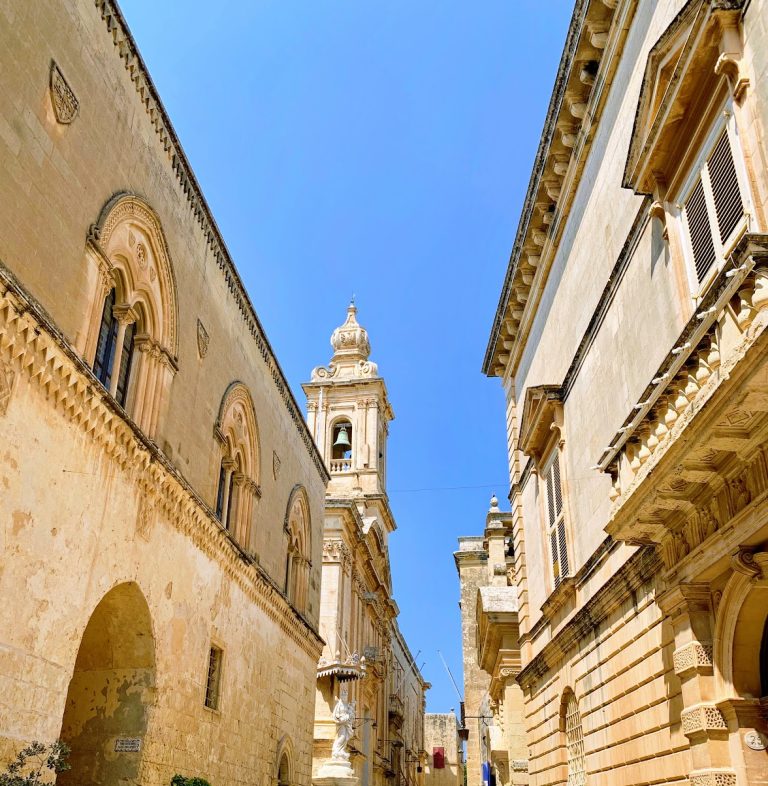
Palazzo Falson is a medieval townhouse in Mdina, Malta, built as a residence for the Maltese nobility. Its present name comes from the Falson family, while earlier names included Palazzo Cumbo-Navarra, Casa dei Castelletti, and The Norman House. The building is generally described as Siculo-Norman or Italo-Norman in style and is regarded as the second-oldest building in Mdina, after the ground floor of Palazzo Santa Sofia.
The site was first occupied by a defensive structure known as La Rocca. A single-storey house stood here by the thirteenth century, and parts of the present palace may incorporate this early building and a later synagogue. The family connected with the residence was prominent in medieval Mdina and took part in municipal affairs. Its earliest recorded reference dates to 1299.
Ownership in the sixteenth century remains uncertain. Some documents indicate that the palace originally belonged to the Cumbo family, while other claims identify Ambrosio de Falsone, head of Mdina’s town council, as its owner. According to this version, Ambrosio was succeeded in 1524 by his cousin Michele Falsone, a vice-admiral.
Tradition holds that Philippe Villiers de L’Isle-Adam visited the residence in 1530 for a banquet after the ceremony through which he took possession of Mdina on 13 November. Villiers de L’Isle-Adam was the first grand master of the Order of St John to rule Malta. The Order was a Catholic military and religious order that governed the island from 1530 to 1798. Both the identification of the residence visited and the palace’s ownership at that time remain uncertain.
Confiscation and changing ownership
The palace later passed to Matteo Falson, who was identified as Master of the Rod. He fled to Sicily in 1574 after persecution by the Inquisition for his Lutheran views. The Inquisition seized the building, which eventually passed to the Cumbo-Navarra family.
In 1657 the palace belonged to Ugolino Cumbo Navarra. Following his death, it passed to his aunt Guzmana Cassar, who transferred it to her nephew Federico Falsone. Federico belonged to a separate branch of the Falsone family and probably never lived in the residence. The building subsequently passed through the Muscati-Falsone-Navarra family and, by the 1920s, belonged to Count Francesco Palermo Navarra Bonici of Catania. Subdivision into several tenements gradually reduced the size of the original residence.
Olof Frederick Gollcher and the museum
Olof Frederick Gollcher and his mother, Elisa Gollcher, acquired part of the palace in 1927. Gollcher bought the remaining portion in 1938, moved his collections into the building, and called it The Norman House, reflecting the contemporary interpretation of its architecture. The facade was restored and modified in 1929, and parts of the interior were changed.
Born in Valletta in 1889, Gollcher was a collector, artist, and cultural enthusiast. He served in the British Army from 1914 and during both world wars, becoming a captain in 1945. He served on Malta’s Antiquities Committee and acted as secretary of the International Institute of Mediterranean Archaeology and the Malta Underwater Archaeological Branch. The latter organization had its headquarters in the palace. Gollcher also trained in Italy in the cleaning and assembly of terrestrial and underwater archaeological finds.
His interests ranged from paintings, furniture, Oriental carpets, silver, books, and jewellery to archaeological objects and maritime material. He intended that the house and its collections should eventually be opened to the public. After his death in 1962, they were transferred to the Captain O. F. Gollcher OBE Art and Archaeological Foundation. Restoration of the building and collections began in 2001, and the Palazzo Falson Historic House Museum opened in 2007. Since then, Fondazzjoni Patrimonju Malti has managed the museum, preserving Gollcher’s permanent collections and occasionally presenting temporary exhibitions with loans from Maltese museums and private collections.
Palazzo Falson was included in Malta’s Antiquities List of 1925. It has been a Grade 1 scheduled property since 1992 and appears in the National Inventory of the Cultural Property of the Maltese Islands under number 01193.
Remains
Building, facade, and courtyard
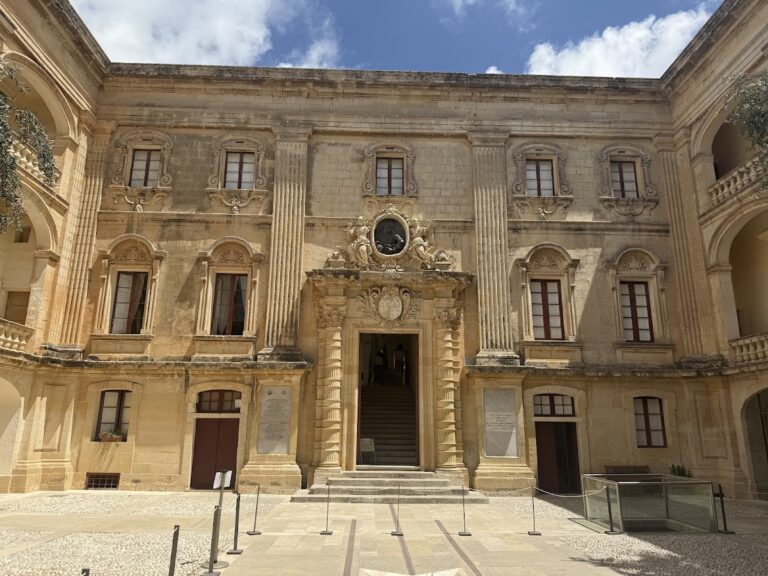
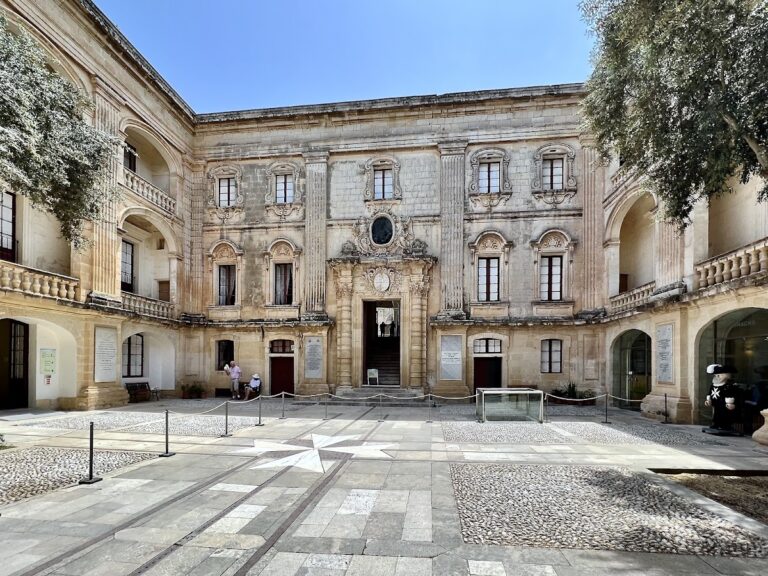
Palazzo Falson has two storeys arranged around a central courtyard. The limestone building combines a vernacular medieval ground floor with a more elaborate upper residential level, known as the piano nobile, the principal and usually most richly decorated floor of a European palace. The earliest structure was considerably larger than the surviving building. Its principal facade and entrance once faced what is now Bastion Square, while a second entrance from Our Saviour Street served as a rear entrance and led towards an adjoining church dedicated to the Saviour.
The ground floor is dated either to the thirteenth century or to about 1495, with the later date understood as a rebuilding that probably incorporated earlier fabric. The piano nobile was added or enlarged in the middle of the sixteenth century. In the fifteenth century, the facade was reoriented towards Villegaignon Street. Its limestone front has a double serrated string course, a horizontal band separating storeys, decorated with inverted triangles and balls. A hood mould, or projecting frame around an opening, surrounds the main entrance, while a similar single-tiered cornice runs at roof level.
The cornices resemble those of Palazzo Santa Sofia in Mdina and Palazzo Montalto in Syracuse, and comparisons have also been made with Palazzo Maria in Sicily. Spanish influences appear in the facade, particularly in several Catalan-style paired windows called bifora. Each of these windows is divided by a slender central support. They were probably designed by the local architect Jacobo Dimeg, also recorded as Dimecha, although the palace’s original architect is unknown.
The courtyard contains an external staircase inspired by Siculo-Renaissance architecture, leading to the first-floor terrace. It also includes a pseudo-Siculo-Norman fountain and a Byzantine-Romanesque folly, a decorative structure created mainly for visual effect. The latter occupies the right-hand corner and resembles a small tower supported on columns with intricately carved capitals. These courtyard features reflect Gollcher’s historically romanticized alterations.
Ground-floor rooms
Refectory
The refectory belongs to the oldest part of the palace and probably dates from the medieval period. Its thick walls survive as part of the early fabric. Restoration revealed a narrow, blocked, arched passage between the kitchen and refectory, probably belonging to the thirteenth-century core. The room contains four Maltese ceremonial chairs, including one from the seventeenth century, together with spinning wheels, locks, scales, measures, pewter and lead vessels, oil lamps, and candlesticks.
Kitchen
The kitchen has thick walls, massive arches, and elongated windows characteristic of medieval construction. A large fireplace is decorated with colourful maiolica tiles showing figures in eighteenth-century dress. A wood-fired stove is faced with blue-and-white tiles, and copper pots, pans, kettles, jugs, and other containers occupy the room. A seventeenth-century cupboard known locally as tas-sagristija, originally made for church sacristies, is used for storage. One cupboard supports an il-baqra, a vessel traditionally used to prepare rabbit stew.
Armoury
The armoury displays swords, polearms, pistols, rifles, helmets, spurs, a brass mace, a medieval axe, and a flail. A Spanish crossbow dates from the beginning of the sixteenth century. The Oriental section includes a Persian Kulah Khud helmet, probably from the early nineteenth century, with a nose guard, plume holders, and a mail neck guard. Its surface is decorated by damascening, the inlay of contrasting metals into a metal surface, forming foliage, human figures, and Arabic Quranic quotations. A Persian convex sipar shield and a Persian dagger are also displayed.
The firearms include English, Italian, French, and Spanish flintlock pistols. Some French-style examples were made specifically for eastern markets, particularly Turkey. A chastity belt is also exhibited, traditionally interpreted as a medieval object of marital fidelity but now commonly regarded as a Victorian fabrication.
Studio and treasury
Gollcher’s studio contains his oil paintings, etchings, lithographs, and pipes, along with works connected with the Confraternità della Pipa and records of his participation in Malta’s art organizations. The treasury presents part of his collection of more than 800 silver objects, including Maltese, British, and European silverware. Among them are an eighteenth-century table service bearing the arms of the Order of St John, coffee pots, nineteenth-century tea services, sugar containers, and a silver nef. A nef is a ceremonial ship-shaped table vessel that could contain and distribute salt, pepper, and other spices, and sometimes hold napkins or cutlery.
Upper-floor collections
Maritime and domestic rooms
The stair landing contains maritime views, including six eighteenth-century views of Valletta harbour, representations of ships, maritime objects, four of the museum’s fifteen ship models, and navigational instruments such as an octant. A painting by Girolamo Gianni shows the ship Swalan entering Valletta harbour in 1848 under the command of Johan Gustaf Gollcher, Olof’s great-grandfather.
At the top of the stairs is a typical early-twentieth-century bedroom for a butler or servant. Nineteenth-century lithographs show street sellers and local products, including a Maltese woman wearing the traditional għonnella, a garment that disappeared during the second half of the twentieth century. A frame above the bed contains saints’ relics surrounded by decorative motifs.
Study and small-objects room
The study holds Gollcher’s prints, small family portraits by the nineteenth-century Swedish naïve artist Alexis Witterbergh, an opium pipe, and apothecary jars. It also displays three engravings by Albrecht Dürer, works by Salvator Rosa, and prints based on I Balli di Sfessania by Jacques Callot.
The small-objects room contains jewellery, coins, decorative objects, portraits of Gollcher and his contemporaries, and portraits of Gollcher and his wife Nella placed opposite one another. The collection includes a rare silver-gilt medal of Grand Master Alof de Wignacourt dated 1607, a filigree necklace and brooch with Maltese motifs, nineteenth-century clothing accessories, silver corsets, medallions, opera glasses, decorated combs, more than thirty silver snuffboxes, bouquet holders, pocket watches, watch chains, rings, gold-trimmed decanters, and scent bottles.
Principal reception rooms
The drawing room is one of the palace’s three principal reception rooms, or sale nobili. It contains Mattia Preti’s The Suicide of Lucretia, a painting titled In a Tavern attributed to David Teniers the Younger, two Teniers-style works titled The Monkey Orchestra and The Cat Barber, a small portrait of a boy attributed to Bartolomé Esteban Murillo, and four paintings of putti representing the Four Seasons traditionally attributed to Nicolas Poussin. An early-eighteenth-century Maltese chest of drawers has four drawers, rounded feet, and a veneer of olive and walnut wood. Orange-wood medallions form a lace-like pattern within a double chain motif, while the edges are stained black to resemble ebony.
The living room contains portraits, furniture, porcelain, and one of the palace’s nine standing display cabinets. This cabinet has six drawers with fronts decorated by glass panels painted with mythological scenes. Other furnishings include a portrait of a Genoese noblewoman painted in the manner of Anthony van Dyck, an eighteenth-century bureau with a fall-front, undulating drawers, and concave sides, a seventeenth-century Maltese table inlaid with olive and orange wood, more than thirty fans, a Maltese wall clock with a painted and gilded case and floral dial, and Capodimonte porcelain figures.
The dining room is dominated by a fireplace bearing the arms of Grand Master Philippe Villiers de L’Isle-Adam and an inscription commemorating his stay. Victor Fleri Soler, a Maltese artist, painted the frieze of fruit and flower garlands around the room, partly with Gollcher’s assistance. The furnishings include family portraits, landscapes, still lifes, a marble bust of Napoleon based on Antoine-Denis Chaudet’s 1804 sculpture, silver tableware, a Dutch silver nef from the second half of the nineteenth century, Venetian glass bearing the arms of Fra Gaetano Bruno, a covered jug by Gioacchino Lebrun that once belonged to Grand Master de Rohan, and a landscape by Richard Bonington.
Library and chapel
The library contains more than 4,500 books and manuscripts on warfare, the two world wars, medieval history, mineralogy, French royal courts, biographies, British history, and art history. Its Melitensia, books concerning Malta or published there, include two histories of the Order of St John, Giacomo Bosio’s 1594 history continued by Bartolomeo Del Pozzo, the 1726 Histoire des Chevaliers Hospitaliers de S. Jean de Jerusalem, its 1728 English edition, Baedeker’s Northern France from 1894, a leather-bound ninth edition of Encyclopaedia Britannica published from 1875 to 1889, Voltaire’s seventy-volume works published from 1785 to 1789, History of the Popes (1305–1700) from 1923, and the fourteen-volume Cambridge Modern History published from 1904 to 1912. Old Paris apothecary jars decorated with flowers, leaves, gilded borders, and the serpent symbol of pharmacy are also displayed.
The chapel contains religious paintings and icons, including two images of the Virgin and Child fitted with metal coverings indicating special veneration. One follows the Eleousa type, which depicts the Virgin and Child in an intimate gesture of tenderness. Other icons include an eighteenth-century Greek image of the Sorrowful Mother holding a crucifix and an icon of Saint Nicholas. The altar painting probably dates from the eighteenth century and depicts Saint Angelo the Martyr. It is attributed to a Sicilian artist. Two eighteenth-century silver processional lanterns bearing the Order’s cross stand beside the altar, accompanied by nineteenth-century silver holy-water vessels, seventeenth-century silver vessels for holy oil, and a portable stoup from the second half of the seventeenth century.
Bedroom, carpet gallery, and archaeological room
The master bedroom is dominated by a four-poster bed. It contains eighteenth-century female portraits, early-twentieth-century Chinese embroidered-silk panels, a carved cabinet holding women’s purses and bags, Gollcher’s club membership cards and medals, and two nineteenth-century fans, one Maltese and one Cantonese. The carpet gallery contains more than eighty Oriental carpets from Azerbaijan, Afghanistan, and Turkmenistan, together with Persian carpets and prayer rugs.
The archaeological and documents room contains Roman objects such as an early trefoil-mouthed jug on a flat base, a dipping bowl, an unguentarium, oil lamps, bowls, amphora fragments, and ancient clay figurines. Seven papal bulls are displayed alongside a richly illustrated German-language manuscript containing a miniature of a nobleman’s complete coat of arms, whose colours remain well preserved.
Other notable holdings include a rare ten-hour watch from the French Revolutionary period, made by Robert Robin and numbered second in its series, one of only three surviving watches known from this maker. The collections also include an ink-and-wash landscape sketch by Edward Lear made during one of his stays in Malta, further engravings by Salvator Rosa, Maltese earthenware vessels known as il-baqra, and the chastity belt traditionally linked with medieval marital fidelity but now generally regarded as a Victorian fabrication.