Palazzo Vilhena: A French Baroque Palace in Mdina, Malta


Site at a Glance
- Rating
- 4.6
- Popularity
- Low
- Country
- Malta
- Primary era
- Early Modern
- Eras represented
- Early Modern
- Civilizations
- Knights Hospitaller
- Site type
- Domestic
- Remains
- Palace
On this page8 sections
History
Palazzo Vilhena is a French Baroque palace in Mdina, Malta, built between 1726 and 1728 for António Manoel de Vilhena, the Grand Master of the Order of St John. Designed by the French architect Charles François de Mondion and constructed under the supervision of the Maltese master builder Petruzzo Debono, it formed part of a major rebuilding of Mdina after the 1693 Sicily earthquake.
From ancient settlement to civic palace
The site had been inhabited in ancient times, and remains from the period after Punic rule have been found there. Around the eighth century, a Byzantine fort was probably established on the location. During the Middle Ages, it developed into a castle known as the Castellu di la Chitati.
The castle’s inner walls were demolished in the fifteenth century. What remained was converted into a palace during the 1530s by Grand Master Philippe Villiers de L’Isle-Adam. Known as the Palazzo Giuratale, it became the seat of the Università, Mdina’s civic administrative council rather than a modern university.
The eighteenth-century rebuilding
The 1693 earthquake badly damaged the palace. On 3 November 1722, Grand Master António Manoel de Vilhena ordered the restoration and renovation of Mdina. The city entrance was completely rebuilt, while the Palazzo Giuratale was demolished to make room for Vilhena’s summer residence. The Università received a new meeting place in the Banca Giuratale.
Palazzo Vilhena was constructed from 1726 to 1728. Its design drew on the formal solutions associated with Parisian hôtel palaces and established the building as an important example of French Baroque architecture in Malta.
Hospital and museum use
The building was used as a temporary hospital during the cholera outbreak of 1837. On 12 June 1860, the British military converted it into a sanatorium for British soldiers. It closed temporarily in 1890 and was briefly used as a barracks before reopening. Its hospital service finally ended in 1907.
King Edward VII reopened the building on 22 April 1909 as a hospital for tuberculosis patients. It became known as Connaught Hospital after Prince Arthur, Duke of Connaught and Strathearn, whose donation supported new hospital equipment. The hospital closed in 1956.
Palazzo Vilhena opened as Malta’s National Museum of Natural History on 22 June 1973. The building remains owned by the Government of Malta. It was included on Malta’s Antiquities List in 1925, designated a Grade 1 national monument, and entered in the National Inventory of the Cultural Property of the Maltese Islands under number 01184 on 28 December 2012. Its forecourt was restored between 2000 and 2002.
Remains
Forecourt and exterior
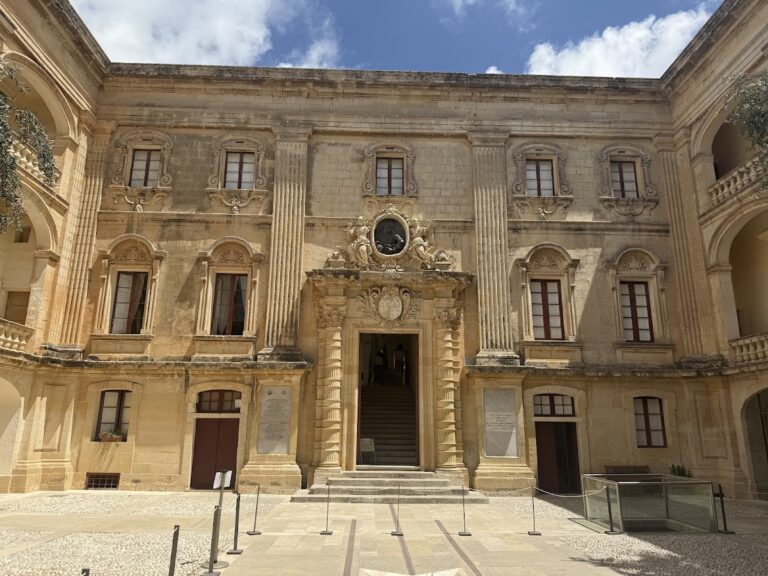
Palazzo Vilhena is a large limestone palace organized around a U-shaped front forecourt surrounded by loggias, which are roofed, open-sided galleries. The forecourt follows the plan of the earlier castle and may incorporate remnants of the sixteenth-century palace. Its entrance is marked by a gate decorated with Vilhena’s coat of arms.
The central façade has an ornate main doorway framed by Corinthian columns, a classical type with richly decorated capitals based on acanthus leaves. Above the entrance is a bronze relief showing Vilhena together with another coat of arms. The regular balance of the exterior reflects the formal character of French Baroque architecture.
Interior and connected civic building
Inside, the palace has an irregular plan that contrasts with the order of its exterior. An inner courtyard forms part of the building’s surviving arrangement. Palazzo Vilhena is physically linked to the Corte Capitanale, which was built at the same time and also designed by Charles François de Mondion.
The Corte Capitanale served as Mdina’s law courts and now houses the city’s local council. Its connection with Palazzo Vilhena reflects the close architectural relationship between the palace and the civic buildings created during Mdina’s eighteenth-century rebuilding.
Natural history collections
The building now contains Malta’s National Museum of Natural History. Its collections include specimens of flora and fauna, fossils, rocks, and minerals, together with dioramas, three-dimensional scenes representing Maltese natural habitats.
Nearby sites