Palazzo Drago Ajroldi: A Historic Palace in Palermo


Site at a Glance
- Rating
- 4.9
- Popularity
- Low
- Country
- Italy
- Primary era
- Early Modern
- External website
- Open
- Eras represented
- Early Modern, Modern
- Civilizations
- Italian, Kingdom of Sicily
- Site type
- Domestic
- Remains
- Elite Residence
On this page15 sections
History
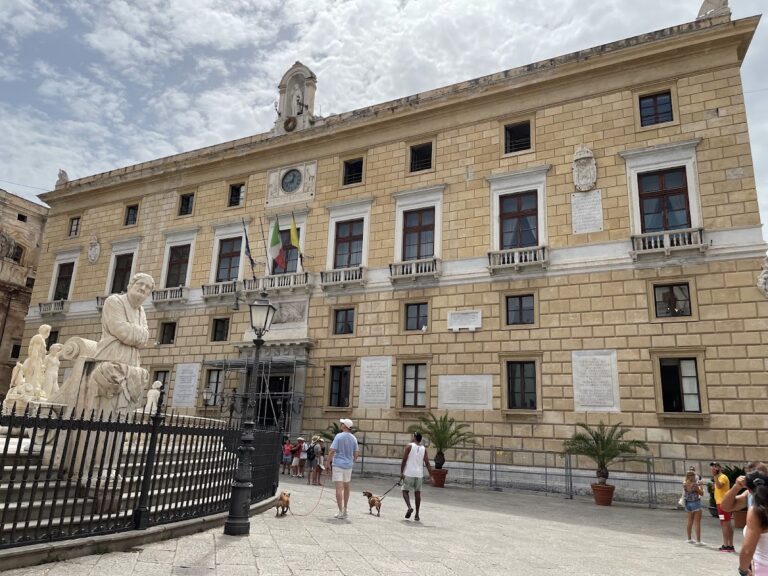
Palazzo Drago Ajroldi is a historic aristocratic palace in Palermo, Italy, that developed from an Arab outpost along the early route of the Cassaro, now Via Vittorio Emanuele. Successive rebuilding phases gave it the form it had acquired during the first twenty years of the eighteenth century, while its architecture and decoration later combined Baroque influences with Neoclassical elements and the Liberty style, the Italian form of Art Nouveau.
The Drago Family
In 1714, during the reign of Vittorio Amedeo II of Savoy, the palace became the property of Casimiro Drago, president-lieutenant of the Kingdom’s Master Justiciar. Vittorio Amedeo II belonged to the Savoy dynasty and ruled as king of Sicily during this period. In 1724, the Holy Roman Emperor Carlo VI granted Casimiro the title of marquis. Ownership later passed to his son, Biagio II Drago.
Biagio II commissioned an extensive painted programme for the reception rooms, including ceiling frescoes. The best-known work is Olivio Sozzi’s Judgment of Paris, signed and dated 1745. Sozzi was an eighteenth-century painter, and this mythological scene is among the few palace frescoes, and among his works generally, that do not have a religious subject.
The Ajroldi and Later Owners
During the nineteenth century, the palace passed to the Ajroldi family, originally from Lombardy, who became marquises of Santa Colomba. Giovanbattista Ajroldi, a deputy of the kingdom, purchased the marquisate title from Gaspare of Santa Colomba.
In 1872, the architect Giovan Battista Filippo Basile carried out improvement works. In the early twentieth century, when the Liberty style was dominant in Palermo, Ettore De Maria Bergler and his workshop redecorated the largest salons. Other reception rooms retained their earlier decoration, including Sozzi’s frescoes. The last owners were the Bertolino family, represented by Giovanni Bertolino, who were responsible for recent restoration work. The residence is intended as a house museum and is to contain works by contemporary painters, including three paintings by the nineteenth-century Sicilian artist Francesco Lojacono.
Remains
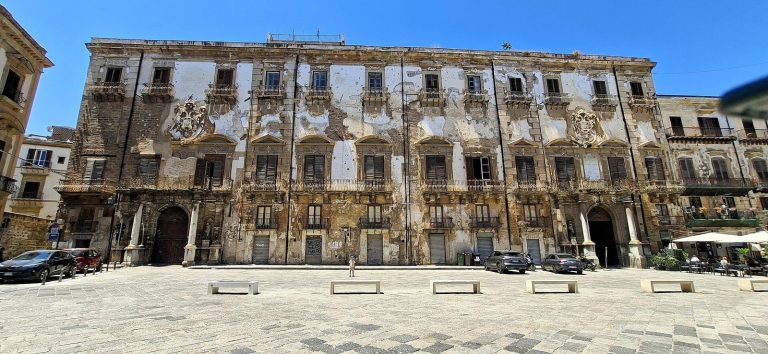
The palace has four levels arranged around a monumental central entrance. The ground floor contains the principal portal and a courtyard with a fountain. Above it are a mezzanine, the piano nobile, or main reception floor, and an upper floor. The piano nobile and upper floor each have a row of five balconies, while the mezzanine has two openings on each side.
Exterior and Entrance
Central Portal
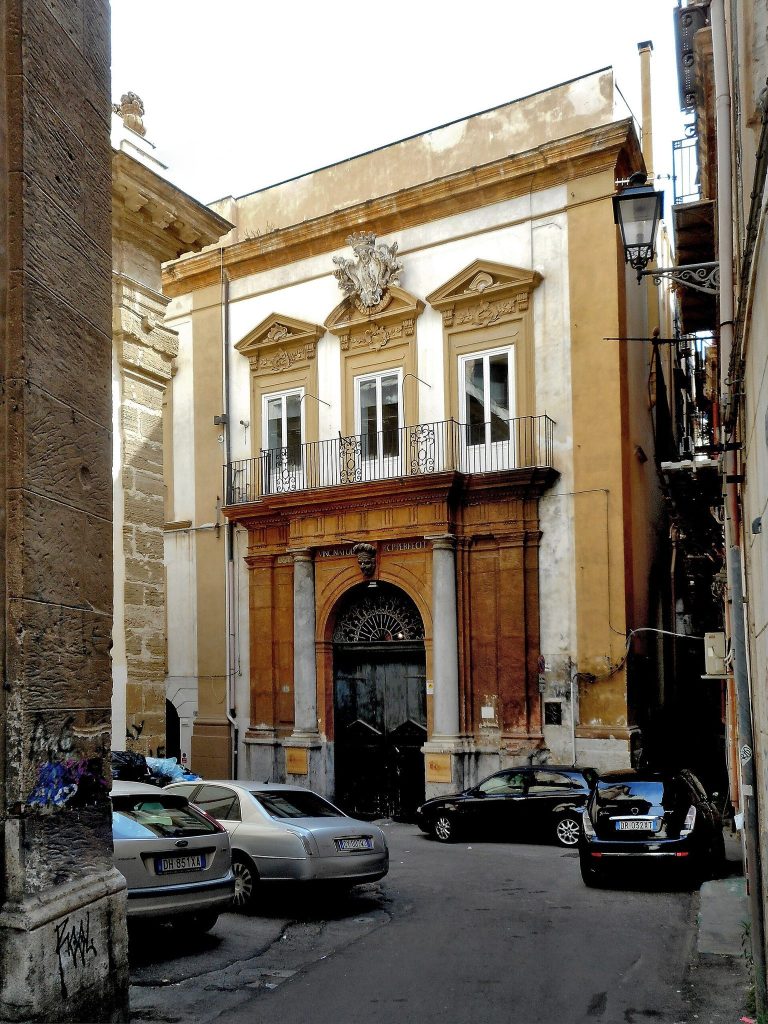
Facing north, the central entrance is crowned by a broken-arched pediment. It bears the former marquisate’s large coat of arms, showing a winged dragon within a garland beneath a noble crown. The emblem connects the building’s exterior to the Drago family’s title and ownership.
Courtyard
The ground-floor courtyard includes a fountain and forms part of the palace’s surviving lower-level arrangement.
Reception Rooms
Enfilade and Sala Dell’Incarico
The piano nobile is organized as an enfilade, a sequence of rooms whose doorways align in a continuous view through the suite. In the Sala Dell’Incarico, the ceiling fresco depicts the Apple of Discord, the golden apple at the centre of the classical myth in which Paris judges Hera, Athena, and Aphrodite.
Sala del Trompe-l’œil
The Sala del Trompe-l’œil contains an illusionistic representation of balconies by Ettore De Maria Bergler. Trompe-l’œil is a painting technique designed to make painted forms appear three-dimensional, extending the architectural imagery of the room through visual illusion.
Sala Neoclassica
The Sala Neoclassica was the former principal salon on the building’s longitudinal axis. Its decoration includes painted medallions and a central view of the sky, where a female figure and putti, winged child figures, hold flowers. The room also contains paintings by Francesco Lojacono.
Sala dei Coralli
The Sala dei Coralli has Pompeian-style decoration. One female figure represents Eleonora Duse, the major Italian stage actress who was a guest of the palace. A display case contains personal objects that belonged to her.
Sala dei Piatti
The Sala dei Piatti is decorated with an allegory of Spring. Cupids fly through the air across the composition, contributing to the room’s mythological and seasonal imagery.
Saletta dei Paggi
The Saletta dei Paggi contains colonial memorabilia, adding a later historical layer to the palace’s sequence of decorated interiors.
Judgment of Paris Fresco
Sozzi’s signed and dated Judgment of Paris occupies the main salon’s ceiling. Paris stands between Hera and Athena as he gives the fatal apple to Aphrodite, whom he has judged the most beautiful. Shepherds witness the scene, while Zeus watches from above the clouds and Hermes points it out to him.
Friezes and cartouches surround the composition. Above the family arms and noble crown are stucco angels playing music in the manner of the Serpotta school, the Sicilian ornamental tradition associated with the stucco artist Giacomo Serpotta. The fresco combines classical mythology with the palace’s heraldic decoration and remains a particularly distinctive element of its eighteenth-century interior.