Palazzo Pretorio: Palermo’s Municipal Palace


Site at a Glance
- Rating
- 4.5
- Popularity
- Low
- Country
- Italy
- Primary era
- Medieval
- External website
- Open
- Eras represented
- Medieval, Early Modern, Modern
- Civilizations
- Crown of Aragon, Italian, Kingdom of Sicily, Spanish
- Site type
- Civic
- Remains
- Palace
On this page11 sections
History
Palazzo Pretorio, also known as Palazzo delle Aquile, is Palermo’s municipal palace in Italy. Built in its present late-fifteenth-century form between 1463 and 1478, it became the representative seat of the city government and brought civic offices together in one complex.
Foundations and fifteenth-century construction
In 1322, King Frederick III recognized the need for a suitable building for Palermo’s civic assemblies, which had previously taken place in religious buildings such as the Church of San Francesco d’Assisi. A traditional account places an earlier palace on the site during the fourteenth century under Frederick II of Aragon. Documents published in 1875, however, indicate that the decision to construct the palace was made in 1463.
The building raised between 1463 and 1478 was directed by Giacomo Benfante on the initiative of Pietro Speciale, magistrate, praetor, and lord of Alcamo and Calatafimi. The late-fifteenth-century work is therefore understood as a reconstruction within an earlier civic building tradition. The palace was formerly known as Palazzo Senatorio or Palazzo di Città, names that reflected its connection with Palermo’s Senate and municipal administration.
Expansion and civic administration
The palace was enlarged and given a new principal facade in 1553, with further work completing the facade in 1597. These changes gathered offices that had previously been scattered around Palermo. The main entrance was later turned toward the north, probably as part of the reorganization of Piazza Pretoria, the extension of the Cassaro, and the installation of the fountain.
Mariano Smiriglio carried out another major restructuring between 1615 and 1617. In the same period, the Public Bank, founded at Garaffello on 21 February 1553, was transferred to the palace. A statue of Palermo’s patron saint, Saint Rosalia, was placed on the cornice in 1661. Saint Rosalia, the principal patron saint of Palermo, was closely associated with the city’s religious identity and protection.
Austrian and Bourbon government
During the Austrian administration, the Senate, also called the Municipal Annonary Magistracy, administered the city’s patrimony. An annonary office dealt broadly with the city’s provisioning and supplies. The institution was headed by a praetor, the chief municipal magistrate, and six senators, who served two-year terms. A Civic Council of 110 citizens, elected under a specified income qualification, chose them for four-year terms.
On 15 August 1722, Emperor Charles VI granted the members the rank of first-class Grandee of Spain and the title of Excellence. Seven noble officers assisted the council: the master notary, master accountant, treasurer, chancellor, building-works officer, arms conservator, and archivist.
On 3 April 1746, King Charles III of Bourbon granted the Senate the title and authority of the Supreme, General, Sole, and Independent Magistracy of Health. Charles III was the Bourbon monarch who extended the Senate’s authority in this field. The new body included the praetor as president, six serving senators, the archbishop of Palermo, an ecclesiastic, four former praetors, two legal advisers, four former senators, three physicians, and a chancellor. Members held office for life and could be replaced or reinstated by the Senate and its deputation.
Earthquake, unification, and later transformations
The earthquake of Pollina on 5 March 1823 led to further enlargement of the monumental complex. Damaged spaces and objects were reconstructed in their present forms during restoration work in 1827.
After Palermo was captured in 1860 during Giuseppe Garibaldi’s campaign, the palace housed Garibaldi’s dictatorial government. Garibaldi, the Italian revolutionary and military leader whose campaign helped bring Sicily into Italian unification, addressed the people of Palermo from the palace balcony on 30 May 1860. A plaque commemorates the event.
Between 1873 and 1875, Giuseppe Damiani Almeyda reinterpreted the building in Renaissance Revival and Neoclassical forms. Renaissance Revival reworks Renaissance architectural ideas, while Neoclassical architecture draws on the formal vocabulary of classical antiquity. Since Italian unification, the Sala delle Lapidi has hosted the municipal council, the Sala Gialla has served as the meeting room of the municipal government, and the Sala Rossa has been used as the mayor’s room.
In 1877, Piazza Pretoria was connected with the level of Via Maqueda by a monumental staircase. The palace remains in municipal use and is recognized as Italian national heritage. Its old clock, which had stopped in the 1980s, returned to operation after restoration in 2014. A Second World War air-raid shelter beneath the palace and Piazza Pretoria preserves a physical link with the building’s wartime history.
Remains
Palazzo Pretorio has a rectangular plan arranged around a central courtyard. Its four facades correspond to the cardinal directions, while the principal entrance faces north toward Piazza Pretoria and the Fontana Pretoria. The building has four external orders and three stories above the ground floor. It was originally faced with cut stone, but thick plaster now reproduces the appearance of rustication. Rows of large windows are interrupted on the piano nobile, the principal ceremonial floor, by balconies with balustrades and small columns.
Facades and commemorative sculpture
The portal opening onto Piazza Pretoria carries a large eagle, Palermo’s civic symbol. Four further eagles by Domenico Costantino decorate the corners, and Salvatore Valenti created the large marble eagle in high relief beneath the central balcony. The facades contain numerous inscriptions, plaques, statues, and other eagle representations.
Marble inscriptions and medallions on the main facade commemorate the royal coronation of Victor Amadeus II of Savoy and Anne Marie of Orléans on 24 December 1713. Paolo Amato designed their frame. Andrea Palma designed another frame commemorating Charles III’s designation as king of the Two Sicilies in 1735. A Palermo coat of arms supported by a telamon, a sculpted male figure used as an architectural support, dates from 1625 and is attributed to Gregorio Tedeschi.
The central facade is crowned by Carlo D’Aprile’s statue of Saint Rosalia, dated 1661. Below it is a large clock brought from Paris in 1864. The monumental staircase linking Piazza Pretoria with Via Maqueda is bounded by two sphinxes carved in Billiemi marble by Domenico Costantino. Other inscriptions around the building commemorate events associated with the square, including Garibaldi’s visit and the visit of Pope John Paul II.
Entrance, courtyard, and staircase
The interior sequence runs from the porter’s lodge through the atrium and covered portico to the monumental staircase and the piano nobile. The entrance from the lodge passes through a Baroque portal made in 1691 by Giovan Battista Marino to a design by Paolo Amato. The former location of the Public Bank is to its right. To the left are Giuseppe d’Alvino’s 1591 painting of the Crucifixion and Giovanni Paolo Fondulli’s image of the Virgin Mary surrounded by saints.
The fifteenth-century internal portico is covered by a metal-and-glass dome, an intervention that allowed a large area to be recovered for rooms and exhibitions. It contains an Imperial-period marble group of two spouses joining their right hands, originally a funerary monument from the building’s northeastern corner. Other works include Vincenzo D’Amore’s 1888 statue of the Palermo poet Giovanni Meli, a cinerary urn surmounted by a two-faced Janus, a bronze high relief by Antonio Ugo, and a 1921 plaque showing Dante Alighieri between allegories of Victory and Italy. A monument depicting Trinacria caressed by Ceres is surmounted by a marble eagle bearing the acronym SPQP.
The Genio di Palermo stands beside the wall on the landing of the monumental staircase. This figure is Palermo’s tutelary civic personification, traditionally understood as the city’s protective genius. The marble work is attributed to Domenico Gagini and Gabriele di Battista and includes an inscription on the rim of its basin. Two putti hold shields, one bearing Palermo’s eagle and the other the arms of Giovanni Ventimiglia, marquis of Geraci, prince of Castelbuono, and president of the kingdom. Royal plaques occupy positions above the flights of stairs.
Municipal halls
The principal rooms include the Sala dei Bassorilievi, the Sala dei Gonfaloni or Sala degli Stemmi, the Sala Rossa, the Sala Gialla, the Sala delle Lapidi, the Sala Garibaldi, and the Sala Montalbo. The large former assembly halls on the piano nobile now serve as municipal representative offices. They contain inscriptions, archaeological and historical objects, works of Sicilian, Italian, and European art and craft, and a collection of Chinese porcelain. Standard weights and measures used in commercial activities are preserved in several rooms.
The Sala dei Bassorilievi takes its name from Valerio Villareale’s marble work of 1819, which depicts Sicily crowned by Minerva and Ceres. The Sala Rossa, designed by Giuseppe Damiani Almeyda, was the mayor’s study and takes its name from the bright color of its furnishings. It contains a statue of an ephebe from the group known as the Naked Contestants, two Murano glass chandeliers, and painted decorations by Francesco Padovani from 1891. The paintings show young women, cupids, dancers, female figures, and the allegories of Prosperity and Justice. Gustavo Mancinelli painted an allegory of Peace.
The Sala delle Lapidi, formerly the Public Council Hall or Great Hall, is the municipal council chamber. Its name refers to the marble inscriptions on its walls. Fifty marble plaques were installed in 1875 by Gioacchino Di Marzo, a Jesuit and art historian. The room also contains a painted fourteenth-century wooden ceiling, retouched by the Florentine painter Tito Covoni, a carved wooden chandelier, and an inlaid marble floor from the Oratory of Peace.
In September 1760, the Palermo Senate inaugurated the city library in the Sala delle Lapidi. The library began in a small room in the palace, but donations of manuscripts and printed works soon made that space inadequate. It temporarily occupied rooms rented in the palace of the Duke of Castelluccio before moving permanently to the Jesuit complex of Casa Professa.
The Sala Gialla was formerly the first Senate Hall and now serves as the meeting room of the municipal government. Its name comes from the gold color of its brocade upholstery. The room contains a monumental plaster fireplace by Vincenzo Ragusa from 1868, decorations by Rocco Lentini and Francesco Padovani, and portraits of Umberto I and Margherita of Savoy by Gustavo Mancinelli, dated 1884. Salvatore Gregorietti painted the emblems of Sicily’s principal cities on the vault in 1922. Gregorietti also created the wooden benches with lions and panels bearing numerous eagles. Earlier contents included marble busts of Francesco Crispi and Mariano Stabile and paintings by Michele Catti, Lete, Ettore De Maria Bergler, Francesco Lojacono, Salvatore Lo Forte, and Rocco Lentini.
Chapel and commemorative rooms
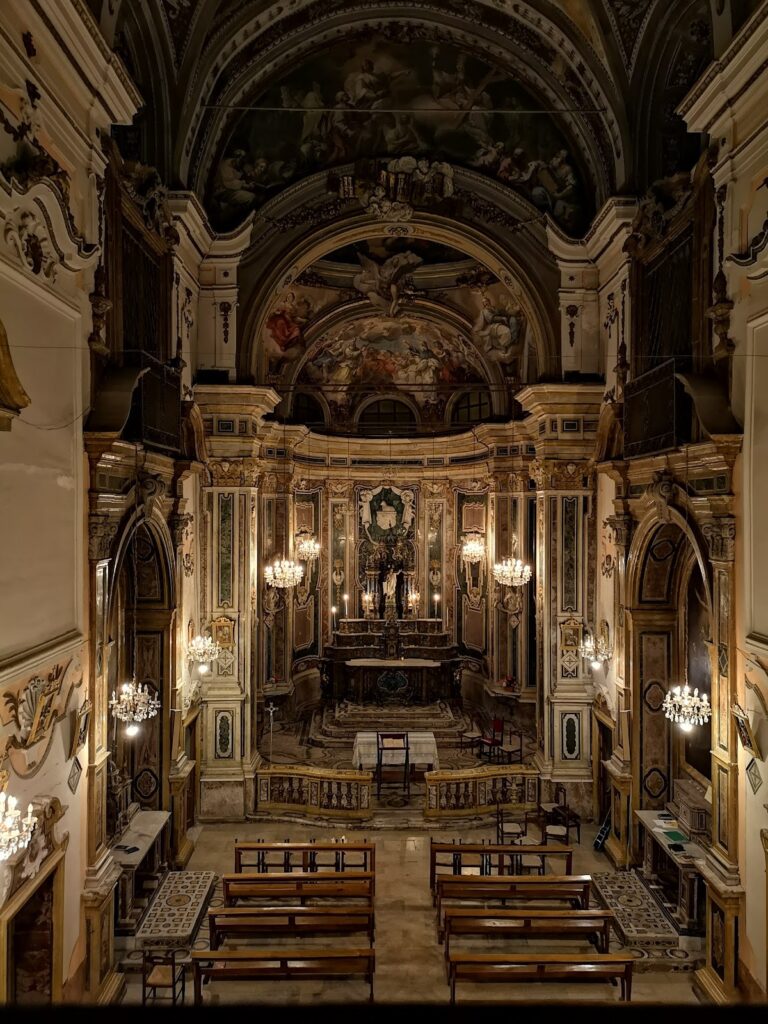
The small Senatorial Chapel was built in Baroque style in 1663. Its upper niche contains Cosmo Sorgi’s statue of Saint Rosalia standing on an eagle. The chapel also includes a statue of Saint Agatha with the instruments of her martyrdom, sculptures of Saint Sebastian and Saint Roch, and an altarpiece depicting the Immaculate Conception.
The Sala Garibaldi contains marble slabs bearing extracts from Garibaldi’s speeches, a portrait of Garibaldi by Salvatore Lo Forte, paintings by Francesco Lojacono and Rocco Lentini, and Mario Rutelli’s 1893 bronze bust of Francesco Crispi. Vases, tapestries, and chased weapons donated by Napoleon Bonaparte to Admiral Federico Carlo Gravina are also preserved there.
The Sala Montalbo contains Benedetto Civiletti’s 1876 bronze high relief of Frederick III of Aragon laying the first stone of Palazzo Pretorio. It also includes Salvatore Marchesi’s oil painting of the interior of the Church of San Domenico and seven marble busts of mayors sculpted by Civiletti. Together with the staircase and exhibition areas, these rooms retain the palace’s civic, commemorative, and artistic collections.
Subterranean wartime remains
A Second World War air-raid shelter extends beneath the palace and the area of Piazza Pretoria. Its access is from the present porter’s lodge, linking the surviving municipal interiors with a subterranean structure created for wartime protection.