Palazzo delle Papesse: A Renaissance Urban Palace in Siena


Site at a Glance
- Rating
- 4.7
- Popularity
- Low
- Country
- Italy
- Primary era
- Medieval
- External website
- Open
- Eras represented
- Medieval, Early Modern, Modern
- Civilizations
- Italian, Republic of Siena
- Site type
- Domestic
- Remains
- Palace
On this page7 sections
History
Palazzo delle Papesse is a Renaissance urban palace in Siena, Italy, commissioned by Caterina Piccolomini in 1460 and completed around 1495. Its Florentine-influenced design was probably based on a plan by Bernardo Rossellino, with Antonio Federighi and Urbano da Cortona involved in its completion. The name “delle Papesse,” meaning “of the female popes,” derives from Caterina’s relationship to her brother, Pope Pius II, the humanist pope born Enea Silvio Piccolomini.
The Piccolomini Palace
The palace belonged to the Piccolomini family and later became associated with the wider Piccolomini consorteria, a formal association that united related branches of a powerful family and coordinated their collective interests. By the late seventeenth century, the Piccolomini branch that had owned the building had died out. The consorteria, established by Pius II to bring together branches including the Piccolomini Todeschini, Piccolomini Clementini, Piccolomini Pieri, and Bandini Piccolomini families, then leased the palace to the Convitto Tolomei.
The Convitto Tolomei had been founded by Celso Tolomei in 1629. The college later moved to another building, which was partly reconstructed by Agostino Fantastici in 1820.
Galileo’s Residence
In 1633, Galileo Galilei stayed at the palace from 9 July until December as the guest of Ascanio II Piccolomini, Archbishop of Siena. Galileo was an astronomer and physicist whose telescopic observations and support for heliocentrism brought him into conflict with the Roman Inquisition. His stay in Siena was permitted house arrest, granted in place of the prison sentence imposed in Rome. From the palace roof, he observed the Moon.
State, Bank, and Exhibition Uses
The palace later passed to the state, which installed offices in the building. Augusto Corbi restored it in 1864, carrying out extensive interventions in the grotesque decorations and altering the character of the original scheme. From 1884, the building belonged to the Banca d’Italia, which adapted it for its own purposes. The neo-Renaissance decoration of the piano nobile, the principal or ceremonially important floor of an Italian palace, dates from this period.
After another restoration, Palazzo delle Papesse reopened in 1998 as a contemporary-art centre, closing in 2008. During that phase it hosted group and solo exhibitions, formed part of TRA ART, a public Tuscan network supporting contemporary art and culture, and housed the ARSNOVA Academy for Multimedia Arts and the Radio Papesse audio project. The palace later returned to Banca d’Italia ownership and was transferred to Opera Laboratori for renewed exhibition use. It reopened in 2025 as a venue for temporary exhibitions. The building is recognized as an Italian cultural property.
Remains
Facade and Courtyard
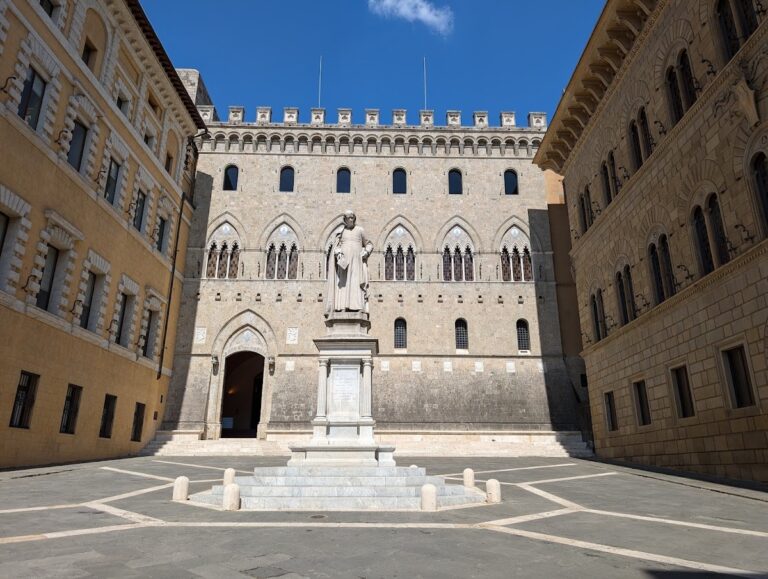
Palazzo delle Papesse stands at 126 Via di Città, on a central Siena street that follows a winding course above the Campo. The Renaissance palace is integrated into the medieval streetscape and has three floors. Its facade is faced with travertine, with rustic rustication on the ground floor and two tiers of paired mullioned windows above.
An internal courtyard forms part of the palace’s surviving architectural arrangement. Its capitals are attributed with near certainty to the sculptor Lorenzo di Mariano and date to around 1509–1510.
Upper Floors and Roof
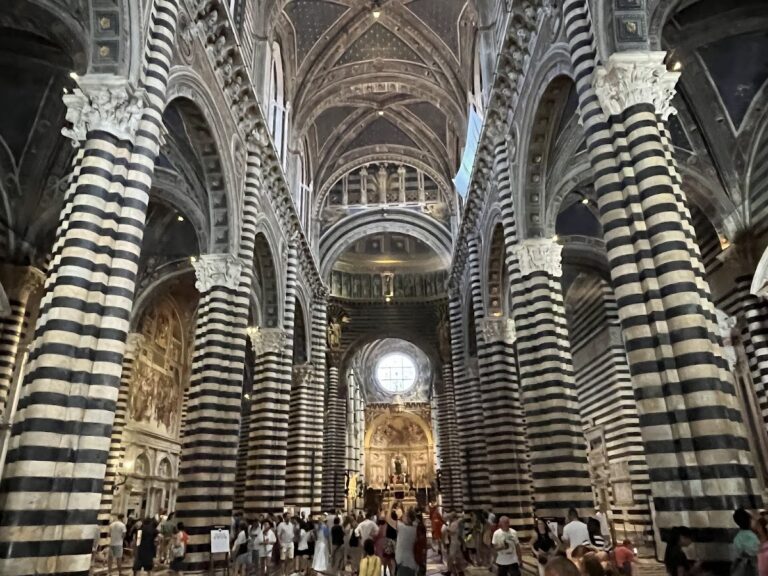
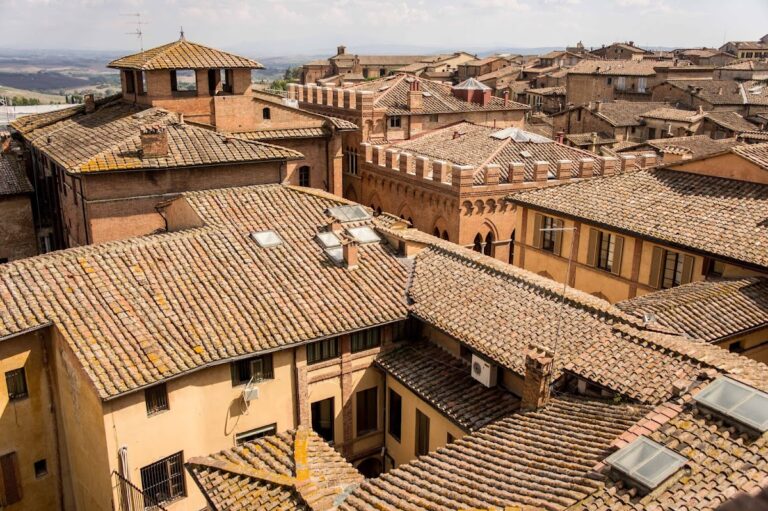
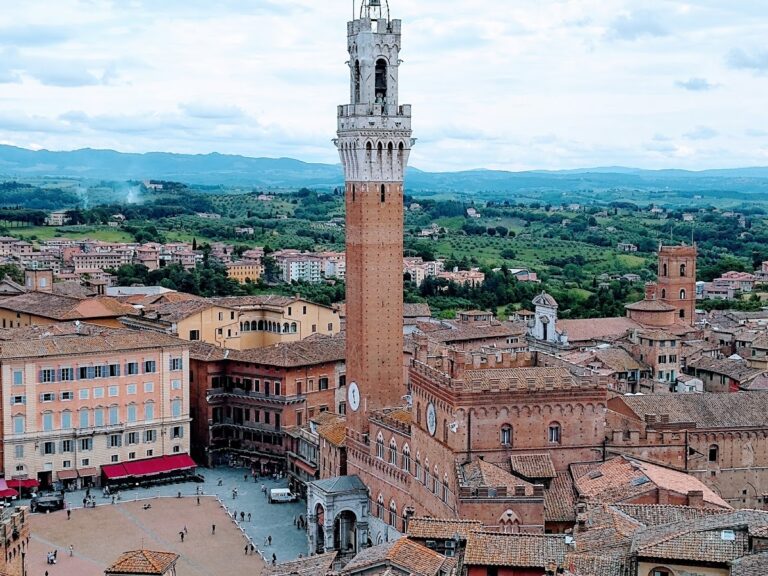
The piano nobile contains frescoes in a fifteenth-century style that were produced during the nineteenth and twentieth centuries. The second floor has an open terrace oriented toward Siena Cathedral, while a loggia on the top floor provides views over Siena’s roofs, the Campo, and the surrounding countryside.
An altana, a roof-level terrace or belvedere, occupies the roof. It is associated with Galileo Galilei’s lunar observations during his stay at the palace in 1633.
Nearby sites