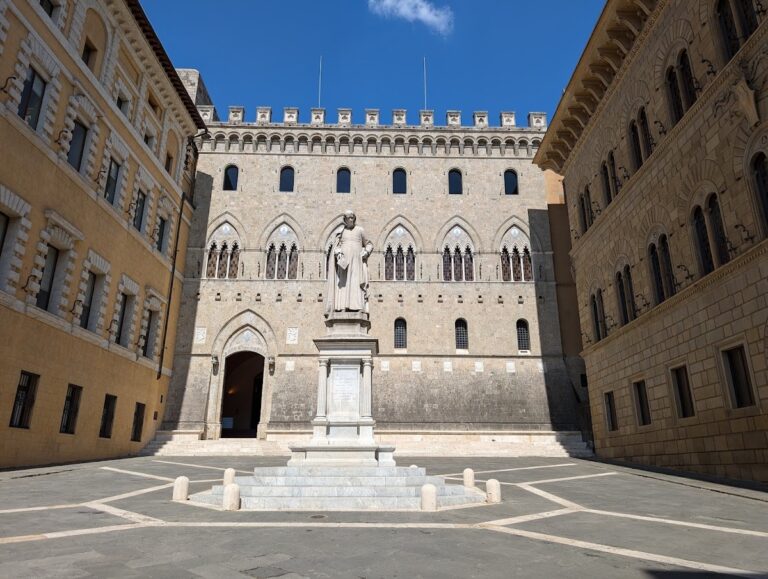
Palazzo Chigi-Saracini: Siena’s Historic Aristocratic Palace and Musical Academy


Site at a Glance
- Rating
- 4.7
- Popularity
- Very Low
- Country
- Italy
- Primary era
- Medieval
- External website
- Open
- Eras represented
- Medieval, Early Modern, Modern
- Civilizations
- Grand Duchy of Tuscany, Italian, Republic of Siena
- Site type
- Domestic
- Remains
- Palace
On this page11 sections
History
Palazzo Chigi-Saracini is a historic aristocratic palace in Siena, Italy, whose Gothic core dates to the twelfth century. Known originally as the Marescotti Palace, it developed through successive enlargements and became associated with Siena’s civic, artistic, and musical life.
The Marescotti Palace and the Republic of Siena
The oldest part of the palace belonged to the Ghibelline Marescotti family, supporters of the imperial side in the medieval conflicts between the Holy Roman Emperor and the papacy. The building grew as adjoining structures were incorporated, reaching its present size by the first half of the fourteenth century. Before the construction of Siena’s Palazzo Pubblico between 1297 and 1310, the palace housed the council of regents of the Republic of Siena.
Renaissance transformation
In 1506, the Piccolomini del Mandolo family acquired the palace and substantially remodeled it in the Renaissance style. Their work included the decoration of the loggias, open-sided architectural galleries, and the interior rooms. The medieval fabric remained part of the building while its spaces received new decorative treatment.
The Saracini period
The Saracini family acquired the palace in 1770. Marcantonio Saracini directed a major restructuring that continued until 1824, when the property passed to his son Galgano. The renovation retained the building’s Gothic character while adapting the facade to the curve of Via di Città. Agostino Fantastici modernized the interiors.
Galgano Saracini formed an art collection of more than 12,000 objects and opened a museum in the palace in 1806 for visitors and students. The collection helped establish the building as an important setting for the preservation and study of art.
The Chigi-Saracini inheritance and the Accademia Musicale Chigiana
By the testament of Alessandro Saracini, who died in 1877, the palace passed to Fabio Chigi, who adopted the surname Chigi Saracini. The property later passed by inheritance to his nephew, Count Guido Chigi Saracini Lucherini. Guido commissioned further restoration and alterations under Arturo Viligiardi, including work on the exterior, interiors, and concert hall.
In 1932, Guido Chigi Saracini founded the Accademia Musicale Chigiana in part of the palace. The Siena-based institution became the Fondazione Accademia Musicale Chigiana in 1958 and later developed into a school for advanced musical training. The Chigi-Saracini-Lucherini family lived in the palace until 1965. After Guido’s death, the building passed to the Accademia Musicale Chigiana. It retains an important private art collection and remains the seat of the academy, while its history has made it one of Siena’s most prestigious aristocratic palaces.
Remains
Medieval structure and facade
The palace stands on Via di Città and incorporates the original medieval Marescotti tower, which remains visible at one end of the building. The tower was enlarged during the Piccolomini alterations in the sixteenth century. The building has two principal floors: the ground-floor facade is faced with natural stone, while the upper floor is built of brick. Rows of triforas, windows divided by two vertical supports into three openings, illuminate both levels.
The Saracini remodeling extended the facade along the bend of Via di Città while preserving the Gothic structure. The extension continued the row of triforas as far as Vicolo di Tone. The facade also retains the Marescotti emblem, an eagle with spread wings, on its triforas.
Courtyard and Renaissance decoration
The courtyard loggias received Renaissance decoration in a style associated with Raphael during the Piccolomini remodeling. Historicized friezes and frescoes commissioned for the interior rooms survive in some chambers. One side of the courtyard is porticoed, forming a covered passage supported by columns or arches, and its vaults are decorated with frescoed grotesques by Giorgio di Giovanni. These ornamental designs combine foliage, animals, figures, and fantastical motifs derived from ancient decorative forms rediscovered during the Renaissance.
The entrance atrium contains a statue of Pope Julius III by Fulvio Signorini, dated 1609. In the courtyard, a well bears the inscription “Micat in vertice,” the Chigi family motto translated as “I shine at the summit.”
Concert hall
Part of the first-floor apartment was adapted in 1922 by Arturo Viligiardi. He designed the concert hall in a restrained eighteenth-century style with Rococo character, and its vault carries a fresco by Viligiardi.
Galleria Chigi-Saracini-Lucherini
The Galleria Chigi-Saracini-Lucherini preserves Sienese art from the thirteenth to the twentieth century. Its paintings include an early-thirteenth-century Madonna by the Master of Tressa; The Adoration of the Magi and fragments of a painted Cross by Sassetta; a small folding triptych by the Master of the Observance; a polyptych by Sano di Pietro; a Madonna with Two Angels attributed to Matteo di Giovanni; Madonna with Two Saints by Neroccio; several panels attributed to Sodoma and his school; a Risen Christ; a Pietà by Riccio; two tondi, a Saint Sebastian, and a small altarpiece by Andrea del Brescianino; and The Mystical Marriage of Saint Catherine of Siena with other works by Beccafumi.
Non-Sienese paintings include a thirteenth-century Aretine Cross; two Madonnas with Saints and an Annunciation attributed to Mariotto di Nardo; a tondo from the school of Botticelli; a tondo by Biagio d’Antonio; two self-portraits by Salvator Rosa; and sketches for Sebastiano Conca’s large fresco of the Pool of Bethesda in the church of Santissima Annunziata at Santa Maria della Scala.
Sculpture, ceramics, and decorative arts
The sculptures include Francesco di Giorgio’s stucco Discord, a marble relief of the Madonna and Child by an artist close to Donatello, and Gian Lorenzo Bernini’s terracotta model for the Saint Jerome in the Chapel of the Vow in Siena Cathedral. Additional works by Giuseppe Mazzuoli are also preserved.
The collection contains maiolica plates by the Sienese artist Ferdinando Maria Campani, who lived from 1702 to 1771. Their late Baroque designs were inspired by Raphael. Sixteenth- to eighteenth-century ceramics, ivory and silver objects, and richly furnished interiors add to the palace’s surviving artistic contents.