Basilica of San Domenico: A Gothic Dominican Church in Siena


Site at a Glance
- Rating
- 4.6
- Popularity
- Medium
- Country
- Italy
- Primary era
- Medieval
- External website
- Open
- Eras represented
- Medieval, Early Modern, Modern
- Civilizations
- Holy Roman Empire, Republic of Siena
- Site type
- Religious
- Remains
- Church
On this page22 sections
History
The Basilica of San Domenico is a Catholic church in Siena, Italy, built by the Dominicans between 1226 and 1265 and enlarged into a Gothic complex during the fourteenth century. Dedicated to Saint Dominic, founder of the Order of Preachers, it became one of Siena’s principal churches and is also an Italian national monument. Its connection with Catherine of Siena, a fourteenth-century Dominican tertiary, mystic, religious writer, and later saint, gives it the alternative name Basilica Cateriniana.
Foundation and Gothic development
The Dominicans arrived in Siena in 1220, one year before the death of their founder, Dominic of Guzmán. In 1225, Fortebraccio Malavolti gave the order land on the hill of Camporegio for a monastery and church. The city helped finance the building, and further support came through donations. Work on the church began in 1226 and continued until 1265.
The complex expanded during the fourteenth century and gradually acquired its Gothic form. Building proceeded through several phases, with completion reached in 1465. The church’s development reflected the needs of a mendicant order, whose members traditionally relied on communal support and preaching rather than the economic independence of large landed monasteries. The funeral of the painter Simone Martini was held here in 1344.
Damage, alteration, and restoration
Fire damaged the complex in 1443, 1456, and 1531. Following the last of these fires, Domenico Cinquini directed restoration work. Military occupation affected the basilica between 1548 and 1552, and the church later suffered serious damage in the earthquake of 1798.
During the seventeenth and eighteenth centuries, extensive Baroque alterations changed the church’s interior, particularly through the addition and rebuilding of side altars. The earthquake also affected the already weakened bell tower. It was reduced to its present height and received a crenellated crown, while the central circular window in the facade and the side windows were closed to improve the building’s stability.
The restoration carried out between 1941 and 1963 removed many of the later Baroque additions and partially recovered the earlier Gothic character. Medieval frescoes were uncovered during the work. The campaign formed the final major restoration of the basilica and helped shape the appearance of the church seen today.
Religious communities and the Cateriniana tradition
The Dominicans controlled the church and adjoining monastery until the end of the eighteenth century. The complex was then transferred to the Benedictines, who remained until 1912. The Dominicans returned to the monastery in 1920. In July 1925, Pope Pius XI raised the church to the dignity of a minor basilica. The historic centre of Siena, including the basilica, was inscribed as a UNESCO World Heritage Site in 1995.
Catherine of Siena lived in the nearby Fontebranda district and attended Mass at San Domenico. Several episodes in her life are traditionally associated with the church, especially the Chapel of the Vaults, where Dominican laywomen and members of the Third Order prayed from the fourteenth century. The Mantellate, Dominican-associated women penitents identified by their black religious mantles, used the chapel. Tradition connects the space with Catherine’s reception of the Mantellate habit and with visions and other devotional experiences involving Christ.
Catherine died in Rome in 1380. After her death, her confessor, Blessed Raymond of Capua, separated her head from her body. The relic, a physical object preserved because of its association with a saint, was brought to Siena in 1384 after the city requested a relic of its revered patron. It is now preserved in the Chapel of Saint Catherine.
The crypt and cloister through the modern period
The crypt was abandoned after an earlier period of religious use and later served secular purposes. From 1862 to 1924 it was used as a stable. It was reconstructed in 1934 and 1935 and adapted as a memorial crypt for Fascist war dead. The memorial was inaugurated in November 1938 and remained until the fall of Fascism in 1945. Ten tombs and a sculpture of the Risen Christ by Vico Consorti were installed there; the sculpture was later moved to the Camposanto della Misericordia cemetery.
The crypt was restored and reconsecrated in 1935. It is now used for most religious services, particularly during winter, because conditions there are milder than in the church above. The cloister was built in 1425, later restored, and partly rebuilt in 1941. Its decoration included frescoes by Lippo Memmi and Lippo Vanni, who painted an Annunciation in 1372.
Remains
The basilica stands on the summit of the tuff hill of Camporegio above the Fontebranda valley and plain. Its exposed brick construction is severe and massive, reflecting the relatively humble materials favoured by mendicant orders. The plan combines a broad single nave with a transept and is described as an Egyptian cross or Saint Anthony’s cross. Rib vaults, which are supported by intersecting structural ribs, cover the chapels along the transept’s terminal wall, while the eastern end is flat and the central chapel rises higher, wider, and deeper than the others.
Exterior and main church
Facade and bell tower
The facade is a plain, undecorated gable with a high oculus, a circular window that functions as a rose window. Much of it is concealed by the raised Chapel of the Vaults, which projects beyond the facade. Convent buildings cover the right side, while the entrance portal is placed on the left. The unusual arrangement resulted from the restricted space behind the facade.
The bell tower stands to the left of the church and dates from 1340. It was shortened in the early eighteenth century and received its crenellated crown after the earthquake of 1798. Four bells hang within it, tuned to E-flat 3 and probably cast by the Rafanelli foundry of Pistoia.
Nave, choir, and sacristy
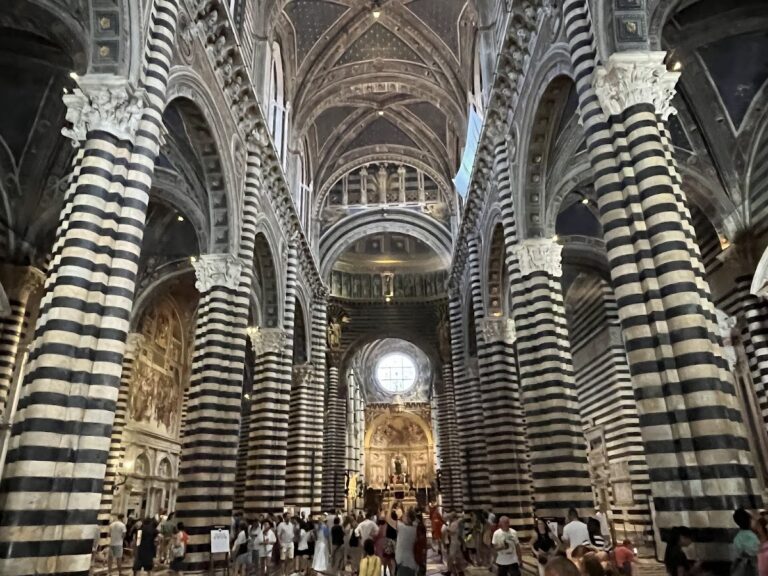
The nave has two vertical levels. Altars occupy the lower level, while Gothic windows with stained glass open above them. The exposed roof trusses remain visible overhead. Twentieth-century stained glass includes works by Bruno Saetti and Domenico Cantatore on the right wall, Fabrizio Clerici and Giorgio Quaroni on the left wall, and Bruno Cassinari in the choir, where scenes from the life of Saint Catherine are represented. Renaissance carved wooden choir stalls survive in the choir.
The old chapter room, old sacristy, refectory, and dormitory belong to the original church complex. The large sacristy is reached from the right transept or the right side of the church. Its altar holds a banner of the Madonna in Glory, attributed either to Sodoma or, more probably, to his pupil Girolamo Magagni, known as Giomo del Sodoma, and dated to about 1526 or 1527. Opposite it is Ludovico Dondo’s Multiplication of the Loaves and Fishes, painted in 1635. Other seventeenth-century paintings are copies after Giovanni Lanfranco and other Emilian artists of a cycle formerly kept in the choir chapel of San Lorenzo in Rome.
Nave paintings and transferred works
The left wall contains Francesco Vanni’s Saint Hyacinth of Poland Saving a Statue of the Virgin and the Blessed Sacrament from a Fire of 1600, Alessandro Casolani’s Mystic Marriage of Saint Catherine of Alexandria, and Rutilio Manetti’s Saint Anthony Abbot Freeing a Possessed Woman of 1628. A fifteen-panel predella, a series of small narrative panels beneath an altarpiece, represents the Mysteries of the Rosary. It has recently been attributed to Sodoma and dated to the first half of the sixteenth century. Other works include a Virgin and Child by Francesco di Vannuccio, an Eternal with a Saint by Sodoma, and a Saint Catherine of Alexandria by Sebastiano Folli.
On the right wall are Stefano Volpi’s Apparition of the Virgin to Blessed Gallerani of 1630 and Alessandro Casolani’s Nativity of the Virgin, painted in 1584 and 1585 for the Dominican tertiary Onesta Longhi. The latter was originally intended for the Chapel of the Vaults and is considered Casolani’s masterpiece and one of the notable Sienese paintings of its period. A reliquary, a container made to preserve and display a relic, holding relics of Catherine stands beyond the altar.
Beyond the Chapel of Saint Catherine are Sodoma’s sixteenth-century Martyrdom of Saint Sebastian with Saint Catherine, Saint Sigismund, Saint Vincent Ferrer, and God the Father, a panel by Francesco di Vannuccio dating to about 1375, and Francesco di Giorgio Martini’s Adoration of the Child of about 1490. The last work is accompanied by a lunette, a semicircular painting above an opening, by Matteo di Giovanni showing the Pieta between Saints Michael and Mary Magdalene, together with a predella attributed to Bernardino Fungai and containing five scenes.
Catherine’s chapels
Chapel of the Vaults
The Chapel of the Vaults is raised above the basilica floor and is entered from the reverse side of the facade through two broad arches resting on piers. It consists of two bays covered by rib vaults. A dividing wall once separated it from the nave. The twentieth-century restoration removed that wall and installed the broad staircase now used to reach the chapel, although the earlier small stair remains visible.
The chapel contains an image of Catherine and a group of works devoted to her life and miracles. On the end wall, Andrea Vanni’s late-fourteenth-century fresco shows Catherine with a devotee. Because Vanni was her disciple and had opportunities to see her, the image is regarded as a faithful portrait.
Other works include Mattia Preti’s Canonization of Saint Catherine of 1672 and 1673, and two paintings signed and dated 1602 by Crescenzio Gambarelli. They show Catherine giving a pilgrim’s garment to Christ and Christ returning the cross she had given him. Deifebo Burbarini’s seventeenth-century Apparition of Catherine to Saint Rose of Lima is also preserved here. Gambarelli’s Death of Saint Catherine and Saint Catherine Reciting the Office with Christ are likewise dated 1602.
Chapel of Saint Catherine
The Chapel of Saint Catherine opens from the right side of the nave. Niccolò Bensi commissioned it in 1466 to house Catherine’s head relic, making it a major Renaissance chapel. Giovanni di Stefano produced its marble altar in 1469. The relic is now kept behind a grille in a small twentieth-century Neo-Gothic reliquary shaped like a temple.
The chapel’s painted decoration includes Sodoma’s Decapitation of Niccolò di Tuldo, Ecstasy of Saint Catherine, and Fainting of Saint Catherine Caused by the Stigmata, all dated 1526. Francesco Vanni’s Liberation of a Possessed Woman by Saint Catherine dates from 1596 and was painted in oil on plaster rather than in fresco. Vanni also decorated the chapel arch with Raymond of Capua and Antonio Nacci, known as Caffarini, presented as the authors of the Legenda Maior and Legenda Minor of Catherine. Sodoma painted Saints Luke and Jerome in the upper arch.
A fifteenth-century marble inlaid floor, attributed to Francesco di Giorgio Martini, probably depicts Orpheus and the Animals. Sixteenth-century grotesques decorate the pillars, and the dome was rebuilt after the earthquake of 1798. Beside the chapel is a modern copy of an older image of Blessed Caterina dei Lenzi. The original, once highly venerated in Siena, was destroyed in 1939.
Transept chapels
Right transept and Blessed Ambrogio Sansedoni
A very high pointed arch separates the nave from the choir and transept. The right transept ends in a chapel with a Baroque altar dedicated to Blessed Ambrogio Sansedoni. Francesco Rustici’s central canvas, dated 1611 and 1612, shows Ambrogio Sansedoni appearing to Blessed Nera Tolomei. Marble figures of Saint Thomas Aquinas and Blessed Jacopo da Mevania flank the painting.
The first chapel of the right transept contains a double fresco, probably from the early sixteenth century, found in a tomb beneath the floor. It depicts the Virgin and Child enthroned with a donor and two saints. The second chapel has a marble altar with a central crucifix and figures of Saint Barbara and Saint Mary Magdalene from the school of Giambologna, dated 1595. Its side walls hold funerary monuments, especially those commemorating German students and other members of the University of Siena who died during the sixteenth and seventeenth centuries.
Further right-transept chapels
The third chapel contains Matteo di Giovanni’s Virgin and Child with Saints Jerome and John the Baptist of 1476. Fragmentary sixteenth-century frescoes transferred from the cloister are also displayed there. The central transept chapel has a modern altar decorated with a ciborium, a canopy-like structure over an altar, and two angels by Benedetto da Maiano, made around 1475. Behind it are Arcangelo Salimbeni’s Martyrdom of Saint Peter of Verona of 1579 and other works from the seventeenth and eighteenth centuries. A rear portal provides a view over Siena’s city centre.
The next chapel contains Raffaello Vanni’s Crucifixion with Saints Eugene and Benedict of 1649 and a carved wooden Saint Anthony Abbot made by Francesco di Valdambrino and painted by Martino di Bartolomeo in 1426. Its left wall bears a detached fresco by Pietro Lorenzetti showing the Virgin and Child with Saint John the Baptist and a kneeling knight. The fresco was transferred from the convent cloister and is regarded as one of the basilica’s most important works.
Monumental transept chapel
The following chapel is the most monumental and richly decorated of the transept chapels. Giuseppe Nicola Nasini painted its frescoes and added stucco decoration. The chapel contains Guido da Siena’s large Maesta, an Italian devotional image of the enthroned Virgin and Child, signed by the artist. An inscription gives the date as 1221, but most scholars favour a date around 1270, after Coppo di Marcovaldo arrived in Siena. The faces of the Virgin and Child are thought to have been repainted by an artist close to Duccio di Buoninsegna.
The same chapel holds Benvenuto di Giovanni’s Virgin and Child with Saints Gregory, James, Jerome, and Sebastian, dated 1483 and accompanied by a Pieta lunette. Matteo di Giovanni’s Saint Barbara with Saints Mary Magdalene and Catherine of Alexandria, with an Epiphany crowning panel, dates from 1479.
Seventh chapel and left transept
The seventh chapel contains a wooden crucifix attributed to Vecchietta and dated to the second half of the fifteenth century. On the wall opposite the sixth chapel is the funerary monument to Giuseppe Pianigiani, a Sienese engineer associated with the Siena to Empoli railway. Enea Becheroni and Tito Sarrocchi sculpted the monument in 1855.
At the end of the left transept, an altar is dedicated to Dominic of Guzmán. A modern painting by a Dominican artist places him at the centre, flanked by marble figures of Saint Mary Magdalene and Saint Catherine of Alexandria.
Crypt and cloister
Gothic crypt
The crypt is an early-fourteenth-century Gothic space divided by piers into three aisles. Rib vaults cover the aisles, which terminate in apses, the rounded or polygonal ends of church spaces. Behind the high altar is a painted crucifix by Sano di Pietro. Ventura Salimbeni’s signed and dated Crucifixion of 1600 is also preserved there.
Cloister
The cloister is entered from the right side of the facade and retains fragments of fresco decoration. Lippo Memmi painted a small Maesta, while Lippo Vanni painted an Annunciation in 1372. Pietro Lorenzetti’s fresco of the Virgin and Child with Saint John the Baptist and a kneeling knight was transferred from the cloister and is now displayed in the transept.
Works transferred elsewhere
Several works once kept in the basilica are now in other collections. Giovanni di Paolo’s Virgin and Child with Saints is in the Uffizi. His Branchini Polyptych of 1427, formerly installed on the second left altar, was dismembered. Its Virgin and Child is now in the Norton Simon Museum in Pasadena, while the predella panels are divided between the National Gallery of Siena and the Kröller-Müller Museum in Otterlo.