Palazzo della Penna: A Historic Noble Residence and Museum in Perugia


Site at a Glance
- Rating
- 4.5
- Popularity
- Low
- Country
- Italy
- Primary era
- Early Modern
- External website
- Open
- Eras represented
- Classical, Medieval, Early Modern, Modern
- Civilizations
- Roman
- Site type
- Domestic
- Remains
- Elite Residence
On this page20 sections
History
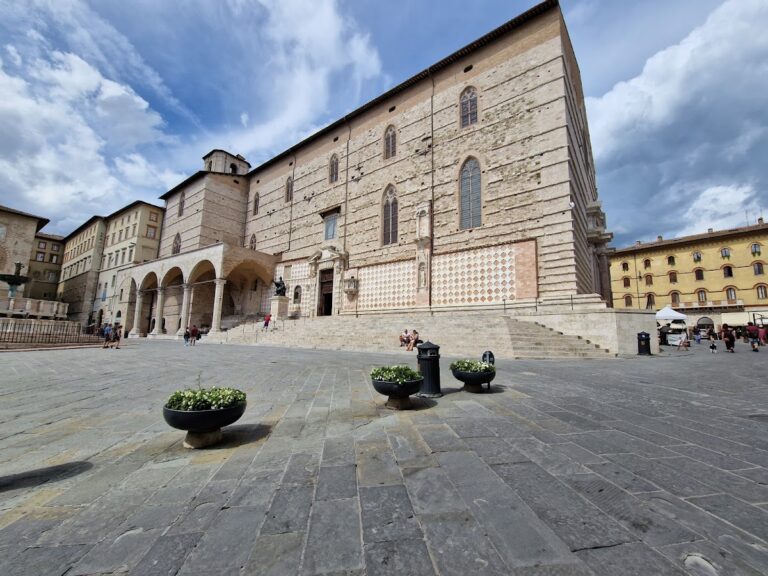
Palazzo della Penna is a historic noble residence in Perugia, Italy, whose present form developed through building phases from the sixteenth to the nineteenth century and is described as Neoclassical. The palace overlooks Piazza d’Italia and incorporates remains of a Roman amphitheatre, a medieval street route, and parts of the city’s medieval walls. Its long history as a residence, collection, and cultural institution reflects several layers of Perugia’s urban development.
From the Vibi family to the della Penna household
The palace first belonged to the Vibi family before passing to the Arcipreti della Penna. Sixteenth-century construction made use of the remains of a Roman amphitheatre, while the southern side incorporated an earlier medieval road and sections of the city fortifications. These elements were not simply nearby traces of earlier Perugia. They became part of the building itself and remained embedded in its later architectural history.
The della Penna family developed the residence as a substantial aristocratic complex. Its picture collection began in the middle of the seventeenth century through the collecting activities of Ascanio della Penna. His interests were encouraged by his service as a page to the grand dukes of Tuscany and by frequent visits to the Neapolitan painter Salvator Rosa. Over time, the palace became associated with both its extensive library and its works of art.
Nineteenth-century renovation and collections
The building was renovated and decorated with frescoes during the early nineteenth century. In 1822, the Perugian writer and historian Serafino Siepi described it as a very large and magnificent palace with a rich library and an important picture gallery. The interiors produced during this period gave the residence a distinctly Neoclassical character. Neoclassicism was an eighteenth- and nineteenth-century movement that drew inspiration from the forms and subjects of ancient Greece and Rome.
Baron Fabrizio della Penna Crispolti purchased Madonna and Child between Saints Jerome and Francis from the Servite fathers of Santa Maria Nuova in Perugia in 1821. The painting was regarded as an excellent work by the Umbrian Renaissance painter Pietro Perugino and was valued at 5,000 scudi. The extent of the family library was recorded in an inventory compiled in 1838 by the notary Giacomo Antonini. It listed 1,994 works, with detailed bibliographic descriptions and a valuation for the collection as a whole.
The family picture gallery was dispersed after Fabrizio Ricci della Penna mismanaged the family property. In 1899, the Tribunal of Perugia ordered the forced sale of his possessions. This ended the unified collection’s history within the palace, although the building itself continued to serve as an important part of the city’s cultural landscape.
From historic residence to cultural institution
Renovation work in the 1980s uncovered the remains of the Roman amphitheatre within the palace. The discovery made the building’s ancient foundations and its later residential history part of the same interpretation of the site. A monumental helical staircase designed by the architect Franco Minissi during the same decade connected three levels and helped adapt the complex for museum use.
Palazzo della Penna now houses the Museo Civico di Palazzo della Penna, Centro di Cultura Contemporanea, together with the Deputazione di Storia Patria per l’Umbria, the municipal Department of Culture, and other municipal offices. The museum’s permanent collections include works connected with the history of Perugia, a substantial group of works by Gerardo Dottori and the Umbrian Futurists, and a section devoted to Joseph Beuys. Futurism was an early twentieth-century avant-garde movement focused on modernity, movement, technology, and new artistic forms. Dottori was a major Umbrian exponent, particularly through his aerial painting.
The Beuys section concerns the artist’s visit to Perugia in 1980. On 3 April of that year, six blackboards were produced and presented during a performance promoted by the art critic Italo Tomassoni in the Sala Cannoniera of the Rocca Paolina. The event brought Beuys into contact with the Italian artist Alberto Burri, whose abstract works are known for their use of materially based techniques. The museum also hosts temporary exhibitions focused mainly on contemporary art, photography, and the city’s recent artistic and cultural history.
Remains
Palazzo della Penna combines a Neoclassical palace interior with archaeological and medieval fabric. Its physical layers extend from a Roman concrete structure to a medieval urban route and fortification wall, followed by the palace’s sixteenth- through nineteenth-century construction. Museum spaces, the courtyard, and the surviving decorative rooms now organize these elements within a single complex.
Roman and medieval fabric
Roman amphitheatre gallery
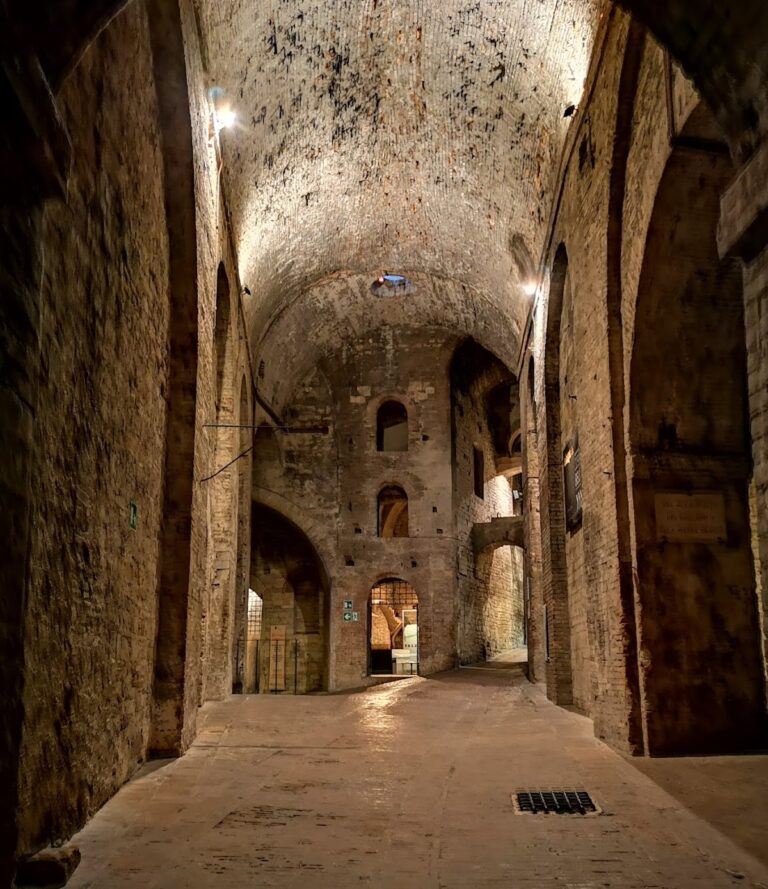
Within the museum route, sections of the Roman amphitheatre’s outer wall survive as a peripheral gallery built of opus caementicium, a Roman concrete material used in walls, foundations, and other structural elements. The visible portion is approximately 35 metres long. It was uncovered during renovation work in the 1980s and forms one of the most substantial physical links between the palace and the ancient urban structure incorporated into it.
Medieval road and city wall
The southern side of the palace contains the line of a former medieval road and sections of the medieval urban fortification wall. These remains preserve part of the earlier circulation and defensive framework of Perugia within the later residence. Their position along the building’s southern edge shows how the palazzo developed around pre-existing elements of the city.
Neoclassical decorated rooms
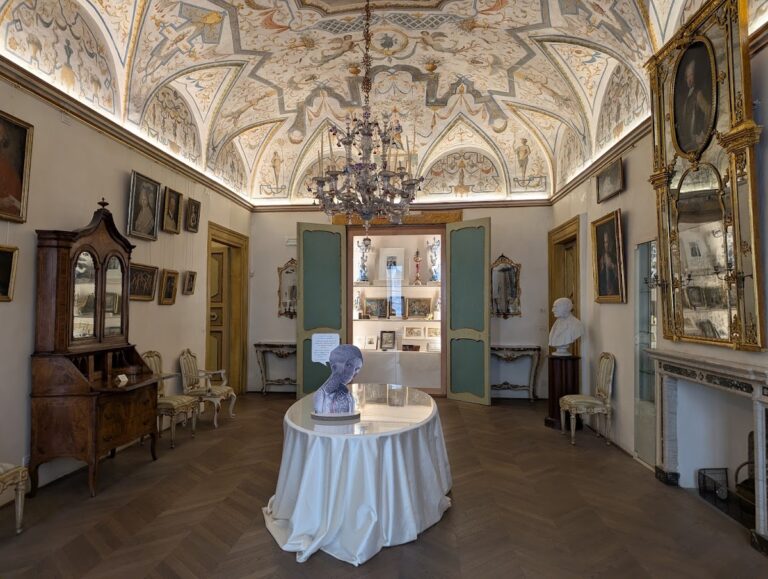
The early nineteenth-century fresco cycle was created by Antonio Castelletti, an Umbrian artist associated with Neoclassicism. The first-floor rooms draw extensively on classical mythology, with the myth of Paris providing the main narrative thread. Castelletti’s scenes combine mythological figures, allegories, monochrome historical imagery, and painted architectural effects.
First room: Apollo and the lyre
The ceiling of the first room shows Apollo playing the lyre among dancing figures. The composition imitates ancient Greek red-figure vase painting by placing red figures against a black ground. The design translates an ancient ceramic technique into the scale of a palace ceiling.
Second room: the Judgment of Paris
The second room presents the Judgment of Paris inside a circular panel surrounded by decorative motifs. Hera, Athena, Aphrodite, and Mercury appear in the scene. The episode introduces the mythological conflict that informs the sequence of rooms.
Third room: the Apollo Room
The third room, known as the Apollo Room, contains an Apotheosis of Paris. The mortal Trojan prince is received into Olympus by Apollo and appears among allegories of the four seasons and the ages of humankind. Saturn is shown in the background with the ouroboros, a serpent biting its own tail and associated here with cyclical time.
Below the oval containing the principal scene, night flees before the coming dawn. Apollo’s chariot and rearing horses are held by the three Fates, forming an allegory of time’s passage. Monochrome scenes on the walls show battles, chariot races, and sacrificial rites, including the Suovetaurilia, an ancient Roman ceremony involving a pig, sheep, and bull. Paris appears at the centre of the room, armed and on horseback.
Fourth room: the Abduction of Helen
The fourth room depicts the Abduction of Helen, surrounded by dancing figures and burning braziers. Castelletti’s signature and the date 1812 remain visible beneath the scene, giving the decoration a precise point within the palace’s nineteenth-century transformation.
Fifth room: Dionysian imagery
The fifth and final room contains dancing young figures, possibly maenads, female devotees associated with the Greek god Dionysus. Trompe-l’oeil fabrics and vine leaves surround them. Trompe-l’oeil is a technique that creates the illusion of three-dimensional objects or architectural elements on a flat surface, and here it contributes to the room’s Dionysian visual language.
Upper-floor and courtyard features
Room of Landscapes
The second-floor Room of Landscapes contains idealized views made during the same period as the Neoclassical decoration. They were produced by Pasquale Angelini, a decorator and stage designer. The circular tower on the second floor contains a monochrome frieze probably created by Giuseppe Carattoli in 1835.
Courtyard staircase and artworks
The courtyard contains Franco Minissi’s monumental helical staircase, designed in the 1980s. It connects three levels of the building and provides access to the museum collections. Three mixed-material sculptures from Brajo Fuso’s Elleni series, dated 1965, are also installed in the courtyard.
The atrium contains Daniele Pampanelli’s 2011 installation Io sono Paolo Vinti. It consists of two ties placed on a mirror as a tribute to the Perugian poet Paolo Vinti. On 8 March 2019, the complex also received Senza catene, a sculpture created by students of Perugia’s Bernardino Di Betto art school. It represents a seated woman on a red bench, with a gold sash covering her breasts. The red and gold colors refer to violence, resistance to it, and the hoped-for return of a harmonious golden age.
Modern art collections
Dottori and Umbrian Futurists
The museum’s collection devoted to Gerardo Dottori and the Umbrian Futurists follows Dottori’s artistic development from his academic beginnings and Divisionist experiments to his aerial paintings and Futurist sacred art. The range of works places his changing approach within the artistic history of twentieth-century Umbria.
Joseph Beuys room
The Beuys section occupies a large vaulted room and contains Opera Unica, the six blackboards made by Joseph Beuys for the 1980 Perugia performance. The works are accompanied by a documentary exhibition concerning that visit and the presentation at the Rocca Paolina, preserving the connection between the objects and the event that produced them.
Nearby sites