Collegio del Cambio: Headquarters of Perugia’s Money Changers’ Guild
Site at a Glance
- Country
- Italy
- Primary era
- Medieval
- Eras represented
- Medieval, Early Modern
- Civilizations
- Papal States
- Site type
- Economic
On this page8 sections
History
The guild’s premises
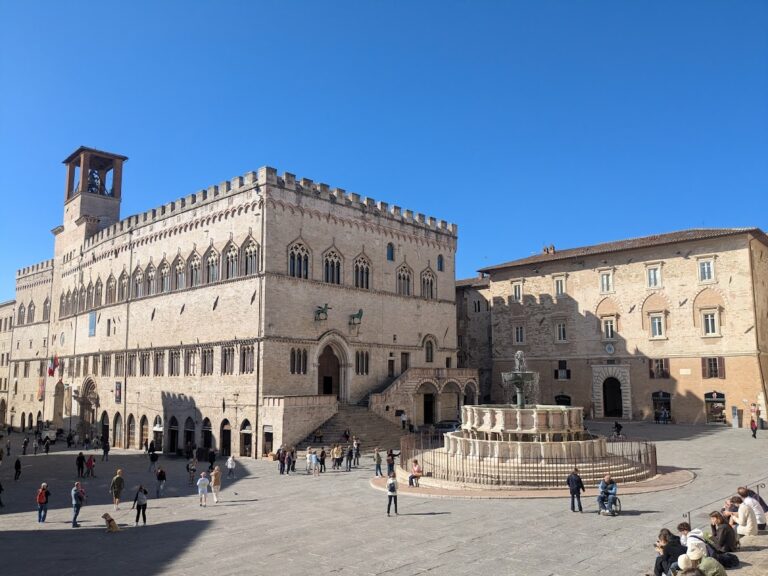
The Collegio del Cambio in Perugia, Italy, was the headquarters of the Arte del Cambio, a powerful guild of bankers and money changers. Between 1452 and 1457, the guild received permission to establish its premises in a southern extension of Palazzo dei Priori, Perugia’s historic civic palace. Bartolomeo di Mattiolo and Lodovico di Antonibo arranged the premises architecturally during those years.
Artistic and religious patronage
Toward the end of the fifteenth century, the guild commissioned a painted program for the Sala delle Udienze. Francesco Maturanzio, a humanist and teacher at Perugia’s historical university, devised its themes, and Pietro Perugino was entrusted with the paintings. Perugino was then regarded as Italy’s leading artist and had workshops in Florence and Perugia. From 1506 to 1509, builder Gasperino di Pietro constructed the Chapel of San Giovanni Battista on the site of an earlier church, San Giovanni della Piazza. That church had been incorporated into the palace during its fifteenth-century expansion.
Remains
The main entrance opens into a vestibule, the first room; the complex also includes a rectangular audience hall and the Chapel of San Giovanni Battista. Its surviving features combine carved and inlaid woodwork with painted walls and vaults, alongside a collection of coin weights and scales.
Entrance and vestibule
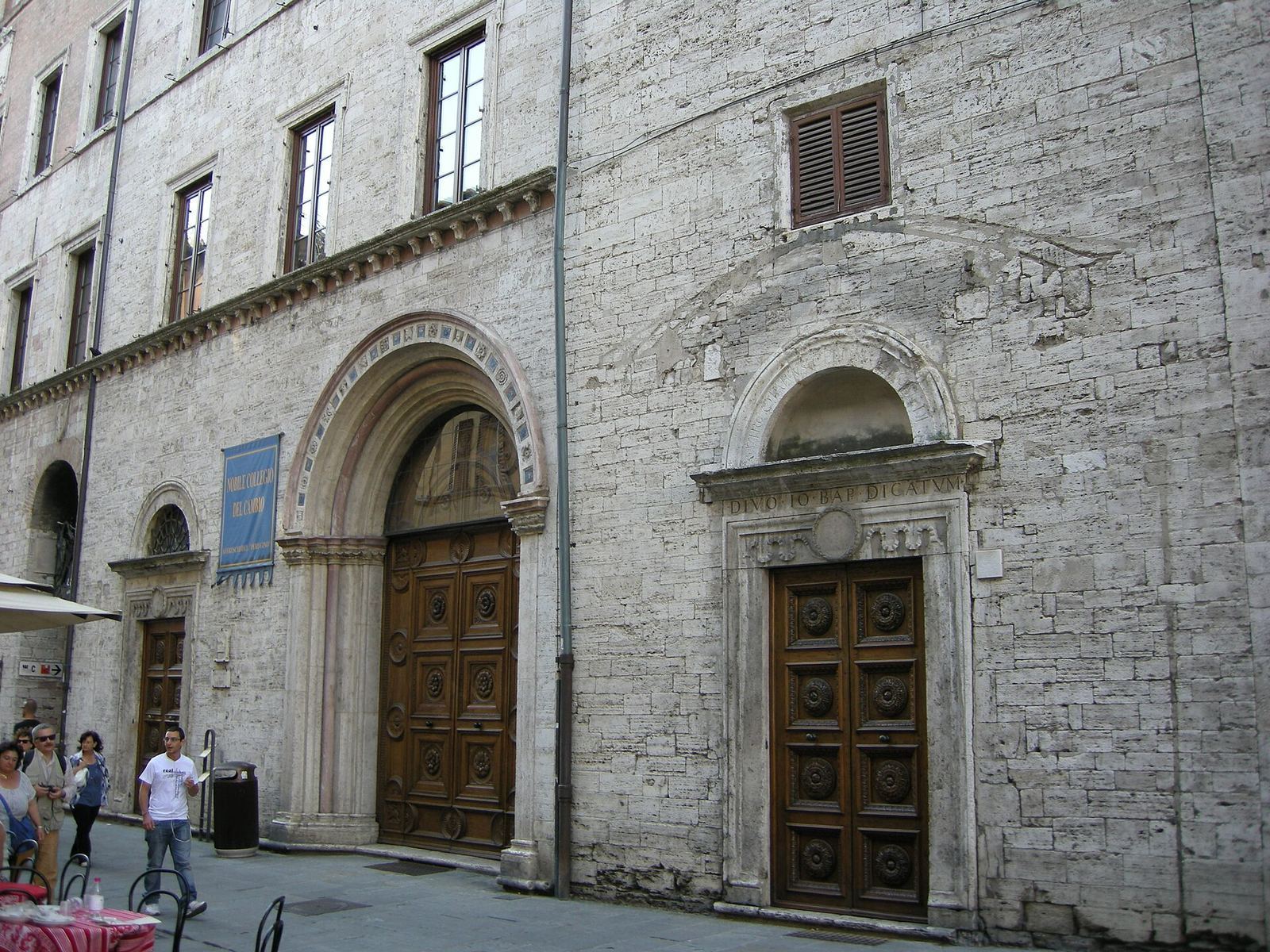
The main entrance has a wooden portal designed by Lodovico di Antonibo, with doors carved by Antonio da Mercatello in the early sixteenth century. The vestibule, also called the Sala dei Legisti, contains Baroque counters carved by Giampietro Zuccari and his assistants, as well as inlaid wooden wall panels by Zuccari. These furnishings date to 1615–1621.
Audience hall
The rectangular Sala delle Udienze has ogival vaults (vaults formed by pointed arches) arranged in a series of lunettes (arched panels beneath vaults). Perugino’s frescoes, dated 1496–1500, cover its walls and vaults. Wooden furnishings made by Domenico del Tasso and Antonio da Mercatello date to 1490–1493; del Tasso used grotesque ornament, or fanciful decorative motifs, in this kind of furnishing for the first time. A judges’ bench occupies one side of the hall, with two tiers of carved and inlaid seats. Above it, a lunette depicts two griffins among garlands framing a terracotta figure of Justice, attributed to Benedetto da Maiano. Another bench has inlay by Antonio da Mercatello dated 1508. At the center of the rear wall, a railing incorporates a small Renaissance pulpit by Antonio Masi d’Antonio, dated 1562.
Chapel
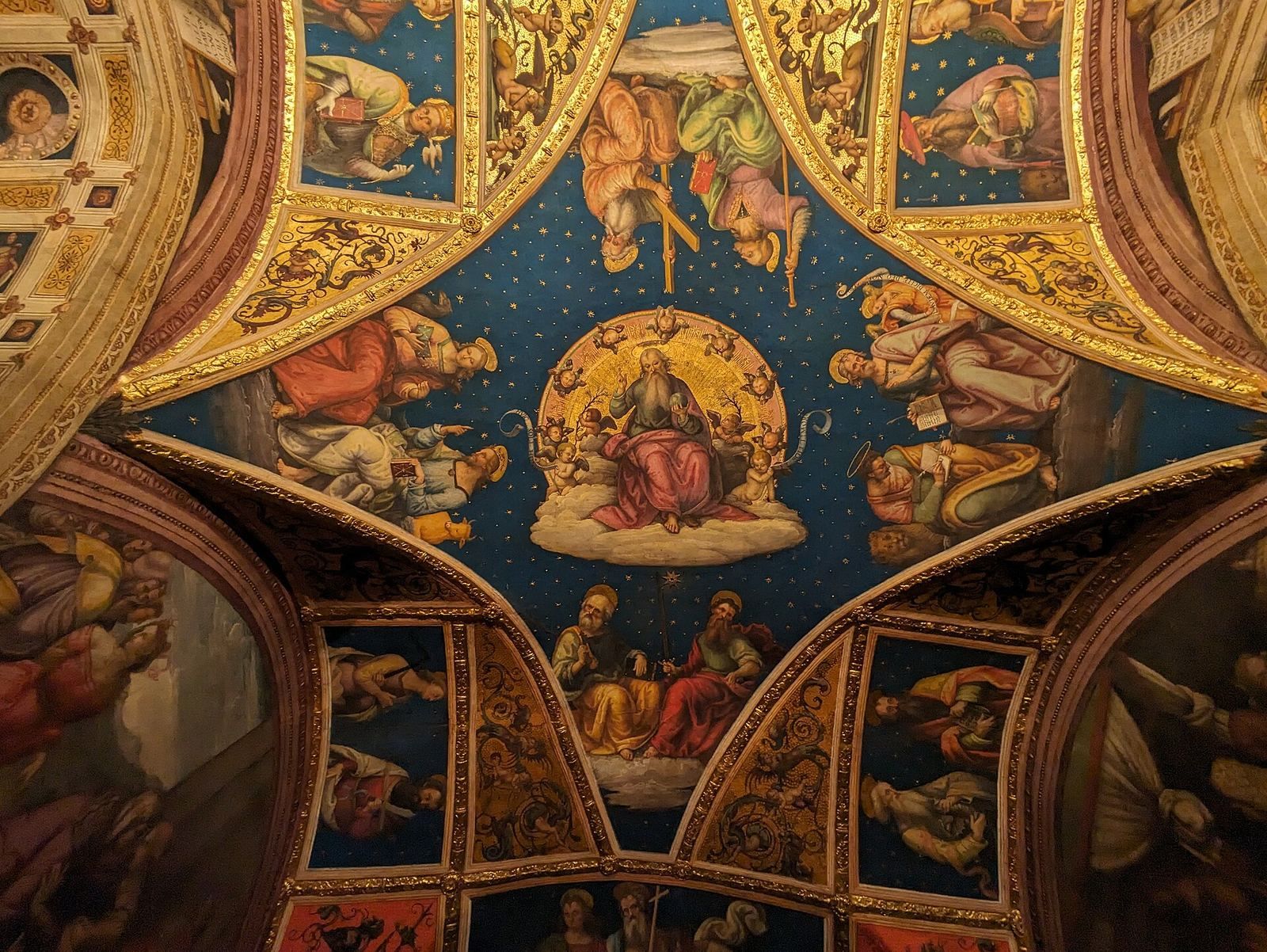
Giannicola di Paolo painted the chapel between 1515 and 1518. Its vault shows the Eternal Father, a Christian image of God, among apostles, evangelists, Doctors of the Church (saints recognized for authoritative Christian teaching), and Perugia’s patron saints. The altar bears a Baptism of Christ flanked by an Annunciation, dated 1515–1516, while the side walls show scenes from the life of John the Baptist and Sibyls, female prophetic figures from classical tradition also represented in Christian art. The altar front, made by Mariano di ser Austerio in 1512–1513, depicts the Baptist within a garland and frieze. Two inlaid seats by Antonio da Mercatello date to 1509, and the altar is dated to 1516. Gold and lapis lazuli, a deep-blue stone used as pigment, enrich the brightly colored walls, which were intended to display wealth and brighten the chapel.
Coin weights and scales
The Collegio holds more than 550 coin weights, the most complete collection of its kind internationally. Money changers used such weights to check coins circulating in Perugia and the Papal States, territories governed by the pope, from the fifteenth century through the second half of the nineteenth. The weights can be identified by the papal arms on their front faces. The collection also includes weights from other Italian city-states, European-made weights dating from the seventeenth through the twentieth centuries, and scales.