Museo di Palazzo Mocenigo: A Venetian Museum of Textiles, Costume, and Perfume


Site at a Glance
- Rating
- 4.2
- Popularity
- Low
- Country
- Italy
- Primary era
- Early Modern
- External website
- Open
- Eras represented
- Early Modern
- Civilizations
- Venetian
- Site type
- Domestic
- Remains
- Elite Residence
On this page14 sections
History
Museo di Palazzo Mocenigo is a historic patrician palace and museum in Venice, Italy, whose present form derives largely from an extensive early seventeenth-century renovation of a building already standing in the sixteenth century. Known formerly as Palazzo Mocenigo di San Stae, it has a Gothic character combined with Renaissance and seventeenth-century features and stands in the Santa Croce district near San Stae and south of the Grand Canal.
From Mocenigo Residence to Civic Museum
From the early seventeenth century, the palace was the residence of the San Stae branch of the Mocenigo family. The Mocenigos were among Venice’s prominent families, and seven of its members became doges, the elected heads of the Venetian Republic. The family continued to live in the palace until the early twentieth century.
A plan of Venice made around 1500 by Jacopo de’ Barbari shows an almost square building arranged around a central courtyard. The palace gradually expanded as adjoining properties were acquired, and its current configuration probably took shape mainly during the early seventeenth century.
Municipal Ownership and New Collections
In 1945, Alvise Nicolò Mocenigo, described as the family’s last descendant, bequeathed the palace to the Municipality of Venice for use as an art gallery that would complement the Museo Correr. The bequest was challenged from the late 1970s by Alvise Coletti, a descendant through the female line. Legal proceedings continued into the early 1990s, when the Venice court recognized Coletti’s claim and awarded compensation after his death.
In 1985, the palace was assigned to the Centre for the Study of the History of Textiles and Costumes and became the home of a museum devoted to textiles and costume. Its collections came chiefly from the Correr, Guggenheim, Cini, and Grassi collections, along with other deposits belonging to Venice’s civic museums. The palace now houses the Centre for the Study of the History of Textiles, Costume, and Perfume and specialized library facilities. It is managed by the Fondazione Musei Civici di Venezia, the organization administering Venice’s civic museum network, while ownership remains with the Municipality of Venice.
The Museum in the Twenty-First Century
Under the direction of Pier Luigi Pizzi, the museum’s display arrangement was completely renovated and expanded in 2013. The reorganization added a section on the history of perfume and essences, relating the subject to Venice’s cosmetic, aesthetic, and commercial traditions. The principal exhibition evokes the life and activities of Venetian aristocrats from the seventeenth to the eighteenth century while tracing developments in fashion, costume, and textiles.
The perfume displays were developed with technical and scientific support from Mavive of the Vidal family for installations involving essential oils. Drom Essential lent the Storp Collection of historical bottles, which ranges from antiquity to the contemporary period. The palace also contains a cinema projection room associated with Casa del Cinema, a cinematheque consultation area, a multimedia room, a perfume laboratory, a White Room for temporary events, and a specialized library.
Remains
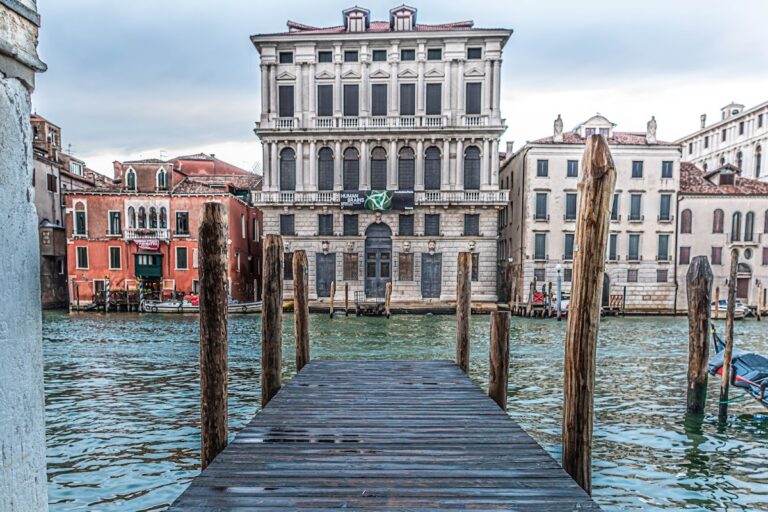
The palace is a large five-level building consisting of a ground floor, a mezzanine, two principal or noble floors, and an attic mezzanine. Its two principal façades face the Salizada di San Stae and the San Stae canal. Broad serlianas, three-part openings with a central arch between two lower side openings, define the façades, particularly at the noble floors. The 2013 museum arrangement occupies nineteen rooms of the noble floor while retaining original architectural elements, furnishings, frescoes, stucco, marble, floors, and window frames.
Façades and Exterior Form
Salizada di San Stae Façade
The Salizada façade has three superimposed central serlianas linked by corbels associated with the architecture of Jacopo Sansovino, a sixteenth-century architect and sculptor whose work strongly influenced Venice. Rusticated plinths support an asymmetrical composition. The left wing was extended through the acquisition of adjoining buildings and is lower than the main body. It has a serliana on its first noble floor but lacks the second noble floor and attic mezzanine of the principal structure.
Canal Façade
The canal façade has architraved doors and serlianas on the two noble floors. Lateral windows are arranged to create a double order of rooms, while a third serliana at ground level forms a water entrance. A substantially lower wing adjoins the main structure and has a serliana at noble-floor level.
Interior and Noble Floors
Central Hall and Decorative Rooms
The interior follows the arrangement of a Venetian patrician house. A large central reception hall, or portego, connects with the other rooms and served as the principal space for reception and representation. The first noble floor preserves frescoes and Rococo and Neoclassical furnishings, styles associated respectively with eighteenth-century ornamental elegance and renewed interest in classical forms. The large reception hall, Red Room, and Green Room are among the notable interiors.
Ceiling frescoes made in 1787 for the wedding of Alvise IV Mocenigo’s nephew to Laura Corner were painted by Jacopo Guarana, Giambattista Canal, and Giovanni Scajaro. Burled-wood doors and carved, gilded wooden frames remain among the interior details. The museum’s furnishings and displays were arranged to evoke an eighteenth-century Venetian aristocratic residence while preserving these architectural elements.
Paintings and Decorative Works
The galleries include an anonymous portrait of Louis XIV painted around 1670 and a portrait of Charles II Stuart attributed to Peter Lely and dated around 1651. Other portraits represent members of the Mocenigo family and Venetian officeholders, including Alvise Mocenigo as procurator of Saint Mark, Procurator Leonardo Mocenigo, Giovanni Tommaso Mocenigo, Procurator General Giovanni Mocenigo, Captain Leonardo Mocenigo, Doge Alvise III Sebastiano Mocenigo, Doge Alvise Contarini in a work dated 1677, Doge Alvise IV Mocenigo in a work dated 1763, and Doge Marino Morosini. A procurator of Saint Mark was a senior Venetian official with civic and administrative responsibilities connected with the state and Saint Mark’s institutions.
The portrait group also includes Dogaresa Loredana Marcello, Emperor Leopold I of Habsburg, Pope Gregory XII, Angelo Correr, Marcantonio Michiel in a work dated 1795, Marquis Scipione Repeta in a work dated 1726, and Francesco Algarotti after Jean-Étienne Liotard. Other displayed works include The Procession of Pietro Mocenigo at the Quirinal and The Entry of Pietro Mocenigo, Ambassador to the Pope, into Piazza del Popolo, both painted by Antonio Joli in 1761; Paris with the Golden Apple by Johann Carl Loth; and Rebecca at the Well, painted by Gregorio Lazzarini in 1690–1695.
The collection further includes a copy of Judith and Holofernes after Johann Liss, an eighteenth-century Venetian genealogical tree of the Corner family, an eighteenth-century Venetian scene of Princess Violante de’ Medici’s arrival at Verona, and another Venetian work depicting a ball held in her honour. A battle scene by Ilario Spolverini and a pastel portrait of a gentleman by Francesco Pavona are also displayed. A Murano glass chandelier known as the Ca’ Rezzonico chandelier, with a polychrome floral form called a ciocca, dates from the eighteenth century. The entrance to the portego and a sculpture commemorating the seven-hundredth anniversary of Marco Polo’s death are also among the palace’s displayed features.
Textiles, Costume, and Perfume
Historical Dress
The textile and costume galleries use mannequins dressed in precious garments and historical accessories. Patterned fabrics, embroidery, and lace show the craftsmanship and luxurious character associated with Venetian dress. Paintings and furnishings formerly held in deposits of Venice’s civic museums were restored before being placed on exhibition, joining the garments and accessories in the reconstruction of aristocratic interiors and material culture.
Perfume Collection and Facilities
The perfume section occupies six rooms and uses multimedia installations and sensory stations to present the history of perfumes and essences. Its historical bottles include the Storp Collection, lent by Drom Essential and spanning periods from antiquity to the contemporary era. A fully equipped perfume laboratory supports the section’s presentation of essential oils, while the multimedia room and White Room provide additional spaces within the museum complex.