Palazzo dei Vicari: The Florentine Vicariate Palace at Scarperia


Site at a Glance
- Rating
- 4.5
- Popularity
- Medium
- Country
- Italy
- Primary era
- Medieval
- External website
- Open
- Eras represented
- Medieval, Early Modern, Modern
- Civilizations
- Republic of Florence
- Site type
- Civic
- Remains
- Palace
On this page12 sections
History
Palazzo dei Vicari is a medieval palace complex in Italy, at Scarperia, founded under the Republic of Florence in the fourteenth century as part of the settlement’s military and administrative system. Scarperia was established in 1306 as a military outpost and as a point for controlling traffic across the Apennines. The route between Florence and Bologna remained the only communication route between the two cities until the mid-eighteenth century, giving the settlement and its governing palace a lasting strategic role.
From military outpost to vicariate seat
The earliest complex probably consisted of the principal tower, which is thought to have served as the residence of the Captain during the fourteenth century. The palace later housed the podestà, a chief magistrate appointed to administer a medieval or early-modern Italian city or territory, and then the vicars, representatives who exercised authority for the Florentine state.
Scarperia’s victory over Milanese troops in 1351 strengthened its political ties with Florence. In recognition of the town’s success, it received a coat of arms resembling Florence’s, but with the colors reversed: a red fleur-de-lis on a white field. After Scarperia became the seat of a vicariate in 1412, the palace was substantially enlarged and altered. In 1415 it became the seat of the Vicariate of the Republic of Florence, the Florentine political state that founded Scarperia and administered its territory.
The vicars served six-month terms and were required to leave an emblem of their family when their office ended. These emblems accumulated on the palace and became part of its historical decoration, preserving a visual record of successive Florentine officials.
Earthquakes, restoration, and continuing civic use
Earthquakes repeatedly altered the palace. The earthquake of 1542 caused devastating damage and prompted major improvement and restoration works. Further damage followed in 1616, while the earthquake of 1919 caused particularly severe destruction. Repairs and reconstruction took place after the major events, including campaigns after 1542, in 1611–1612, and in 1919–1921. Later earthquakes in 1960 and 2019 caused lighter damage, followed by additional repairs.
In 1926, Filippo Sassoli de’ Bianchi, then podestà and mayor of Scarperia, had the council chamber restored in the form it largely retains. The most important recent consolidation and restoration campaign began in 1980 and addressed the palace foundations, structural parts, and frescoes. Since 1999, a new wing has housed the Museo dei ferri taglienti, whose five thematic sections present Scarperia’s knife-making industry. The palace also contains the Scarperia Municipal Library and continues to be used for municipal assemblies.
Remains
Buildings and defensive features
Principal tower
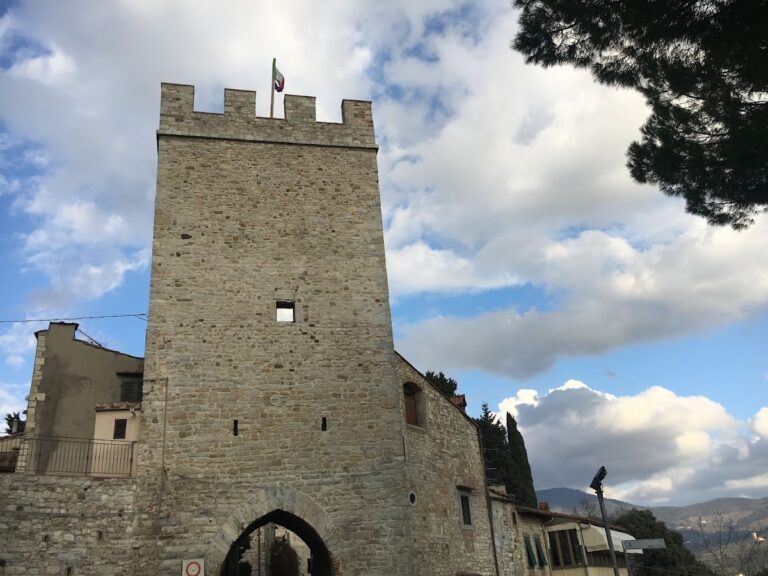
The complex is organized around a principal tower, a front building, and an internal building. The tower rises 42 meters and was later incorporated into the enlarged vicarial palace. By the end of the sixteenth century it had crenellations, a battlement formed by regularly spaced raised sections and openings, as shown in a painting by Giorgio Vasari. During the nineteenth century, corbels, or projecting supports, and further crenellations were added to the facade.
A wooden staircase of 102 steps reaches the summit of the tower. From the top, a lower-level patrol walkway can be seen. This walkway served a defensive lookout function, allowing possible enemies to be detected.
Front and internal buildings
The front building is 21 meters high and has four floors, while the internal building is 13 meters high and has three floors. The enlargement after 1412 reorganized rooms on the first floor, including a chapel and a large hall, and created the present entrance. Service buildings included a kitchen and prisons, which were destroyed by later seismic events.
New museum wing
A new wing added to the palace contains the Museo dei ferri taglienti. Its five thematic sections explain Scarperia’s knife-making tradition and form part of the complex’s continuing civic and cultural use.
Frescoes, emblems, and the historic clock
Vicars’ coats of arms
Numerous vicars’ coats of arms decorate the facade and entrance hall. Several are glazed terracotta works from Florentine ceramic workshops. The arms of Bernardo Lucalberti, dated 1490, and Antonio Lorini, dated 1491, are attributed to Benedetto Buglioni, a Florentine sculptor and ceramic artist. Those of Francesco da Casavecchia, dated 1528, and Gianfranco Baroncelli, dated 1537, are attributed to Santi Buglioni, another Florentine artist associated with glazed terracotta.
Painted decoration
The palace contains a fresco from 1501 associated with the school of Domenico Ghirlandaio, a leading Florentine painter of the later fifteenth century. The entrance hall also preserves a fifteenth-century fresco from the Florentine school depicting the Incredulity of Saint Thomas. Its imagery was associated with judges, who, like Saint Thomas, were expected to touch evidence with their own hand before declaring a judgment.
Ventura di Moro painted a fresco in the entrance hall that expresses the palace’s political connection with Florence. It shows Saint Barnabas, Scarperia’s protector, offering the castle to the Virgin, accompanied by Florence’s patron saints, Saint Reparata, Saint Zenobius, and Saint John the Baptist. A representation of Scarperia and the Mugello also appears in a ceiling panel painted by Giorgio Vasari and his assistants in the Salone dei Cinquecento of the Palazzo Vecchio. Vasari’s Ragionamenti identifies the scene as the Vicariate of Scarperia and describes the Mugello landscape, Scarperia’s arms, and the Sieve River.
Bell-tower clock
The palace preserves the old clock of the bell tower, a documented work by Filippo Brunelleschi, the Florentine architect and engineer also associated with pioneering mechanical clockmaking. The clock is described as the only surviving testimony to his activity in that field, although the biographies by Manetti and Vasari indicate that his work in clockmaking was more extensive.
Nearby sites