Basilica of Our Lady of Sorrows and St. Philip Benizi: Servite Sanctuary in Italy


Site at a Glance
- Rating
- 4.6
- Popularity
- Medium
- Country
- Italy
- Primary era
- Early Modern
- External website
- Open
- Eras represented
- Medieval, Early Modern, Modern
- Civilizations
- Grand Duchy of Tuscany, Italian, Republic of Florence
- Site type
- Religious
- Remains
- Monastery
On this page20 sections
History
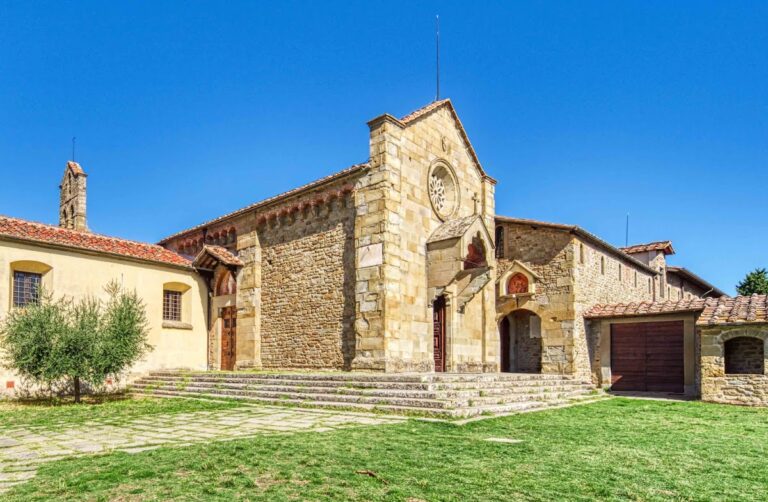
The Basilica of Our Lady of Sorrows and St. Philip Benizi is a Catholic sanctuary and Servite monastery on Monte Senario in Italy, near Vaglia in Tuscany, north of Florence. Its history began in the thirteenth century, and its present character is predominantly Baroque. The sanctuary stands on the watershed between the Valdarno and the Mugello, at approximately 818 metres above sea level, and remains a monastic centre for Servite men and women.
The Servite Foundations
The Servites, formally the Order of Servants of Mary, originated near Florence in 1233. Seven Florentine merchants adopted a life of poverty and penance, becoming known as the Seven Holy Founders: Alexis Falconieri, Bartholomew Amidei, Benedict Antella, Bonfiglio Monaldi, Gerardino Sostegni, Hugo Lippi-Uguccioni, and John Buonagiunta Monetti. The order received approval from the Holy See in 1304 and became especially associated with devotion to the Virgin Mary and the Passion of Christ.
The founders withdrew to Monte Senario around 1245 under the protection of Ardengo Trotti, bishop of Florence, establishing a convent or monastery there in the thirteenth century. The sanctuary’s consecration is also dated to 1234. Monte Senario was the first Servite monastery and became an important centre for the order. On 12 June 1241, Giuliano de Bivigliano donated one third of a wood on Monte Asinario to Ardingo, bishop of Florence, for the redemption of his soul. The mountain was known during the Middle Ages by several names, including Monte Asinario, Monte Sonorio, and Monte Sonaio, before Monte Senario became the prevailing name.
Expansion and Religious Development
The convent was enlarged in the fifteenth century and expanded again in 1594 under Ferdinando I de’ Medici, Grand Duke of Tuscany. Further modifications followed during the eighteenth and nineteenth centuries. The church was rebuilt in 1717, probably under the direction of Giovan Battista Foggini, giving the complex much of its elaborate Baroque character.
The sanctuary is dedicated to Our Lady of Sorrows and St. Philip Benizi, a thirteenth-century Servite leader and saint associated with the early history of the order. During repairs to the church in 1600, the remains of the seven first Servite fathers were found in a common tomb. They were placed in a gilded bronze funerary urn, preserving a physical focus for the community’s memory of its founders.
Later Status and Monastic Continuity
In December 1917, Pope Benedict XV elevated the sanctuary to the status of a minor basilica. This is a special papal status granted to a Catholic church because of its religious, historical, or pastoral importance, and it is distinct from the title of a cathedral. The basilica belongs to the Archdiocese of Florence.
The Servite friars also maintained an old pharmacy for local residents and pilgrims. Its successor is the convent distillery, which has produced Gemma d’Abeto since 1865, Amaro Borghini since 1870, and Elisir di China and Alchermes since 1889. These activities form part of the monastery’s continuing relationship with the surrounding community.
Remains
The complex lies within a densely wooded setting. An avenue leads to a forecourt, where the entrance is marked by statues of St. Bonfiglio Monaldi and St. Philip Benizi made by Pompilio Ticciati in 1754. The buildings and chapels extend from this central approach toward the church, convent, cloisters, terraces, and a group of devotional sites associated with the Servite founders.
Forecourt and Convent
Hospice and Entrance
The large hospice, dated 1603, stands on the left side of the forecourt. A staircase beside it rises to a small square. To the right of the church, the convent entrance retains traces of an earlier ground-floor portico that remained open until the nineteenth century. Its columns and arches were incorporated into the facade wall. The adjacent clock tower was built in 1834.
Interior Rooms and Cloister
The convent entrance area contains a lunette, a semicircular field suited to painted decoration, showing the Pilgrims of Emmaus by Giovanni da San Giovanni. Its atrium is decorated with medallions, some painted by Antonio Nicola Pillori around 1750. The nearby fifteenth-century cloister, a covered walkway around an open courtyard, is now blocked in and formed part of the oldest convent complex. Its lunettes are attributed to Antonio Nicola Pillori and Stefano Fabbrini.
The refectory, the monastery’s communal dining hall, contains The Last Supper by Matteo Rosselli, dated 1634. Two paintings by Francesco Curradi show Christ in prayer and the Annunciation. A panoramic terrace runs around the convent, and its stone-slab pavement covers a large rainwater cistern built for the Medici between 1697 and 1722.
Church and Main Chapels
Church of Our Lady of Sorrows
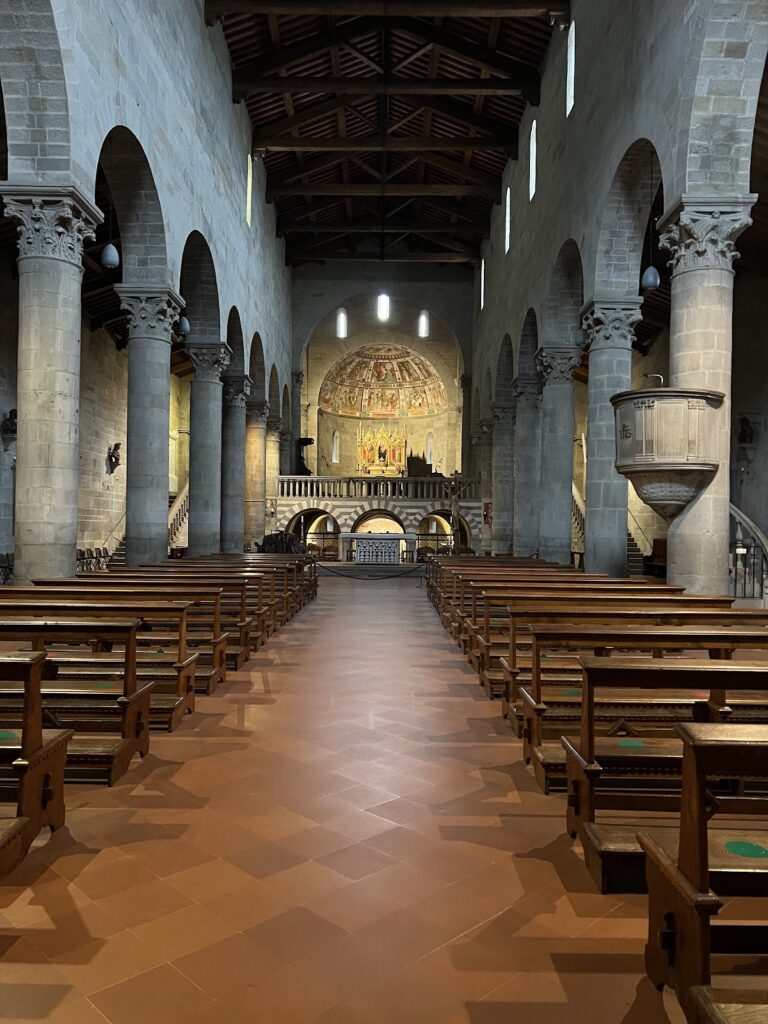
The Church of Our Lady of Sorrows, also dedicated to St. Philip Benizi, was built in 1412 by the della Stufa family over an earlier oratory. A portico precedes the building. Its campanile, or bell tower, was erected in 1648 and renovated at the end of the eighteenth century. Inside, a single nave with side chapels is covered by elaborate Baroque stucco decoration created by Giovan Martino Portogalli in 1717.
The barrel vault, a continuous rounded ceiling formed by extending an arch, frames a fresco by Antonio Domenico Gabbiani showing the Virgin giving the Servite habit to the Seven Founders. To the right of the entrance stands the early-sixteenth-century funerary monument of Sigismondo della Stufa. The apse, the end of the church containing the altar, holds an eighteenth-century wooden Crucifix surrounded by Portogalli’s stucco figures. Paintings by Tommaso Redi on either side depict episodes from the life of St. Philip Benizi.
Choir and Chapel of the Apparition
Behind the church, the choir contains The Assumption of the Virgin by Giuseppe Bezzuoli, painted around 1849. On its right side is a fresco by Pietro Annigoni showing the Seven Founders ascending Monte Senario.
The Chapel of the Apparition opens to the right of the choir and is identified as the oldest part of the convent. It is traditionally associated with an apparition of the Virgin to the Servite founders in 1240 and with St. Philip Benizi’s first mass. The chapel was completely restored in 1983, when its eighteenth-century decoration was removed. Its altar, of a type dating from 1723, supports a terracotta Pieta, a representation of the mourning Virgin with the dead Christ, made by the Servite priest Giovannangelo Lottini at the beginning of the seventeenth century.
Chapel of the Blessed Sacrament
The Chapel of the Blessed Sacrament stands on the left side of the choir. Domenico dell’Antella’s bequest financed its construction in 1726, following a design by Giovan Battista Foggini. Portogalli’s stucco work decorates the chapel, together with paintings by Florentine artists of the early eighteenth century showing episodes from the life of Blessed Manetto, one of the Seven Holy Founders.
Sacristy and Later Chapel
Sacristy
The eighteenth-century sacristy, the room used to prepare for worship and store liturgical furnishings, is furnished and decorated with paintings. It contains The Savior by Matteo Rosselli, a head of St. Peter Chrysologus by Pietro Benvenuti, and John the Baptist Beheaded by Cesare Mussini, dated 1851. Two monochrome paintings are attributed to Matteo Rosselli, while two large landscapes by Antonio Morghen date from 1846. Above the door leading from the sacristy is a panel by the Master of San Jacopo at Mucciana showing the Virgin, the Child, and four saints.
Chapel of the Holy Founders
The Chapel of the Holy Founders is a modern construction from 1933 in the Neo-Gothic style, a revival of medieval Gothic forms. Giuseppe Cassioli provided its decoration. Other paintings in the church include Christ with the Symbols of the Passion, by a Florentine artist of the mid-seventeenth century, and The Madonna with the Seven Saints by Antonio Pillori.
Cross, Grottos, and Hermitages
Monumental Cross
Approximately 300 metres from the church stands an iron monumental cross. The original was made by the Pieri brothers, Florentine artisans, and was illuminated by remote radio control by Pope Pius XI on 1 April 1933, at the beginning of the extraordinary Jubilee commemorating the nineteenth centenary of the Redemption. The same artisans made two wrought-iron gates inside the church.
Grotto and Spring of St. Philip Benizi
The grotto and spring of St. Philip Benizi are covered by a small temple built in 1629. An inscription on its cornice preserves the tradition that Philip opened the spring in 1254 and that Fra Enrico Antonio covered it in 1629 to prevent its loss through neglect.
Grottos of the Founders
The grotto of St. Alexis Falconieri contains a small plaque describing his withdrawal there from the world. A hermitage outside the grotto was built in 1601. The grotto of St. Manetto has an inscription beneath the saint’s effigy describing the cave as a place associated with prolonged lamentation and virtue.
Hermitage of St. Philip Benizi
A second hermitage near the grottos was built in 1606 at the expense of Filippo Salviati and dedicated to St. Philip Benizi. Its garden retains a vine offshoot regarded as miraculous because it produced new growth in midwinter.